Episode Transcript
[00:00:00] Speaker A: Hello everyone, I'm paxton gray, CEO of 97th floor and this is the campaign.
Thank you for joining us today for another episode of the campaign where we talk with marketing leaders about better knowing your audience, innovating beyond best practice and converting visitors into customers. The campaign is produced by 97th Floor, a digital marketing agency designed to build world class organic and paid channel strategies for mid level and enterprise organizations.
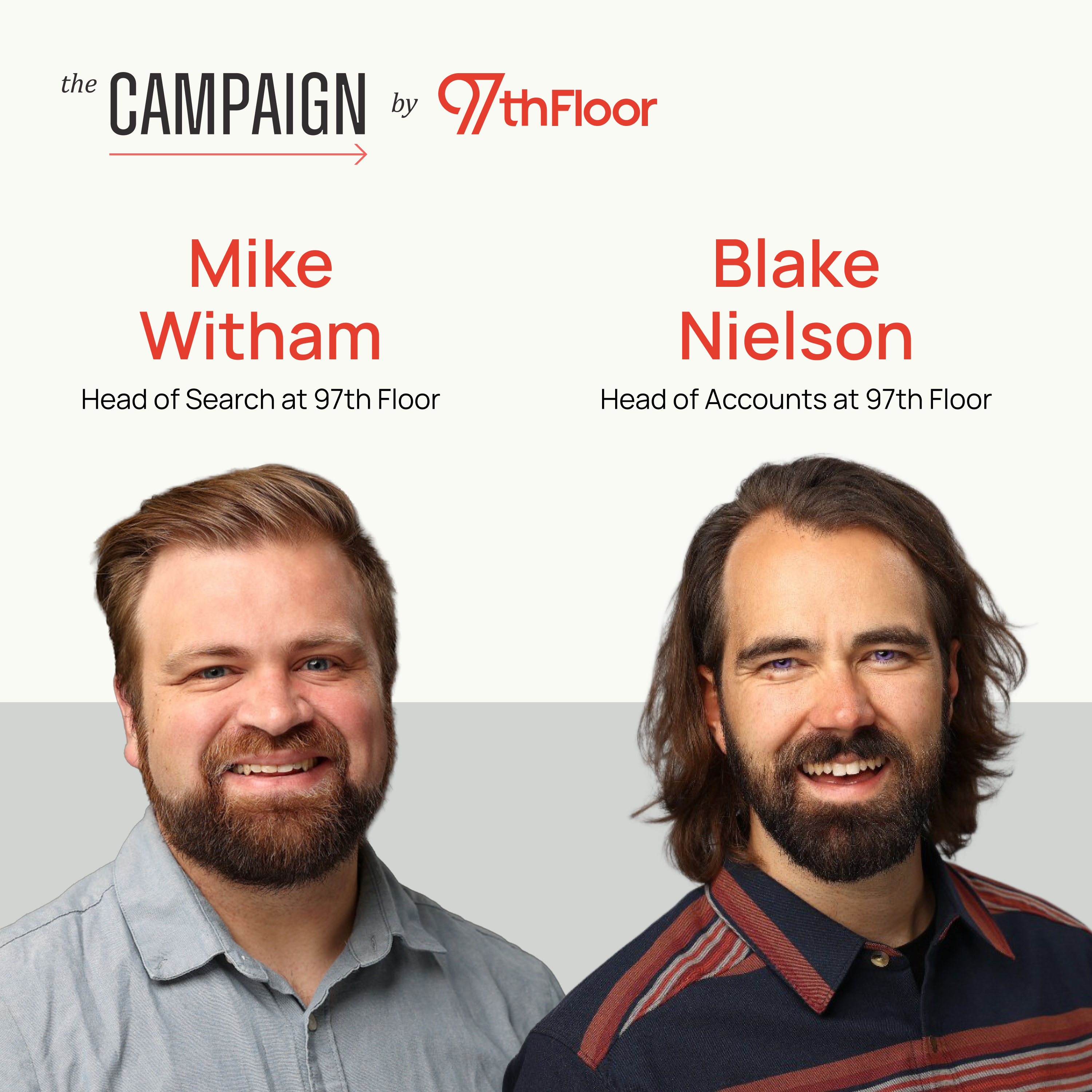
Today's guests are nine seven Floor's own head of accounts, Blake Nielsen and head of Search, Mike Witham. Blake and Mike are both part of Nice and Floor's AI Task force where they test theories, run experiments and measure what actually works when it comes to optimizing for AI powered search.
They work with clients across multiple industries, from travel companies where AI search is critical to industrial manufacturing where adoption may be slower, but it still matters.
Both bring hands on experience, helping enterprise brands navigate the AI search shift and dive into the new reality of zero click searches. In this episode, they'll break down the 8020 rule of AI search. What's actually new and what tried and true tactics still get results.
And they'll share the exact metrics you should be tracking in this new AI search world. Let's get into it. Thank you guys so much for joining today. I'm really excited to talk with you about AI search.
So first off, you know, one of the questions that we get asked all the time is what is the difference between AI search and SEO? Is it a whole new thing? Is it just doing more of the same thing as before, like what's nice? And Floor's take on AI search and SEO?
[00:01:35] Speaker B: Yeah, it's definitely not a fully unique thing on its own. Like there's a lot of overlap here. I think there's a lot of people that are positioning it as an entirely new thing.
But when you start looking at the ingredients of AI search versus traditional SEO, it's a lot of things that we have always been seeing. So things like content, things like off site signals, technical SEO, site structure, that stuff is very, very similar and very much the same when it comes to SEO versus AI search.
What I often tell my clients is about 80% of it's the same and 20% is going to be different or more important. Things that were important, you know, back in the day are now more important now than they have been and that's that 20% that's largely different or. Yeah, that is changing.
[00:02:28] Speaker C: And I think the, the other thing to keep in mind too is that it's the, the results are going to be different too. And like what you care about and what you're, what you're, the outcome you're trying to get. With AI search optimization is a little bit different than SEO. We're not necessarily trying to get a ton of traffic to a site. We still want traffic, but it's not, that's not like our main KPI or main metric we're looking at with AI search. We're trying to get recommended by the LLM and be mentioned in the right way and as much as possible with the LLM.
[00:03:01] Speaker A: So right now how do you recommend a brand measure the impact of their efforts in AI search?
[00:03:08] Speaker B: Something I was thinking with, with traditional SEO, we've always been able to kind of almost hide behind organic traffic. If organic traffic is doing well, seemingly everything else is. But at the end of the day, what really matters with SEO, with AI search, with any sort of your mark, any of your marketing channels, the thing that matters most is revenue. Yeah. And so organic traffic now looks different. It's, you know, click through rates have gone down for virtually every website, every client, anybody you work with that is decreasing with AI search because zero click searches are everywhere now. So leaning harder on revenue and like actually seeing that impact. But what I look at are now a myriad of metrics. So yes, organic traffic still matters, but I'm also looking at impression data, I'm looking at brand mentions, I'm looking at citation data, really kind of looking at those four things, still looking at keyword rankings and AIO appearances as well. But you really now have to look at all of those factors and see if that's impacting revenue. We're seeing an increase across the board or with most of these channels we should be seeing an increase in revenue as well.
[00:04:17] Speaker C: What AI search has done as well is like it's put a new focus or renewed focus on the customer journey and knowing what or anticipating what is going to be the follow up search to whatever you're showing up in LLM for. And that's something that you can measure and can track of. Like how many impressions in Google search console are you getting for something that would be a follow up search or something that would be something that you want the user to do after they read about you in an LLM.
[00:04:45] Speaker A: Talk more about that. So like how does somebody identify what would be or would cause a follow up search? How do you measure that? Where do you look?
[00:04:54] Speaker C: Yeah, measuring it is there's a couple places that you can look the most direct way or the most data like that you're going to get from it is going to be in Google Search Console because your tools like Ahrefs or Semrush or whatever, they're not going to have that keyword data because it's not, it's going to likely be a new branded query and they're not going to register it as a lot of, with a lot of clicks or a lot of searches. And so really Search Console is going to be like your source of truth for those new type of branded clicks that you're getting.
And the other piece to it too is like, so to stop you.
[00:05:30] Speaker A: What do you mean new type of branded clicks? So like what's an example of that? Like, so if I'm Nike, let's say for example, like what is Nike gonna see?
[00:05:38] Speaker C: You're Nike and somebody searched what's the best sweatsuit, gray sweatsuit and tracksuit and then they show up with a bunch of options and Nike's one of them and the consumer, the user likes the Nike one the best. Their follow up search would be Nike Sweatsuit, which could then potentially move you to Nike's website.
And so what Nike would do is they wouldn't say show me all of the impressions or the clicks that I got from the term gray sweatsuit. They would say, okay, what has my.
Have the searches for Nike gray sweatsuits increased since I started showing up in LLM for Nike gray sweatsuits.
[00:06:25] Speaker A: Got it.
[00:06:26] Speaker C: Yeah.
[00:06:26] Speaker B: And it's not that they wouldn't look at gray sweatsuit, it's more that like if you look at gray sweatsuit today versus last year and it's gone down, it's gonna go down.
But we're now supplementing that with what Mike said, that, that Nike gray sweatsuit with Bray branded searches and seeing that increase.
[00:06:44] Speaker A: Yeah, yeah, I think that's an important point. You know that people who want shoes are still buying shoes and AI hasn't changed market demand for shoes.
So if you're saying organic traffic and purchases go down, it's not like fewer people are buying shoes, they're still buying the shoes, they're just now coming through a different way. And so what you're saying is you need to look at it more holistically. Is that how you would summarize that in terms of like whether where the purchases are coming from?
[00:07:13] Speaker B: Yeah, absolutely. And yeah, it's like one of those things where impression data has always been there. Like we've always had the ability to look at impression data, but now it's like we look at impression data a lot more because that's because impressions have gone up virtually for everyone with aios.
[00:07:31] Speaker A: Okay.
[00:07:31] Speaker B: So we're seeing that increase. We should start seeing increases everywhere else.
[00:07:35] Speaker A: Okay, so the KPIs that we're tracking to measure success, first and foremost is always revenue. We have to generate revenue, otherwise it's not marketing.
[00:07:42] Speaker B: Right.
[00:07:43] Speaker A: And then we're looking at brand mentions.
Citations is one that always gets brought up. Is that a thing that people should care about or measure?
[00:07:53] Speaker B: Yeah, absolutely. Citations.
So citations influence your brand mentions.
[00:07:57] Speaker A: There maybe talk about what a citation is.
[00:08:00] Speaker B: Yeah. So a citate. So a brand mention is any reference in an LLM. So aio chatgpt perplexity.
Anytime your brand is mentioned, linked or unlinked, if your brand is mentioned, that is what we are tracking in tools like ahrefs. As a brand mention, citations are anytime there is a link back to your website from the LLM.
So it's important to distinguish the difference between them and they. They are connected, but they don't always. They're not mutually exclusive. So there isn't.
Brand mentions doesn't necessarily mean there will be a citation and citations doesn't necessarily mean there will be a brand mentioned within the query.
The query response.
[00:08:37] Speaker A: The response. Yeah, okay. Okay. So we should still measure though citations.
What else are we measuring for impact?
You said pull in search console and the traffic we're getting from branded clicks, branded queries. Anything else that people should be measuring in the AI age?
[00:08:58] Speaker B: I'm. I'm reporting like on brand mentions and citations for every one of my clients where it's like I want to see that our brand mentions are increasing across all LLMs and I want to see an increase in citations as well.
So yeah, I guess that answers your question about what we're tracking. Yeah, yeah, still tracking keywords.
Keyword still matters.
Now with the new the Google Update, we can't track anything past page or spot 10. So still heavily tracking keyword rankings for positions 1 through 3, 3 and then 4 through 10.
[00:09:32] Speaker A: Do you not? Is there a correlation between rankings like today, Is there a correlation between rankings and showing up getting brand mentions in AI search or are they unrelated?
[00:09:43] Speaker C: What I would say is that there's a correlation in indexed pages and brand mentions.
[00:09:50] Speaker A: So not citations.
[00:09:52] Speaker C: Not, not. Well, citations too. I think citations is in there. But brand mentions and indexed pages, that correlation comes from you have the right content and the right amount of content to cover this topic to have topical authority. So the number of index pages for a specific topic matters and the number of total index pages for all of your brand Mentions matters too. So like keyword rankings for sure. Yeah, go for it. But with the much more limited view we have of keyword rankings now, it's much harder to make that correlation. And so the indexed pages is the next best thing in my mind and
[00:10:35] Speaker B: I guess a good distinguishing point there in citation. So citation is anytime there's a link about your brand, we can split citations even further between an owned citation versus a third party citation. So what Mike's talking about with index pages, that's typically what we would call an owned citation.
That is a link in the LLM back to your website.
That's, that's the best kind of citation. If the LLM is referencing us and we're linking back and a user can click and basically get referral traffic, that's great. But that's not the only signal that the LLMs look at. And so one of those is going to be third party citations which is going to be the Reddit's of the world, the blogs, the you're in the travel space, the travel websites, travel blogs.
[00:11:22] Speaker C: Listicles.
[00:11:22] Speaker B: Listicles.
Yeah, and that, and that's more of that off site signal that has always existed within SEO, but now it looks slightly different.
[00:11:32] Speaker A: Right.
So just to finish this point, is there a relationship between ranking in the top 10 and likelihood to show up in as a brand mentioned in the answer?
So if, if I search best running sneakers, you know, let's say it's Nike and Adidas. I mean this is maybe a bad example because Nike, Adidas own the world. But let's say these are second tier brands. If they happen to rank in the in spots 1, 2 or 3, are they more likely to appear in that result?
[00:12:05] Speaker B: Yes. Yeah, because because basically Google is able to crawl index your page. It finds it authoritative, it finds it valuable, it likes your content. So if you are ranking on position three or one or two, whatever, you are more likely to show up in aio.
[00:12:21] Speaker C: Yeah, and that's a important distinction that we need to make too is like we're talking about AIO for that to answer that question. Like I've done analyses, I've read analyses, the citations listed on ChatGPT or the results from ChatGPT and Perplexity and Google vary wildly. There's maybe two pages crossover of 10.
So just because you rank in Google doesn't necessarily mean that you're going to rank in ChatGPT. You probably have a better shot of ranking in ChatGPT or showing up in ChatGPT, but it's not, it's not a one to one thing.
[00:13:02] Speaker B: And I think that's where Google has a lot of advantage for optimizations because Google gives us more data than ChatGPT does. So similar to years ago where Google has, you know, basically beat out being. It's because we have more, we have better, more data, more that we can work with.
But it's also like if we optimize for Google AI search, we should in theory be ranking for chat, GPT and perplexity. But like Mike said, there is a lot of nuance and a lot of times those do not look one to one.
[00:13:32] Speaker A: So let's talk about some of that nuance, that 20%. So a brand is saying, okay, we want to show up more in AI search.
What do those teams need to turn the heat up on that they might not currently be focused on?
[00:13:48] Speaker B: I would start first with content. So again, contents always matter, but what does that look like now? So topic clusters, query fan outs.
Having content that answers questions, having content that has FAQs or key takeaways is quick and easy for LLMs to pull.
That's, that's where I would start having really, really good content clusters. If you think about LLMs, they want to get information as quickly and as easy as possible. And so the easier that we can serve them that information, the easier it is for them to rank and cite you as a brand mention and ideally citation as well.
[00:14:28] Speaker A: Mike and I were just in Vegas doing an event at CES and you said something interesting about content clusters.
Love to hear like your take on kind of rethinking, I guess the cluster.
[00:14:42] Speaker C: Yeah. So like traditional SEO, a topic cluster would be like a hub and spoke model. Right. Where you have a hub page, that's your like core page, that's the most important keyword ranks for that on that page and then you have a bunch of spokes all around it. Are typically blogs, just informational, maybe a little bit more high level blog posts about the hub topic and they link back to it and it's considered supporting content for that hub topic.
With LLMs and AI search, we need to make it a little bit further. We need to pull it out a little bit further, zoom out a little bit wider. In, in. Because it encompasses so much more than just your blog and the internal links that go to a hub page.
And the, the most important thing to remember is you have to keep in mind the customer journey and where in line, what pages would fall in line of that customer journey. So if you sell baseball bats, for example, and you have a, if you have a Blog post, an article about the best baseball bat for 12 year olds and you list all the reasons why you think the recommendations you're giving are the best for the 12 year olds. Those, those recommendations that you're giving on that blog post and the uvps and the reasons why those baseball bats are the best for 12 years. Those same things should be listed on the product pages of your recommendations. So you have your blog post and then you have a product page that backs up the information given on the blog post and then you have another page of a competitor comparison maybe page or like a, or a baseball bat comparison page. And you mentioned that that's like better one ver. One baseball bat is better for a 12 year old than another. And like, or this is a really good youth baseball bat that should also be mentioned on your product page. So everything, all of the messaging across all the different types of pages about that subject and would, that would fall within that topic cluster match and they all are cohesive messaging. And then it doesn't stop there either. Right. So you should also be having the same message on your socials, wherever your brand is mentioned, on all of your own channels. You should be giving the same information so that the LLM can see your authority and see that it's backed up in multiple places and it will give the right information. That's what all it's trying to do is just consume information and validate what you're trying to say.
[00:17:36] Speaker B: Yeah. When I'm thinking topic clusters, it's expanding everything you said, but it's expanding just beyond our own page or our own website. So the socials that Mike mentioned, that could be considered a citation.
Are we doing any sort of affiliate linking or affiliate product placement or anything like that like that should have a similar message across the board.
So anything that we have control over in terms of our own content, in terms of our own socials, in terms of partners we might work with, we should try to make sure that messaging is lined up. That's more sources for the LLMs to basically verify.
[00:18:15] Speaker A: Yeah.
[00:18:15] Speaker B: You are the best with baseball bats or whatever it is.
[00:18:18] Speaker A: Yeah.
[00:18:19] Speaker B: You know, this website says it, your website says that your socials are all talking about all these things. It can, it can get to contextualize that and make it. Yeah. Make sense.
[00:18:28] Speaker A: So what should brands be doing off site?
So you talked about, we need to make sure that every listing, every social profile, it has the correct context and teaches the correct things about our product or service.
What else should brands be doing outside of their website? And the content on their site in order to influence their ability to show up in AI.
[00:18:53] Speaker B: Yeah, I would first hit any of your own social platforms, something that has always mattered. But with SEO, not as much. Google wasn't ranking or indexing social. They are now. That's, you know, because chat GPT is all the other LLMs are so making sure our content from our social, if we use YouTube, making sure that's all consistent, link back to our website, we're owning that as well. So I would say anything that's off site, but you still own extension of your website. The more we can make that consistent, the easier it is for the LLC to contextualize it. Then there's the PR play. So then there is. Does it make sense in our industry, the industry that you're in, to have blogs or have affiliate links? And this is different than backlinks. Like it could be in, you know, a no index or affiliate link. It doesn't matter if it's an authoritative website that's talking about your brand or comparing your product to others.
That's. That's what I'm talking about.
The more control we have there, like the PR play, that's something that LLMs can reference.
And then like Reddit is something that gets brought up a lot. And in some industries it's everything. In other industries it's not. It doesn't matter. But so if it does matter in the industry that you're in, if your users are looking up your products or competitors on Reddit, be active in those subreddits, like say that you're the brand. Be active in those, reply to comments, whatever it is, because that helps to, you know, contextualize and control that messaging.
[00:20:27] Speaker A: When you say, say you're the brand, you're saying the brand should create a branded Reddit account and start posting.
[00:20:32] Speaker B: Exactly. Yeah. And posting a lot. You can't just go and post promotional stuff on most subreddits. Yeah, right. But it might mean that you are active and you're engaging in that community because that's what Reddit's about. It's about community. So if it makes sense for your brand to answer those types of questions, if you're, you know, an espresso machine or something like that, where people are asking a lot of questions and need help, that's a good opportunity for you to answer questions.
[00:20:57] Speaker A: Be helpful.
[00:20:58] Speaker B: Yeah, be helpful.
Yeah.
[00:21:01] Speaker A: Anything else, Mike, that you think brands
[00:21:04] Speaker C: should be doing off site on that point? Like, if you think about, like why an LLM would care about what's on Reddit, it's because it's user generated content and it's like a pretty good platform that's protected user generated content and it's a little bit hard to manipulate. Like Blake said, you can't just go on any subreddit and just start saying whatever you want. There's moderators in place for that that like really help keep that content or whatever is written on Reddit actually user generated and not gamified as much.
Does it work all the time? 100%. No, it doesn't. But like that's the point is like they want authentic user generated content and, and Reddit is just one platform of user generated content. There's Reddit, YouTube and LinkedIn are three of the most cited domains across all LLMs, including Google.
[00:21:58] Speaker B: And two of those your brand could
[00:22:01] Speaker C: have almost complete control over. Yeah, exactly.
[00:22:03] Speaker B: LinkedIn, YouTube, which is why I would recommend optimizing those first if it makes sense for you brand.
[00:22:10] Speaker C: Yeah, no, exactly. And, and like that's such low hanging fruit too. And so before you start investing a bunch into Reddit or before you started investing a bunch into YouTube even go to some of the SERPs, just go, just do, just search some things on, on Google or on ChatGPT and see what they're citing. Are they citing LinkedIn? Are they citing Reddit? Are they citing Quora? And then make that be your informed decision on, on your strategy, where you're going to go next.
[00:22:40] Speaker A: Do you think there's maybe we don't know this, but do you think that there's a chance that like if I'm searching chapstick, let's say, and I search best chapstick for skiing to avoid winter bird, like whatever. You know, AI is going to have some answers and it's probably going to cite, you know, some outdoor magazine article, it might cite some listicle or something like that. Maybe it cites Reddit, probably even YouTube. You know, there's likely not going to be a LinkedIn article cited in this.
Do you think that brands should say, okay, that's a weird space to have a LinkedIn thing, so we're not going to optimize or create content there? Or do you think the only reason that it's not cited is because there's nothing there, which means it's a wide open field to be the only chapstick brand posting LinkedIn content about their chapstick, you know what I mean? And, and that's why there's no citation like should they start exploring or because when you do that research, you're seeing what's already there or should you be exploring other stuff? Is there other reasons that that's not a cited source in the AI search?
[00:23:49] Speaker B: I mean it goes back to audience with marketing. If I'm thinking about like, if it's lip balm that I'm looking into. Do users of lip balm hang out on LinkedIn for lip balm?
[00:24:00] Speaker A: Yeah.
[00:24:00] Speaker B: No, they don't.
[00:24:01] Speaker A: No.
[00:24:02] Speaker B: So I would say no.
[00:24:04] Speaker A: But does AI know that they don't? You know what I mean?
[00:24:06] Speaker B: Yeah, AI would because AI knows where its users are hanging out. It's users for lip balm are likely asking questions on, you know, if it's for outdoor skiing, they're probably asking the ski subreddit or the hiking subreddit.
There might be some blogs in there. There's likely affiliate links. I would imagine a lot of affiliate pages.
Maybe YouTube.
[00:24:27] Speaker C: Yeah. And like LinkedIn has very specific semantically relevant terms to one another. All the pages on LinkedIn. I don't know, LinkedIn gets kind of
[00:24:38] Speaker B: weird sometimes and I would say like on the theme, on the list of things to optimize for citations, slower. Sure, sure. Maybe do it. But I would say like let's, if I was a lit balm company, I would say like let's, let's get on.
Maybe let's be useful on Reddit. Yeah, let's answer questions. Let's say that we're the brand. Let's figure that out. Let's be useful there.
And I would probably look into a lot of affiliate links as well.
[00:25:03] Speaker C: Cool.
[00:25:05] Speaker A: How do you recommend brands? I mean, with your own work, like how do you look to see what the citations are? Are you just going to ChatGPT AIO and just recording it in a spreadsheet? Do you have a tool to gather what's being cited?
How do you kind of build that plan of attack for starting to get mentioned in these different places so that those will be cited and thus the brain will be mentioned?
[00:25:31] Speaker B: Yeah, we use ahrefs. Ahrefs can pull citation data and we will often compare that to our competitors as well, where our competitors showing up in citations as well and then really a strategizing for there. So let's, like we said, let's start with what we own. Let's start with our owned media, our own website content. And then let's move on to socials, whatever socials are relevant. And then if a brand has a PR team, like that's killer, like what are they doing on the PR side that we can start reaching out to other competitors. If we're seeing that there are affiliate link listicle articles that our competitors are all being mentioned in, but we're not, let's reach out. How do we get on there? Is it a pay to play? Like, what does it look like to get listed on those? But that's more for that PR play that connects with it.
[00:26:18] Speaker C: And understanding the type of query that you're optimizing for as well is important. Is it kind of an evergreen piece that you're trying to write or is it something about a current event or is it something about like something that's happening, like an industry trend or something? Then you're probably going to be more of like a PR play, like let's try and get listed in Forbes or whatever other publisher can we. What publisher can we get listed in? But whereas if it's just like advice, general advice, then it's probably going to be a UGC play where you're going to try and get into YouTube or LinkedIn or Reddit or Quora.
[00:26:54] Speaker A: I haven't looked, looked into this myself. I should.
Have you seen paid or sponsored posts as cited in an AI search so much?
[00:27:07] Speaker B: It is shocking. Yeah, that's what I'm saying. With affiliate links, my whole career in SEO, it's like you get a backlink and then it turns out that it's sponsored or affiliate and then suddenly it doesn't pass any link juice. That's the old way of thinking.
There's so many products out there that you can start getting paid sponsored posts.
That's kind of like the intersection of like ads and ad spend and AI search because those give reference, especially if they're high authoritative sites and if they're quick, if you can get them to rank. So then there's like a parasite SEO play as well. So let's say you do get mentioned on a sponsored affiliate post that's not necessarily passing SEO value, but you could build backlinks and get that page to rank better and then that would start to be a citation and show up in LLMs.
[00:27:57] Speaker A: Yeah.
[00:27:57] Speaker B: So.
[00:27:58] Speaker A: Yeah. Cool. Okay. I mean, that's a whole different tactic. That's part of that 20%. That is not the same.
[00:28:04] Speaker B: Yeah. And, and that was, you know, when we really, when the, the AI search update happened last year, when Google really went all the way in on aio, that was one of the most shocking things to me was we were seeing all these citations for affiliate and sponsored posts that like I'd never seen before.
We just got to get like mentioned on these, like that's what we. Okay. All right, let's go.
You know.
[00:28:29] Speaker A: Yeah.
Any hot takes or, you know, differences opinion from what you've seen as you've read different people approaching this tactic of AI search and optimizing for AI search, anything that you've like opinion you have that you feel like differs from the majority.
[00:28:47] Speaker C: My hot take is to ignore hot takes unless they're relevant to you. Like everybody, like AI search is so new and everybody's coming out with their own hot takes of like, oh, schema
[00:28:59] Speaker B: markup is everything for this or markup is everything.
[00:29:03] Speaker C: Or you have to be on ready. You have to be like managing Reddit or like your Google reviews matter the most or something like somebody comes out with something new, some hot take about how to optimize for AI search every day and marketers will just pick up on that and just go full blast on it without actually verifying that it's actually going to do something for them. What's the outcome that they want to happen?
And that preliminary research of is this actually good for my industry? Is the LLM actually care about this for the topic that I want to go after?
Then.
Then go for it, do it. And I mentioned schema markup because it's like, what, what do you think schema markup's doing right? What, what do you think? The LLM is coming to you and it is really important and we have a ton of of data and tests that show how much it helps with both citations and brand mentions increasing. But you have to understand what type of schema markup am I implementing and why? What do I want the LLM to parse out? What's the data that needs to be shown in an easy way to the LLM before you just say, let's throw in article schema markup or you know, that one makes sense or product schema. Without knowing what fields should I have in the product schema, what should I do? I maybe like the most important thing is review schema.
And you didn't do the preliminary research to identify that as the most important thing. And so you just put in product schema that has the price and the description of the product or whatever and call it good. And you check that off.
You did what the influencer said and that's not an effective way of doing it. It's something. It's a trap. I see a lot of marketers fall into is like they read it online, take it as gospel and run with it.
[00:31:03] Speaker B: Yeah, I would say, yeah. Always starting with audience. You know, when it goes to a lot of the hot takes. I hear it's like this, it's this way or the highway. And it's like, well, it turns out that my audience is not on LinkedIn or maybe, you know, like those types of things. So before I take blanket advice, I was like, well, where does my audience hang out? Do. Does my audience even use LLMs? Like we're showing up in AIO and we need to. But like, like I have clients that are in the travel space. LLMs matter so much for travel. Everybody's using LLMs for travel, but I have clients that are in industrial manufacturing, less so. But they do show up in LLMs, so it matters. It's something that we need to optimize for. But it's not ride or die in the same way that it is in the travel space.
[00:31:53] Speaker A: Yeah, yeah, I like that.
I want to end with we, you know, at Nice and Floor, we have a group of marketers doing, you know, what we call AI Task force, which both of you are a part of and running.
And in that group you test different theories of what will or will not have an impact and kind of measure the outcome. I'd love to hear either some cool tests that you've run and seen the outcome of or some tests that we're running right now, even though we don't have the results yet. Just to get a little peek behind the curtain on, on what we're experimenting with.
[00:32:29] Speaker C: Yeah, I, one, one that comes to mind that's super interesting is, uh, I just got off a spiel of schema markup. I'm gonna get right back on that spiel of schema markup. But we have a client that has a fairly new website. They've only been around for like eight months. So they don't have a ton of pages that are indexed. They don't have, they're not getting crawled, they're not getting noticed a ton.
And we did two things. We did a strong.
Push for citations that we owned, right? And so those, those socials and kind of the low hanging fruit citations, we got those and every message that's put onto those to match what's on the website. So we have a really cohesive messaging across multiple different sources and then we put in schema markup. So we, what we did was we were able to get the site noticed more and then we were able to give the LLM the information that it needed really quickly with that schema markup and really easily. LLMs are just lazy robots. They just want to find the Easiest answer as fast as possible, the most efficient answer as fast as possible.
And then they're going to digest it as fast as possible. So they need as as many helpful hints we can give them or tools we can give them. And schema markup is a great one for that. And what happened was they went from having zero citations and zero brand mentions to after implementing schema markup, within a week, we had like four dozen different brand mentions. And they were all from pages that and citations that were pages that had that schema markup that we had implemented.
[00:34:20] Speaker A: That's awesome. That's exciting.
[00:34:21] Speaker B: Those are the quick and those are the quick wins. Like, I feel like often with technical SEO, it's like, it's part of the whole thing, but like so much of that, we can just make those really optimized, really good site architecture. It's like, it's quick. We can get things rolling pretty quickly.
[00:34:37] Speaker A: Cool. Anything else exciting that you'd have to share from the AI Task force?
[00:34:43] Speaker B: You know, really, I, I lean so heavy on just having really, really good topic clusters and content clouds and expanding beyond your site and going into the social side of it as well. And like, that's where we're having a lot of success with our clients, is keeping those really, really tight contextual content clouds. And like, we're winning in a lot of spaces with our competitors in that.
[00:35:03] Speaker A: Awesome.
So I think, Mike, you were doing some preliminary, just like audits for brands who want to learn a little bit more about what they could do to dive in deeper. Tell us a little bit more about, like, what those look like for anybody who's interested in getting one.
[00:35:20] Speaker C: Yeah. So these analyses, they are meant to show you where you're showing up currently.
And we have tools that will allow us to identify those topics that, where you're being mentioned across all the different, most popular LLMs. And so we're showing you how, where you're showing up. We're also showing you how you're showing up. So what is the sentiment that, that the LLM is using? Are they giving you recommendations? Are they giving you downfalls? Are they talking about your brand the way they should be talking about it? And are they highlighting the UVPs that you want them to highlight? So there's those two pieces. And then we also do a competitive analysis and a market analysis to identify what topics could you be going after and where's your best opportunity? And what ones, what topics do you not currently show up for that you could potentially show up for? We PAX and I tag teamed a really cool one that we did for a really big tractor company that is very established in the space. And they did, they definitely owned the share of voice for construction equipment. That topic. Right. But then there was another competitor that's also fairly established, but not quite as big as the one that we did the analysis for that was coming up really quick. They were about to like meet up with the level of share voice that this, the original, the big one had.
And PAX and I were able to identify like, oh, they're doing a ton of competitive comparisons and that type of content is really being picked up by the LLMs. And that's what they're showing up for. And those are really great words to be showing up for. Really great prompts to be showing up for. And so that's a huge opportunity that the company that we were looking at didn't take advantage of yet that we were able to highlight for them.
[00:37:07] Speaker A: Awesome. We'll share in the show notes where to get an audit if that's something that you're interested in. Thank you guys both for joining and sharing the latest in AI Search. We got to do this again. You know, this is very new. You know, people have been doing this at most two years, really, and I'd love to have you back on to share as we as an agency learn more to kind of share the latest and greatest in AI search.
[00:37:32] Speaker C: Absolutely. We'd love to.
[00:37:34] Speaker A: Okay, thanks guys.
[00:37:35] Speaker B: Thanks.
[00:37:37] Speaker A: That's it for today everybody. If you enjoyed this episode, please consider leaving us a five star rating and subscribe so you don't miss future episodes. Huge thank you to Blake Nielsen and Mike Witham for joining us today. You can find both of them on LinkedIn. If you want to connect and talk more. You can also find past episodes of the campaign and examples of our work at 97th floor.
Learn more about the agency and get in touch with a marketing specialist if you want support for your own marketing campaigns. That's it for now. Thank you for listening. Until next time. Keep innovating, keep converting.