Episode Transcript
[00:00:00] Speaker A: Hello everyone, I'm paxton gray, CEO of 97th floor and this is the campaign.
Thank you for joining us today for another episode of the campaign where we talk with marketing leaders about better knowing your audience, innovating beyond best practice and converting visitors into customers. The campaign is produced by 97th Floor, a digital marketing agency designed to build world class organic and pay channel strategies for mid level and enterprise organizations.
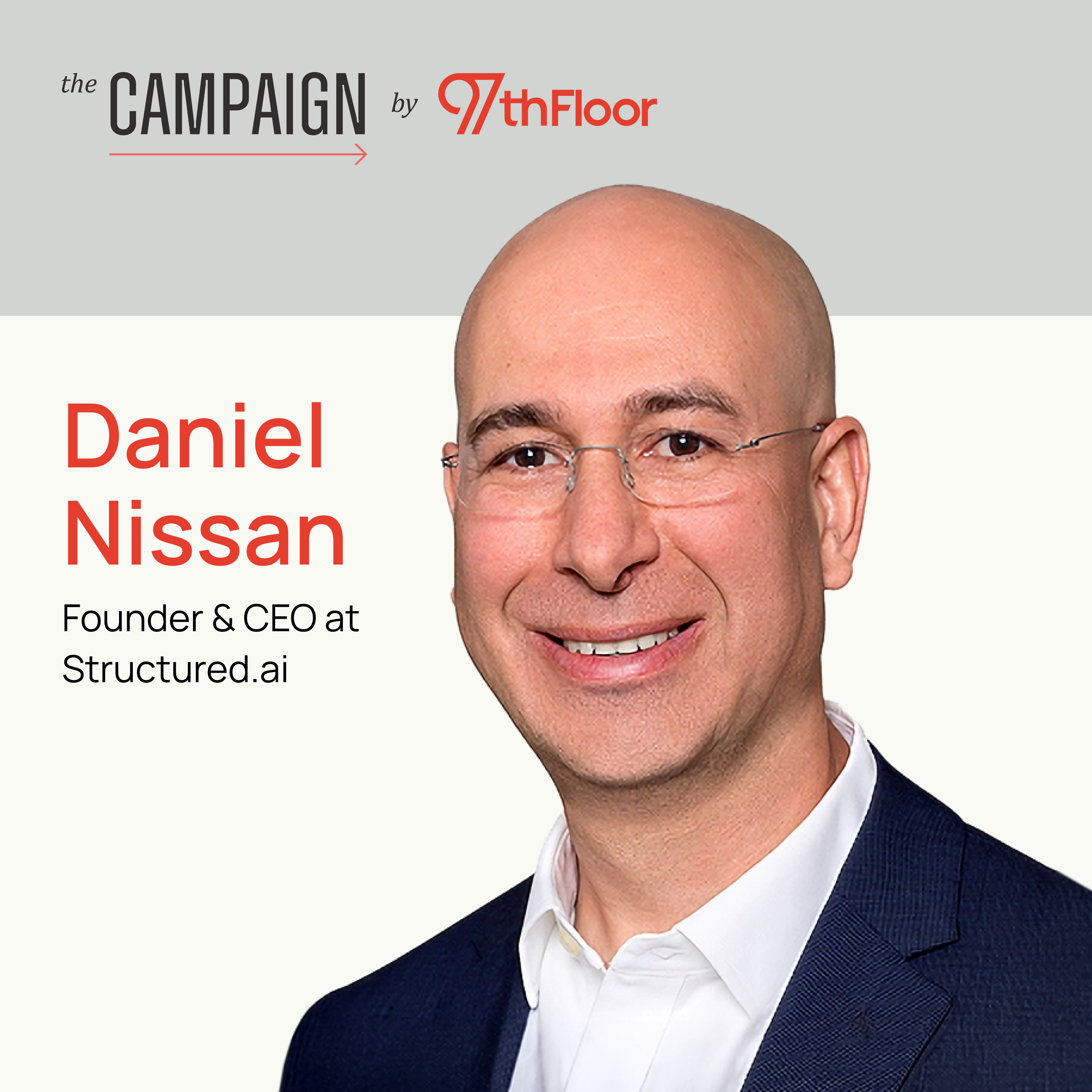
You can find past episodes of the campaign on YouTube, iTunes, Spotify and at 97th floor.com. today's guest is Daniel Nissan. Daniel founded structured 26 years ago and still leads the company's strategic vision across marketing, engineering and product development efforts. In January of 2025, Structured secured a $30 million majority investment from Invictus Growth Partners. That was its first external capital in over two decades and it was intended to help Structured focus on AI innovation as part of its growth roadmap.
Today we're going to talk with Daniel about his career history and about what it takes to lead companies to do incredible breakout things. Let's get to it. Daniel, I'm so excited to have you on today. Daniel has multiple experiences being on the forefront, cutting edge of we'll say technology but I would say maybe even influence within different markets.
And so you know, we've taken care of some of like walking through that background. But I want to, I want to go through this one by one because some of the things that you've been doing since the early 90s is just absolutely remarkable.
So maybe let's start at Vocal Tech and tell us about the innovation there. So you were the very first Internet VoIP basically like phone over Internet. So tell me about, I'd love to hear that story, how you got to that spot and the overall theme for this conversation I'd love to really hit on how do you engender the kind of thinking that keeps people on the cutting edge when I would say our natural state of being is to be in an area of comfort and that often conflicts with, with going there. So let's talk about Vocal Tech. I'd love to hear the story there first.
[00:02:14] Speaker B: Thank you for inviting, inviting me to your podcast. Very excited to have the conversation today and be able to tell my story to your audience.
Starting with Vocal Tech. I've been entrepreneur as I remember myself from early age, even before going to business.
I started my first company when I was I think 20, 22 or 23 years old and since then I'm starting companies always in the tech.
Was always fascinated by computers since I was teenage doing programming, thinking about what to do with these devices. And it always something that keep me excited. Even today.
It's also a nice industry that every few years you have something new, right? You're not in the same thing. So if you look what happened to the industry over the last 30 years, it's quite amazing.
V started as coincidence was a group of developers that created sound cards because back then in the early 90s, late 80s, sound card didn't come built into computers.
So they created those sound cards and started a company, raised some capital for that and got stuck with a big inventory. Nobody wanted to buy those cards because they didn't find a use case for them.
But they went ahead and brainstormed what can we do with that? And say, oh, let's create an intercom in the office so everybody will have a microphone and a speaker on their desktop and have a conversation.
Then they post, I think five or six people company. They raised $1.5 million from a local VC and they called me, they knew me from other venture that they had and they called me and would you join us? I said of course, it sounds interesting, but this is a stupid idea. I don't see why people need an intercom in their office. Who we talk about privacy. Everybody has a phone on their desk. But you know what? There is something here called Internet was back in 1992 and I learned about it from other experiences that I have.
You know what, let's put it together and if we can take this inside the office communication and put it in this network that nobody heard about it before called Internet, then we have a great deal now people will be able to speak one to each other for free all around the world.
It was easier to say than to do. It took us about three years before we managed to create the product. There was some technical limitation, protocol limitations and otherwise. But the industry matured and we solved the technical issues on our end.
And in 1995, 30 years ago, we launched the first Internet phone product called iPhone Internet phone and the rest was successful. We took the company public in 96 and later the company merged with other company in the voice over IP and we continue from there to grow the company and I continue for my other ventures.
[00:05:01] Speaker A: What motivated you to join a senior VP of sales and marketing back before the concept had been proven. And you know, as you said, you know, it felt like a stupid idea.
[00:05:11] Speaker B: Who needs this?
[00:05:11] Speaker A: We all have phones.
So you know, why take that bet on that organization so early on?
[00:05:19] Speaker B: Some people, when they climb, they will climb the mountain only if they know what's on the other side of the mountain. And some people get thrilled about not knowing what's on the other side of the mountain.
So I was excited. Group of smart individuals, great engineers.
The subject was interesting and I said, look, let's join a startup and work on something together. I didn't know exactly what to do, but we'll figure it out. And that's what we did. And it was very, very exciting journey from starting with a small basement and then grow up to a company, publicly traded company, on the Nasdaq, and do it in four years. That was quite a thrilling journey.
[00:05:59] Speaker A: Yeah, it's quite a ride. And you were on the very first voip call, is that right?
[00:06:04] Speaker B: Yeah, I actually made the first VOIP call back. I think it was 93 or 94.
And we were in two different locations. There was only one place in our, in my country back then. I grew up. I grew up and was living in Israel and was only one place where you have really Internet connection that was fast enough to try something about.
And I drove to Jerusalem. There was another person in a town near Tel Aviv and we connected and couldn't hear anything. But I heard the grubble and something went through that and I was so excited. So, okay, this is going to work.
And a few days later it really worked. There was something with the protocol and how things connected that we didn't know. We figured it out, connected, and the next test worked extremely well and it was very exciting.
[00:06:55] Speaker A: I love that story of you taking this bet and I really love your answer when it came to some people, as you said, some people only want to climb the mountain if they know on the other side. Other people are motivated by climbing the mountain. Just to find out, have you seen people change, become.
They need to know what they're getting into to someone who can just enjoy the ride for what it is.
Or is that a skill that can be developed?
[00:07:24] Speaker B: I think for most people that I meet, it's something natural. Right. They were born with. I think if you really committed to that, you can, you can develop it. But when we say to climb the mountain without knowing what's on the other side, it means you have a lot of surprises, a lot of challenges. Right? You have to sacrifice a lot. It's not simple being, you know, in the venture, being in tech startups, being entrepreneurs, it's not an easy process. Everybody reads that, you know, title, oh, they went public, they sold the company for $500 million. So the process is, is pretty challenging and there are more failures than success. But if you're committed to that, it's something that you'll enjoy both the ride and the outcome eventually.
So yes, for some people is natural and, but people that want to try it and they don't have it like any other skills, I think it can be developed. More work required, but it can be developed.
[00:08:17] Speaker A: Yeah. I imagine that there's some of an entrepreneur gene in there that if you're not climbing a mountain without knowing what the, what's on the other side, you're almost bored.
So I have to find mountains.
[00:08:31] Speaker B: Exactly. Yeah. It's like, you know, people likes to ride, run, marathon or do other activities. So there's something. Now some people know there is a beautiful print behind me. Some people know to do that beautiful print. I, I don't know how to do it. I don't know to sing, I don't know how to paint.
But I know to build great software and build companies and that's what gets me excited every morning.
[00:08:52] Speaker A: Yeah.
So a lot of people would be able to build an entire career around.
Hey listen, I stuck with this VoIP company. We made the first VoIP call, we launched, super successful and that's the end of their career, that's the end of their story. But you move on to innovate in a completely different area.
So tell us about why, like from VoIP to Net Grocer. I'd love to hear how that developed and then tell us about the innovation there.
[00:09:21] Speaker B: So at Vocal Tech, it's all started actually at Vocal Tech, we had a great software called Internet Fun and we want to sell it. So how do you sell it? Now they have in stores, but people buy it in stores. They don't know what Internet is and how they get connected online. But how do you sell online? So we said, you know what, let's put it on a, on a web page. Let's put a form, put your credit card information here, submit it and we'll send you the license code to open it. But we built actually the first online commerce to sell software online. That was in 1995. We sold almost $10 million worth of software in one year.
And was no, submit a card, somebody at the office, we'll get the credit card, punch it to a terminal, send it back. The unlock code, very simple. Then I met a guy, I was living in New York back then and met a guy that was my co founder and he was in the consumer packaged goods business. He developed products as manufacturing. And I said, look, why, why won't we take this concept of selling Online and we start to start to sell groceries. I didn't know anything about supermarket groceries at that time other than being a customer, nothing about the industry. But we joined forces. I brought my knowledge of technology, of marketing, of the Internet and he brought his expertise in the CPG category and and we built Net Grocery. I was the co founder and CEO and run the company and we raised I think over $50 million in capital back then and built one of the most known brand in the late 90s online.
[00:10:56] Speaker A: Doing grocery delivery before Doordash, before Amazon.
The first pioneer on that front.
Somewhat similar to vocal tech in that it started off with one thing and then developed into another. And then Net Grocer came from let's sell these keys. And then it's like what else can we sell?
So tell me what role do you feel like play has in innovation?
Did it feel like play as you were messing around with these technologies or was it just like pure business and we're looking to find a need and fill it and monetize it immediately?
[00:11:37] Speaker B: Maybe play is not the right word but you have to have the excitement. You have to have something to wake up every morning and feel that you build something different, you change something and you affect people life. It's not such a cliche. It's something that really you need a fire to do something every day and fail again and fail again and have more challenges and fail again. There's so many obstacles in the process that if you don't have something that drives you that fire, you'll give up at some point. And so building Net Grocer was, it wasn't easy. Think about, there was no E commerce software. We had to build everything from scratch.
But even then that developing software, connecting it to the database, buying the first servers, all of that was extremely complex because there was no, virtually no industry at that time, nobody to support you, no knowledge even to search and say oh people do it this way, let's copy that.
There was a lot of creation but that's what get me excited. Those challenges and the need to find new frontier and develop something that nobody did before.
So we built all of that and that really was also building the technology, the infrastructure, the E commerce, but also all the logistics that the first time I dealt in my life with logistics now we had warehouses all around the country.
We had to do delivery, which we partner is eventually with FedEx, which is a story by itself. How we got to meet with Fred Smith, the founder, founder of FedEx and convince him and his team to support us back Then.
But it was about busy building the business model. The pricing, the delivery, the packaging. Right. How you put groceries and don't break them. So actually I went and worked for UPS and FedEx for a few days as a delivery assistant and put the uniform and went to deliver packages and says, I need to see how it happens in real life so we can design it properly. And they said we had many customers over the years. That's the most awkward request that somebody ever asked past to work with us.
[00:13:39] Speaker A: So how big was the team when you first started net grocer?
[00:13:44] Speaker B: Oh, maybe we were four or five people.
Grew up to about 200 people at the peak. Yeah.
[00:13:50] Speaker A: When we get down to the full team of 200 people, I'm curious if you have any perspective on engendering that excitement across the entire organization.
Because the. The period. Time period of 96 to 99 was a very heady time in America and excitement was easy to come by given like all the innovation and a lot going on and everybody wanted to be a part of it. So do you feel like, you know, listen, it wasn't that hard. You just get people on, tell them where we're going and people were excited. Or did you learn any kind of skills and motivating and bringing that excitement out of people who maybe didn't come up with the idea or didn't initially see the vision?
[00:14:31] Speaker B: Yeah. I think as an entrepreneur, even today, this is something that you have to work on that skill of. It's not just you. It's how to build a team and how to become a leader.
So when you're a small company, that's easy. It's four or five people. You go and do it. Everybody's really good at what they do. And you run like a commander unit.
When you grow the company, it's quite difficult really to recruit the right people. That's most important, I find, to recruit smart people, motivated and positive and motivated people. It's really critical as you start to expand the team then to share a vision, to tell a real story that people can understand. Right. Where do we go? Why do we do that stuff? What will make a difference to our customers? Right. And build the principles. Right now, for example, customer centric. That's something that was key to me all my life. Even a net grocer, if somebody orders something, then we need to deliver it to them on time. We need to make sure that nothing breaks in the process. We need to make the experience positive.
And that's. That really drove people to talk about the company and Share and spread the news and help us grow the business quite quickly.
And you show people why we do it. So we in our net gross, the story was we're going to make that chore that people stay in going out to buy groceries. We'll make it something simple and fun, right? So we click, you know, and today it's obvious, right? But back then open your computer, log in and order groceries and the next day it will show up at your door. And that's something that people didn't believe it's actually working.
And it worked.
And also we drove great value because we saved a lot of money in stores and fulfillment and others, right? And shrinkage and breakerage.
And so we were able to deliver it to your door at 25% below your local supermarket if you lived in big metropolitan area. So no need to go to the supermarket delivered to you below your local prices. What can be bad about that, right?
[00:16:35] Speaker A: It's kind of a no brainer is that where you had most of your adoption were in the big metro markets
[00:16:42] Speaker B: and how actually it was nationwide. So from the beginning you have to build a story for the company, right? And a story from the customer, story from the press, story from investors.
So we have two options. One, to go to be a local company, say oh, we just serve New York because you cannot open warehouses all around the country overnight. Very expensive and you don't know where the demand is. Takes years to build it. So I said okay, we need to be a nationwide company and that's, that's will be the unique story of Net Grocery, right? We can deliver to any place, to any location, almost overnight or in two days.
Do we do that? FedEx and UPS, that's quite expensive to ship an envelope cost $15. Think about what to ship a box full of water and cereal and pasta and stuff like that.
So I dropped an email, sent an email to Fred Smith, the CEO of FedEx and said look, this is what we do and I think you should do that and be our partner because we'll help you to build volume of deliveries in local neighborhoods so to really support your day to day delivery because their business is very flat most of the year, B2C and it's only picking up in the holiday season. So we'll give you a great delivery network all year long and on top of that you can tap and deliver other product at low cost.
And he replied to me back and invited me to Memphis. I went and visited him and the rest of his team and they became to, to be our delivery partner. So we were shipping for one warehouse, but we're shipping it nationwide on FedEx plans and trucks. And that was something unique. It really differentiate us from any type of others that try to build something like that locally.
And got the attention, the brand, the connection, the press.
You would open the morning news, Good Morning America, cnn, somebody will talk about Net grosser back then. So it was fun. But there was something that really caught people attention and early on. So the promise and the potential of E commerce where it was really just starting.
[00:18:49] Speaker A: It seems too like the. The FedEx brand was lending some legitimacy to what was probably a very foreign concept to a lot of people. And there might have been some distrust because it is so obviously a great deal. It's delivered, I don't have to go and it's cheaper. That sounds like a scam, but you bring in FedEx and I'd imagine that that helped to win over a lot of people as consumers.
[00:19:13] Speaker B: Exactly. Yeah. That was part of. So when we evaluated who worked to work with, we checked UPS and FedEx and both had great delivery network and great prices. And FedEx, the brand was one of the main reason I chose to work with them and not with UPS back then.
[00:19:33] Speaker A: Smart. And so you also negotiated a deal with aol.
Tell us about that, how that came to be and how that benefited Net grocer.
[00:19:44] Speaker B: So part again, building this strategy was not just to build the network and the distribution really on the category. Right. So I went to all the major Internet properties back then talking about AOL, Excite, AltaVista, Yao and others.
And we said we want to buy exclusivity on any advertising of consumer packaged good products it supplies and over the counter drugs.
We raised a lot of capital and actually bought. So at that time, if you're a consumer packaged goods company and you want to go and advertise online, we own the inventory. We actually conquered the entire inventory for this type of product advertising.
Net Grocery is perceived as a supermarket, but actually think about it. It's a network that connects consumers with brands and brand with consumers in a way that never existed before.
So we didn't have the eventually later on the evolution of the company. We didn't own the warehouses. We had partnership with Fleming, which is one of the biggest distributors in the country where the network of the delivery was FedEx.
Really we control the brand and the connection, the marketing, the programs between brands and consumers and enable brands to do something they could never do before. Have direct communication to consumers and have it done in real time. So we worked with Procter and Gable. They launched their new coffee brand called Milk Millstone Coffee back then.
And we were able to give them data every week about purchases, flavors, repurchases, promotion, how it works, how it doesn't work, and slice it based on regions, based on states, any way they wanted. We were able to deliver to them something. So today it's again obvious. You go online, you have Google Analytics, you have other type of data and tools that you can use. But back then we invented the whole concept of connect directly to your consumers, build your brand, establish ongoing relationship, offer them new products, cross sell upsell. We even invented automatic replenishment so you could go online says I need this amount of coffee. Deliver it to me once a week, every two weeks. And we would deliver it. And every day before you'll get notification if you don't do anything, it can't, it will be fulfilled. If you want to cancel, just click here.
[00:22:03] Speaker A: Were you so I mean, in a sense you were also becoming like a dsp.
Like were you providing them data and selling them this data or was it, hey, I'm going to give you this data in exchange for, you know, I'm your partner to sell your product. And it's exclusivity basically.
[00:22:23] Speaker B: And we sold. We have actually marketing programs because we also control the inventory. So if you want even just to advertise, you know, pasta, you want perilla, we work with them. You want to advertise pasta? Not even three grocery pasta, just in general, we own the inventory. You had to come to us to buy it. So nobody called DSP back then. And maybe we created category specific DSP and then it connected everything we did. We would advertise them. Says why just to advertise? Let's send them online to purchase it and deliver to them directly. So if we combine the advertising and commerce together in a package, together with information, we could go and say, hey, we see people buying this product category, what do you think about offering them your product? So do cross sell upsells.
Introducing new products we had, when we fulfill the orders, we always samples that vendors would pay to put in those packages. But the sample was not just random samples. People that buy that or people buy baby products. So now let's introduce them to other baby related because there is a very clear life events going on for this family and we can use that information to offer them other baby products.
And so we started to build a lot of information to understand from what people buy if they have a specific life event, any specific situation. We also brought for example, information that we actually tagged in the database all the nutrition facts of every product that we sold.
You can go. If you have diabetes, you can actually go and configure. It says filter to me these products and finding that product. So the level of use of information, I don't think anybody, even today in any of the online grocery shopping that you have today, provided that access to information that you can really leverage. Right. I want product below specific, specific category for calories per serving, sugar per serving, high protein, stuff like that. We gave that information already to people back then. And you were able to go and filter the entire store based on this data.
Wow.
[00:24:23] Speaker A: So I mean it's called out publicly like that. The big innovation with Net Grocer was it's the first grocery delivery. And I, I agree that that is big innovation, but I would argue the bigger innovation is we're going to corner the market on ad inventory and then we're also going to gather and sell all this data. I mean that wasn't really widely done from a digital perspective at that time.
And I would assume that that might have been a bigger catalyst in the growth of Net Grocer over time rather than just the initial. I guess it's the initial innovation that then enabled those.
[00:25:07] Speaker B: I think it's combination of that. It's the technology, it's the business model, it's the way you build a brand.
Building a company from nothing requires all this. How you go to market, do you sell?
What is the product, how do you price it? Always use the basic theory of marketing, product price, place and promotion really as the cornerstone to think about everything you do going back to vocaltic. Right. So we start to sell online, but the biggest audience eventually was there and buying in stores. That's pre Net Grocer, pre online commerce in the way we know it today.
So we want to go to retail. And when you go to retail you have to go through distributors like Ingram Micro and others. We went to knock on the door and said, look, there are $5 million to invest in driving demand and advertising.
We don't. That was even before we went public.
Then one day I was at Comdex and was walking the show and tried to see find opportunities and suddenly you see all this computer and software booth. And suddenly I think it was like 40 by 40ft booth, big one all bright white and just boxes and books in the booth.
Proger says, hey, why are you here? What do you do? I says, oh, we're a book publisher called Ventana Communications or based in Raleigh, North Carolina.
I Said, so what do you do here? And says, oh, we actually wrote a book about the AOL official membership kit.
The AOL Official Membership Book. Right. Says, okay.
And so still, why are you here? So, oh, we're actually trying to sell the book in bookstores and nobody would buy it. So we went to AOL and asked them if we can put their software they were distributing for free to everybody's home. But we asked them, can we put it in the box? We sell it as a kit box with art book and your software in retail store that sells computer software and hardware, and we'll even pay you a fee on every book that we sell. So we all told them yes and became a home run. That was one of the best seller in retail back then. So I said, you know what, this is interesting. I have your piece of software called Internet Phone. What do you think? If we take it, you write a book about it, we put it in a box and you put it in retail for us.
They loved it. And three months later, we were in retail nationwide just because of that opportunity. It's always, you have to find those, go to market and partnerships and branding and the story and combine them. It's a moving target. You have to be really open to them and think creatively and many times think outside of the box to see those opportunities and not to go in the traditional way. Oh, I have to go through distribution. I need 5 million doors. I need to do traditional campaign would have taken us probably two or three years before we can get the product in on the shelf. And we got them on the shelves in 90 days.
Wow.
[00:28:08] Speaker A: And that was just from a serendipitous conversation.
[00:28:13] Speaker B: Yeah.
[00:28:14] Speaker A: So I'm curious how you like trying to replicate, you know, as much as possible. Like, if you say, hey, I need to solve this problem, you know, you initially, like, the one problem around distribution you solved with FedEx. And it was just a cold, a cold email to the CEO.
This other one was just a lucky conversation, I guess. You know, if I say, hey, you know, we need to solve this problem, what do you do? What's your first step? Are you just like tapping my network or I'm putting something out there, or I'm just attending as many events and meeting as many people and looking for opportunities. Like, what's your way of tackling that problem today?
[00:28:58] Speaker B: ChatGPT?
Yeah, there's some research now. There's so much information today. You don't need to really, to leave your desk, but it's really, if you try to distill it start to think outside of the box. Right. Don't look at the traditional way to do something.
If you believe in something, be courageous enough to approach someone. Look, I was a tiny company from New York City and I wrote an email to the CEO of FedEx. Nobody would have the courage to do that. Right. But if you have something interesting, people will listen to you.
It doesn't matter your age, where you are and how big is your business. People would pay attention. And back then they paid attention to that because that was very unique. And today we have with different market, different situation, the noise level is much higher. Part of the lag that we had back in the early 90s were first in the market. So we were at Net Grocer. You looked around maybe 20 or 30 other companies and the E commerce business, Right. And focal tech. Nobody thought that that's possible when we brought something pretty new. So part of it is to be early into the market.
But sometimes to be early, it could be also a challenge because when we had Vocal Tech, Right. It was too early or few million people using the Internet globally and not billions of people.
But can you wait for the market to grow?
No. Because then you might miss the market. So timing is critical and you never know. You see an opportunity to jump to it and sometimes you'll be lucky, you'll be successful, and sometimes you'll miss the point will be either too late, too early, or have other challenges.
[00:30:28] Speaker A: Yeah.
So what's remarkable to me is that all we talked about with Net Grocer took place within a span of only three years, which is remarkably fast.
You then move on to founding Structured Web or then Structured Web, now Structured.
Tell us about that transition journey, the opportunity that you saw that led to you founding Structured Web.
[00:30:56] Speaker B: Well, Nick Grosser, I tried to replicate the story of Vocal tech, right? So we built a big brand. We grew up very fast. We built the network, the partnership, and we were scheduled to go Public in 1998.
And we had underwriters and everything ready. And two weeks before the roadshow began, there was a big financial crisis similar to the Lehman Brothers at that, at global scale.
It started with a hedge fund based in Grinch, Connecticut called the Long Term Capital.
That created a global crisis that shut down the IPO market for over a year from 98 to 99. Then we had the boom of the dot com from 99 to 2000 with our commitment, with our strategy, that was very aggressive. Also from a capital point of view, we were burning a million dollars a month. So we have to raise A lot of capital to do that.
Or running like a train, no bullet train on the, on the track. And one day you hit a wall and there is no way to overcome that in. In some situation. And the company really collapsed because of that. So I left. And then my investor in the grocer asked me, I think two days or three days later I got the phone call, says we have a check for you, $500,000. What do you want to do next?
But first, lucky me. And second, I said, okay, I'll come to your office and have some ideas.
Oh, I came to their office was Friday afternoon.
You know what? I think we should not take any risk. 10 ideas.
All of them are good ideas. You'll give me a million dollar and I'm going to evaluate all the 10 ideas over the next few months. And then we pick the right one. Why? To bet on something.
They looked at me with the eyes, they opened their eyes, big smile and this is amazing. We never thought about an idea like that. This is so clever, so innovative.
Go home, come in on Monday with one idea.
And so I went home. That idea of building a Lab and trying 10 different ideas.
Didn't pick any interests, I guess.
And I thought about the list and I came with structure web. That was my topic from my list and start to work on that. So went back the next week, got my $500,000 to start the company and the rest is 26 years history.
[00:33:22] Speaker A: What made you settle on that one as the one idea?
I'm assuming you had a lot of different ideas that you wanted to tackle.
[00:33:30] Speaker B: It was a big problem, what I saw. I always tried to say what were my pain points and where can I see that? A lot of people try to solve something that will make something easier, right? Eventually technologies to make things more fun, entertainment, entertaining, exciting, or to solve different problems, right?
So I was already using the Internet for almost eight years, right? From 1992, we're about 2,000. Back then I was trying to book an appointment at my doctor's office online.
They don't even have a website or trying to get product information or they don't have a website or even if they have a website, they have like a brochure that somebody scan and just put us a big image on their homepage, right?
Looked around says, okay, I understand what is taking to build a website, right? It's pretty challenging. A lot of work. Technology keep changing all the time.
The data center, you need servers, you need how to design HTML, all of that. But even today it's a Bit complex in some situation, but back then it was absolutely impossible for businesses to do it on their own.
And then I talked to one of my investors, he was friendly, Scott Cook, the founder of Intuit.
And I was lucky to be able to talk to him. And I asked a lot of questions about Intuit, about QuickBooks and about small businesses.
And I found that their success was about verticalizing the software. So when you buy QuickBooks even today, you say what industry you're in and will be available to you right away with the right templates, with right chart of accounts and others. And I connected the two together. So you know what, why won't we create websites and Internet presence that is customized for specific business?
Because most businesses are local businesses, they don't compete with each other.
And if we small businesses and if we give them enough variety of design, the ability to customize it and give them something ready made, not tool to build a business, but a ready made website for their business, they can just need in five minutes to put their logo, to put their opening hours and some additional information, click save and they're up and running. That would be a great solution. That's what structured web was at the beginning, a platform that we built vertical marketing solutions for different industries and went with get yourself up and running in five minutes and we will maintain the technology, stack the information as the industry continue to evolve. So you don't need to worry about that.
The first industry was actually chiropractor and that was in 2000, summer of 2000. We launched the product and start to market it to that vertical and later on move to additional verticals.
[00:36:15] Speaker A: And I think it's worth calling out because it's, it's easy to underestimate how early that is because the consumer web had been around for at least, I mean, almost 10 years at that point. In terms of like being in pop culture, everybody was online and yet most businesses still did not have a presence online. Most of online, you know, it was AOL and it was chat rooms and, and email. In 2007 I was selling websites and I remember knocking on doors and saying like, hey, you should get a website. And then thinking, you know what, maybe I should get a website.
Like that was very early in 2000 to be doing that. So first off I think we need to appreciate that. And then the marketing side of it, how much do you feel like you were building a SaaS company, which again was before the big SaaS wave, and how much do you feel like you were building a service company?
And did you like delineate between those two or did you not even care to define it?
[00:37:21] Speaker B: No, it was pure SaaS. We didn't call it SaaS back then and it was not called cloud computing. We call it aasv Application Service providers. But we were selling software, we were not selling services. So the whole idea is ready made qlik, self serve and you're up and running. We didn't have any services unit, we didn't do any work for customers. It was all templatized and ready to use.
And that's, that's what we do even today. If we go and look at the core of structure today, it's the same concept give businesses ready made marketing package that they can use with dates much more than web presence. It's any type marketing and the verticalization is done by industries and by vendors offering it as a solution to their channel partners. The problem that we try to solve, how to give small businesses ready made marketing programs existed back then and it's the core principle of structure structured with AI with other technologies even today.
So it was a ready made solution. Service, online service things. Again that was hard to explain and to sell to businesses.
At the beginning we had even inside sales team that were trying to sell it to chiropractors and they said why do I need a website? $50 a month is a lot of money.
You know, actually I don't have a way to save because I'm not connected to the Internet yet. That was the most common response that we got back then.
And that's, that's always the challenge of the timing, right? So maybe if we waited few more years it will be easier to be in market but then maybe somebody else would do that ahead of us.
So we went to the market and we tried chiropractors. That didn't work out. No, we tried and they didn't want to spend money on that.
So we said you know what, let's, let's think about other industries. Let's look at industries that more marketers there are sellers, they're more investing in driving demand. They will be the one really that want that they're more, more connected to a transaction. They want to do email campaigns, they want to do information sharing with their clients. And we develop an amazing product for
[00:39:21] Speaker A: travel agents that's very similar to the FedEx partnership where it's like we're going to drive like FedEx will deliver the goods. So let's partner with the people delivering the goods, make them convince people that they need websites and then we'll Empower them. And then they have an extension of our distribution.
[00:39:43] Speaker B: We went to travel suppliers and cruise ships, nice travel and to unique resorts. And they were the suppliers built for them something for their agencies and was a great concept, great product.
The only problem is that we launched it on September 9, 2001. So two days after that we had no market and that was again the train hitting the wall. But at that time learn something from the past. So the trend was not driving that fast so we could recover from this crisis.
[00:40:20] Speaker A: Yeah.
So in the scope of your career, you were at vocal tech for three years, saw it from beginning, massive innovation, moving very quickly. Net grocer, same thing, Three years, moving very quickly, massive innovation. And you have now been running structured for over 25 years.
Do you view structured as it's been one thing that's slowly evolving or there clear chapters where it's not the same company after this date, it's a completely different company or has it been more
[00:40:55] Speaker B: multiple chapters in the life of the company? Again, the principle, what we do is the core is the same. But we started as a company selling this software solution for small businesses to get the web presence up and running.
And today we're the global leader, helping the world's largest brands to market, to help their local resellers around the world and partners to do marketing for the products. Now companies like Microsoft and IBM and ServiceNow and Google and Zoom and dozens of other companies run their distributed marketing through their partners on our system.
So again, the core is the same, the business model, the technology, everything is completely different.
[00:41:38] Speaker A: Yeah. So let's go to today.
ChatGPT launched in November 2022.
Most people weren't even paying attention when it launched. And very quickly, six months later, May 2023, structured launches channel GPT.
And this is a time when people are still figuring out what ChatGPT is.
I'd love to take us back to that time and you know, you see ChatGPT, what's that process to innovating and creating channel GPT and moving so quickly in that process.
[00:42:17] Speaker B: Yeah. So you're right. ChatGPT came to market, I think November 22nd, but I was using it already probably a year before. So I was using OpenAI technology. There are different prior versions of that. At the beginning, you write something and computer writes something back to you and was exciting and like talking to a robot. But eventually it got better and better. So when ChatGPT came to market, we knew we were playing with that again. We didn't have APIs, but started to think about it. I said what problem we can solve with this technology. And the first idea we had is making storytelling better, right? What is marketing? It's about to explain to somebody or to convince somebody why they need to buy your product.
And the best and most effective way to do it is to talk about it from their perspective, why they need it for their business. And we're dealing with B2B products in our current.
So why do you need this piece of software or this piece of hardware and how it will make your business better change? It changes based on the business. You talk to industries, right? Transportation, logistics, pharmaceutical, retail, healthcare, they all need to use a specific product, but all will have different use cases. And one you'll talk about students, the other one you talk about customers. And third one you'll talk about patients, right? They're both all customers of that business, but different description of how you talk to the business about their customers.
Then you have different business sizes, you have different buyer personnel, different people buy. And some partners sell to the customer service, some people sell to the it, some people sell to the CEO. Different type of strategies, how to sell. So different buyer Persona. And now we have the languages, we sell global and our customers sell globally. So it's over 130 different languages, right?
So now you have one product and says if I want to have all the different stories, potential stories for all these different potential use cases, it's three, over 300,000 different stories for every single product. Nobody can produce them.
Nobody really need the 300,000 because maybe practically, eventually, maybe 10,000 of them will be used by most partners. So you know what, let's create a machine that can tell the stories better. We'll take the original story and now we can change it. If you're selling to somebody in the transportation industry, we can expand how this ERP software is applicable to transportation industry or how this customer service application, a project management solution, can help you in education, in healthcare, in manufacturing and retail.
But we will tell GPT. Oh, by the way, we're talking now to the VP Sales and VP Marketing and CFO now change the story based on new knowledge of this profession and what they do. And remarkably, it was capable to retell the story in so many different ways.
Again, like vocaltic at the beginning didn't work. It was we couldn't hear the noise from the other side.
The call would be terminated every few minutes. The same with ChatGPT. It was challenging, challenging, challenging. We said, look, it will take time. And my prediction was that by the end of 2025 early 2026 we'll get to the point that we can have a brain brained on a vendor, product and services that can write and generate any marketing content in any language, for any Persona, for any industry and that content will be approved by humans. This is good enough to use as is and we're not there yet. We're I think 90% through the process. It's not us, it's the overall industry and maturity and capabilities of LLM model. But I believe that next year we'll get to that point.
You can generate any marketing content automatically based on specific workflow and training and other specific processes that we implement to create that never ending marketing machine can generate any content for any partners, in any language, for any situations, all on demand.
[00:46:23] Speaker A: What would you say are the biggest bottlenecks in the technology that are preventing that last 10% from being achieved? Like where, where are you seeing the roadblocks? Is it in data, data analysis, consumption? Is it just sheer quality of content? I'd love to know where you're seeing those barriers.
[00:46:42] Speaker B: All of it is the way LLM is set to write, right? It's a statistical model and if you get it to write things as they start off specific pattern and like if you get paragraphs, all the paragraphs will be perfectly formatted and same length and same keywords that repeat. So you need to humanize it a bit. And that's something that we're working a lot of how humanize the content writing and how we add those unique imperfections of human writing into the writing of the content.
Part of it is the workflow itself, how you connect the pieces and you start. For example, there is a concept called rag which you build a big data set with the information and every time you ask something you retrieve some information from there you add it to your request. So the model will know to write about it at the beginning. Say, oh well, let's build a big big bucket with all the information and every time we need to write about something, we'll retrieve it. From there you run some experiments and you find no, it's not good enough. You actually need to have 100 different buckets and every time you need to know to go to the right backend and retrieve that. So, so there is evolution of the technology, but there's also evolution of learning how to use the technology.
And the third is getting the customers to trust it. And that's something that we work a lot today is to give the customer feedback. Is it good, is it bad? Can you trust it? If you didn't trust it or you don't like the copy? Why is it branding issue? Is it use of specific keywords? Is it something else? Style.
You train the machine to understand the customer style. So we have the building blocks, we have the processes, we have the technologies, but we still working to stitch everything together to get to that perfect machine that can do all the work in a scalable way. And then people will invest their time in training it to analyze the usage, to improve it, but don't need to spend time on cutting and pasting content and creating content because simply it's impossible to create all the content that partner needs. And then you, in this case, you delegate it to them, but they're busy, they have other things to do. So you need a more scalable solution to do it and really create for them the marketing assets and the stories and explain to them how to use it in a scalable way, fully customized, bespoke, with no human involved in the process.
[00:49:07] Speaker A: So you, in January, I believe, took your first round of investment in decades, specifically to invest in innovation around AI.
I'd love to know where is structured today and where are you seeing opportunities to build on that innovation?
[00:49:33] Speaker B: Yeah, so we took Care capital from Invictus Growth Partners, amazing private equity group based in California. And we met with many other investors prior to that, of course, and they really saw the vision and shared the vision with us and really pioneered early on on the potential of AI and how it can go.
The day that we announced was kind of the end of the process, but you can just imagine that was months upon months of, of conversations and due diligence and others to get to that point. And they saw the vision and they agree with our vision which I just described, of how AI is going to change channel marketing and marketing in a dramatic way.
And their funding, the support and the knowledge and expertise they've brought to our business helped us really take it to the next level and start to grow it faster, really allocate the right resources to take the AI development to the next level to solve the challenges that I just described.
And we already released several new capabilities and with the introduction of Structured as the new name, because we moved from Structured web to Structured AI. So it's Structured AI, but the company name is Structured now.
It wasn't just rebranding, it was not just doing a facelift with something old.
With this capital and with the support, we took a bold decision to rewrite the platform from scratch.
But we're really building now the whole structured web platform that we develop over 26 years in a whole new technology. So we're using AI to write the code and we use the best practice AI technology stock and best way to build compute and algorithms and others. So we're launching it early 2026, all new platform, completely built from the ground up, built for the AI era. So it's called, of course the term is called AI first, but it's not just a slogan. We really took that big step, investment, a lot of hard work to build the platform from the beginning, but rethink about it because the user interface is different. We have AI already in the current system. But do you see that it's built in, it's not stitch, it's not natural. Right. It's like trying to take a website back in 2020, 2000 and take an existing website and try to connect it on a mobile.
[00:52:00] Speaker A: Right.
[00:52:01] Speaker B: It didn't feel natural. Right. You felt that it was a website that somebody just now did some adjustment that will work on mobile. It wasn't mobile first.
And when people say AI first, it's about that it's built with AI in mind from the beginning, both what's behind the scene and also the front end. So for example, in our current product, you have the traditional log into a portal, you have menus, cloud, point and click and scroll. And you need to do a lot of work to find information.
The new product you just prompt like ChatGPT, you type what you need and you'll get response.
If you see an email that you like, now you want to customize it. In the current product, you click, you get an editor like Canva, you drag, you drop, you type the new product, you just type, change the colors, learn the way I present my business, change the email and the entire campaign based on that. So it's turned to be a conversation and not editing and searching. So becoming more and more natural to people to use it and generating content automatically. So that's really our focus now, which is more focused on the generative capability of AI.
And as things get more and more mature, and I think that will be more toward the end of 2026, is move to more the agentic side of AI. So not just create the content for me, but do the actual work of sending, analyzing it, following up on it. So that's where I hope that end of 26 or early 2022, we'll have this complete marketing machine that the business can run with no direct day to day involvement in the process.
[00:53:39] Speaker A: I'd love to learn about that as you develop It. So I hope we get to talk again because I want to. When you get to that stage, I definitely want to see how all the gears work within that process.
And I love what you're talking about with AI first requires a rebuild. Otherwise it's just bolted on and that rebuild is uncomfortable. And it asks. It requires big questions to be asked. And I think that maybe goes back to bring this full circle. You have to be willing to climb mountains and you don't know what's on the other side of them. If you're going to require knowing what's on the other side, that makes that. That's where we bolt on things. Because, like, I know this, I'm familiar with this. I bolt it on. I know what's going to look like afterwards versus like, let's throw all that away and build from scratch.
I love that mindset.
[00:54:28] Speaker B: Yeah. And you need to rally your team behind it. So go back two years ago and when I came to my team said, hey, we're going to change. We're going to use AI and ChatGPT to build into our product. People thought, I'm crazy, you know, and so now that that cannot be done. And eventually, with a lot of work and encouragement and training them and give them access to try different things, they start to see the opportunity. Right?
[00:54:52] Speaker A: Yeah.
[00:54:53] Speaker B: Earlier this year, when we sat down with our R and D team and with our technology and product officer, we said to the team, okay, we need to build it and we need to have it done by the end of the year.
The first response was, it's impossible.
But we sat for a week. We sat with the entire team for a week. We broke it down to it is possible and how we're going to do it. And at the end of that week, they came back to us and said, you know what? Not only that, we can do it, we can do it faster than you think.
You have to have people to believe in that and see it possible. Otherwise they won't buy into it and they won't. Won't be motivated and will be a lot of concern and anxiety and others. Right. So that confidence that one has, you have to spread it to others and also understand that others might not be the one that like to climb those mountains knowing what's not on the other side.
And a lot of them, they must know what's on the other side. So you have to draw to them a very clear picture where we go, why we do it, why it's possible.
And then if they understand that, it start to be like A magic, it start to spread.
Then you can sit back and just watch it happening.
[00:56:10] Speaker A: Yeah.
Daniel, thank you so much for being on. This has been super informative and I love this discussion. I feel like we could talk for days about all your experiences and stories.
[00:56:23] Speaker B: An hour. Amazing.
[00:56:24] Speaker A: I wanted to end with one question that I think is on everybody's mind all the time as AI is continuing to develop. As somebody who's called a lot of early shots, you know, you work with the marketing industry.
What would be one piece of advice or one place to look that you would recommend? Like where. What should marketers be thinking about? Where should their attention be in these, I guess somewhat early days of AI, as things continue to develop, would say,
[00:56:54] Speaker B: first thing, go out and learn and explore and try. If you're in marketing, if you're in sales, if you're in accounting, right?
There's so much innovation and things going on. There's so much access, right? Going back 30 years ago, if I want to learn something, I have to go on a plan, fly overseas, go to a trade show just to get something basic to know what, what this company actually does, right? Today, go online. You can find anything of all the tools available for you for free. No matter what you do, you do copywriting. Go find and learn how to do copywriting. There was this changing. The world is changing, changing, right? If you sit there and say, well, it's changing, I have nothing to do, then my job was taken. Yes, it will be taken, right? But the other day I heard a great example says no, 100, 150 years ago, there were people in town that will go in the evening before sunset and will light the gas lights, right? And the morning they will come to shut them down or whatever they did with them, right?
I don't see people like that in my town anymore. But I don't see people unemployed in my town either. So things are changing and changing constantly. So you have to learn, learn. It's. For some people, it's not easy and I did something for so many years and, and now I need to learn new skills, new technologies. But that's it. The world is changing and changing faster and faster all the time. I think it's great. More opportunities for people to learn new things, to try new, think new options and then try new careers and because now you can go and learn something and become expert in technology and on technology related type of professions.
So I'll encourage people to go and learn and find something that get them excited.
And as I say to a lot of my friends that say we want to start the business, jump to the water and start to swim.
You cannot learn to swim if you're not in the water. So it's challenging, it's difficult, but it's very exciting at some time and many, many, many of those days.
[00:58:51] Speaker A: Yeah, go climb the mountain and get excited about the fact that you don't know what's on the other side.
[00:58:57] Speaker B: Exactly. Explore something new.
[00:58:59] Speaker A: Yep. Daniel, thank you so much for joining today. How, how can people get in touch with you? What, where would you have them go?
I'd love for to send them to Structured. So Structured AI. And then if they want to reach out to you, what's maybe the best way for them to connect with you?
[00:59:14] Speaker B: Best way is on LinkedIn. Just look for my name, Daniel Nissan. N I S S A N and you'll find me. And if you send me a message there, I'll, I'll definitely make sure to rep to you.
[00:59:23] Speaker A: Okay, great. Thank you so much for joining us today. It's been a pleasure.
[00:59:27] Speaker B: Thank you pax. It was a nice conversation over the last hour. I really enjoyed it. Great questions and thank you for inviting me to your show again.
[00:59:36] Speaker A: That's all for today. If you enjoyed this episode, please consider leaving us a five star rating and subscribe so you don't miss future episodes. Huge thank you to Daniel Nissan for joining us today. You can find Daniel on LinkedIn and go check out what he's building at Structured AI.
You can find past episodes of the campaign and examples of our work at 97th Floor.com.
learn more about the agency and get in touch with a marketing specialist if you want support for your own marketing campaigns. That's all for now. Thank you for listening. We'll see you back here next week. Until then, keep innovating.