[00:00:00] Speaker A: Hello everyone, I'm paxton gray, CEO of 97th floor and this is the campaign.
The campaign is produced by 97th Floor, a digital marketing agency designed to build world class organic and paid channel strategies for mid level and enterprise organizations. You can find past episodes of the campaign on YouTube, iTunes, Spotify
[email protected].
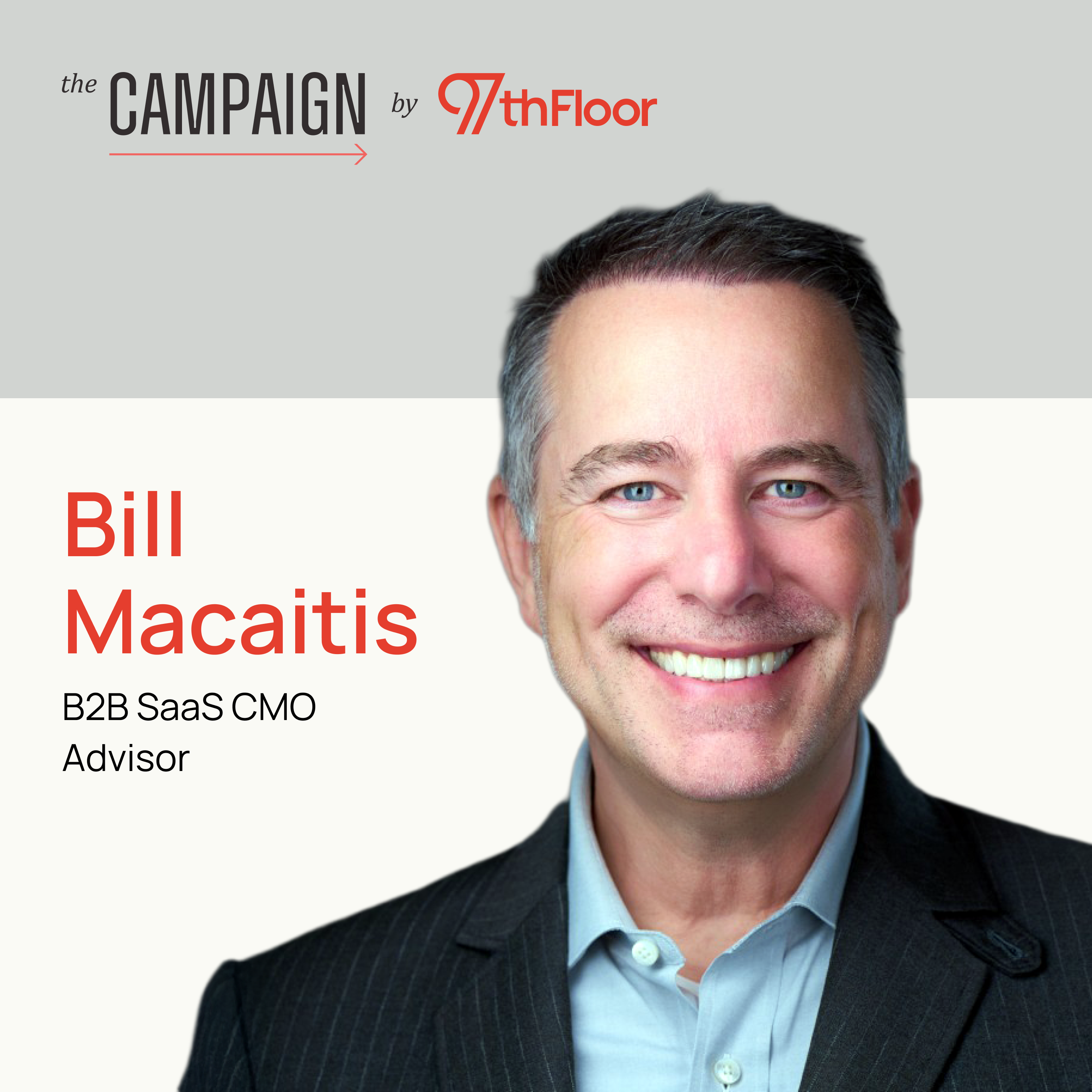
Today's guest is Bill Macidis. Bill is an advisor and board member guiding aspiring unicorns and helping build innovative go to market strategies. Over his 20 year career, Bill has powered growth at three of the fastest ever growing companies. As a CRO and CMO at Slack, the CMO at Zendesk, and the SVP of Marketing at Salesforce. Bill is genuinely excited about the work he does and about sharing what he knows. He could quite literally tackle any marketing topic there is and and have something new and helpful to say about it. He's a B2B SaaS expert and today he's sharing with us five things that every B2B SaaS marketing leader should focus on in 2026. Lots to take away from this one. Let's get into it.
All right, Bill, thank you so much for joining us today. I'm excited to talk with you.
[00:01:07] Speaker B: Oh yeah, honored to be here. Thanks for having me.
[00:01:08] Speaker A: PAX so by the time this episode airs, we will be at the beginning of a new year, which means a lot of people are starting to build or starting to work on their plans for 2026.
The goal for this episode today is talk about where marketers specifically in the B2B SaaS space should be thinking about what they should be thinking about in 2026 to grow.
There's a lot pivoting, a lot changing in our industry.
So what would be maybe the first place you would recommend somebody look in terms of their strategy to get ahead for, for this new year?
[00:01:48] Speaker B: Yeah, I'm excited for 2026. I think it's gonna be a crazy fun year obviously with AI being everywhere. And probably the first thing I would say is just that recognize from a go to market and competitive standpoint that you're just gonna have more and more competitors. And what that means to me is that brand is gonna be that much more important.
I work now, I kind of serve as an advisor and board member for a lot of AI and SaaS companies. And what I consistently hear is like, hey, we've got a really cool product. It does this, the customers tend to like it, but there's 10, 20, 50 other ones that do something similar. Right.
And at the end of the day, I think for a lot of B2B startups, this is a little bit different motion thinking about brand a lot of times was the realm of B2C and kind of when you're coming into B2B it's not just all about sales motions and PLG, but it's like do people even know who you are? Right.
So I think there's going to be just a lot of focus on that or I think there should be if you want to win. Right. You have to think about, you know, awareness levels, sentiments, recall, you know, tracking a lot of new metrics that I think a lot of B2B marketers don't always track. A lot of times it's just leads and pipe and, and so forth. So really tracking the right set of brand metrics really start to invest in that, doing some advanced targeting. But I just think like brands going to matter more. It's just, it's such a saturated competitive field right now and there's so much money pouring in from the VCs. And not only that, it's so much easier to create. Startups now like AI ironically is making it so much easier. You don't need as many people, it's so much faster to code, there's agents coming out for all these different workflows that you're just going to have a lot more competition at the end of day if no one knows who you are. Like it's going to be really hard to succeed.
Yeah.
[00:03:36] Speaker A: So I'm curious how you see that developing because as some economics tighten, attribution becomes extremely important or important in the eyes of the people who are signing the checks. So how do you feel like these B2B SaaS companies should enter that conversation basically when they're being asked to really only invest in bottom funnel, invest in, you know, dollar in, dollar out.
Whereas brand is, you know, often so much awareness and trackable. Very important, but can be difficult to get budget when budgets are tight.
[00:04:14] Speaker B: Yeah, I kind of came up on the data side. My dad was an engineer. I always loved data driven stuff. To me it was like data was the antidote to politics and companies and having data was really important and, and I think the first step I'd probably recommend is just start tracking your brand metrics. Right. Like when I came in as a CMO at Slack, I came pretty early, only maybe 50 people. And one of the first things we did is we started tracking our brand metrics. We started tracking aided recall, unaided recall, sentiment, sure voice, sure conversation.
And one of the first things we found out too is that it was pretty early in slack stages that not a lot of people knew about us, right? But we could track it. And every month we ran a survey and we kind of saw exactly how much it was improving.
And I would say that, like, just by tracking it and having a graph, that's another data point you can provide to your C suite, to the board to try to make arguments as to, hey, why, look, this is important, right? And I think there's a lot of other ways that you can track brand, right? So one is tracking the metrics and attribution. Love attribution. We can geek out on that all day. But a lot of things, like we did, for instance, is we would run brand campaigns, but in very specific markets. So we'd run them in, let's say, like Atlanta or Philadelphia or San Antonio, and then we'd have similar sister cities that would not get those brand campaigns. And we would measure both the lift and awareness and brand, but we'd also measure, hey, was there a lift in pipeline and new leads coming through, average deal size, deal velocity. And what we found is that a lot of times the brand awareness campaigns also created a lot of demand, right? And when people know about you, any salesperson knows this. When you go into a company and they don't know you at all, it's one, it's demoralizing. And two, you have to start a ground zero. Okay, this is what we do. This is who we are. This is what we sell.
You know, when you go into a deal and someone already knows you, has heard about you, has heard good things, like, they're seeing you everywhere. They see your content, they saw your, you know, cool customer of yours that's doing, you know, X, Y or Z, they're much more likely to use you. So I think, like, you know, I get that boards.
I'm on boards now, right? And I get why it's very focused on, hey, let's show the immediate impact. And I think with brand, you can do that. You just, you have to track the metrics and you have to be a little disciplined in how you have these control groups and where you can methodically show the lift. And I think for a lot of B2B marketers, it's just been difficult because, like, they haven't done that or it's just kind of like, well, it's a brand play. We don't really measure that stuff. Right? So of course, like, a lot of C suite and board members are going to be very skeptical or they're going to be worried about it because we've never had metrics to track it.
[00:06:55] Speaker A: That's such a great point and one that I've never heard brought up in this debate or I should say an argument to invest in brand is the impact on the sales cycle.
I think it's a really great takeaway because you're right, if you've already won them over because the brand is so strong, they're going to close deals a lot easier, they're going to close deals a lot faster and they're close them and they're going to be bigger deals. So I think that's a fantastic takeaway for marketers in 2026.
[00:07:28] Speaker B: The other thing that, that we noticed pretty predominantly was that the markets that we invested in brand not only had an impact on the prospects, new deals coming through, but existing customers, they were much less likely to attrit. They had a higher net promoter score. They tended to like the brand more. And again, like I think there's a lot of different campaigns you can run, right. When you run a campaign that's just like hey, we're awesome. Buy us today, 20% off, sign up now. Like to me that's a very transactional type campaign. Right. But when you have a brand that kind of speaks to your values, maybe makes someone laugh or smile, like all those emotions transfer onto your company. And so there, you know, we found that people were less likely to attrit in these areas. And so now it's like, you know, in there runs a B2B SaaS business knows that like, hey, there's multiple parts of the equation as to how fast you're going to grow. And if you're losing customers left and right because they don't like you or they're having bad experiences, well, that's an area that I think brand also has a positive impact on. So I think holistically there's a lot of reasons why to do it.
And I get it, it's hard. Brand is a long term investment. Right. But I think for 2026 it's just going to become more important. There's just, there's just going to be too many competitors out there and you have to stand out and be differentiated.
[00:08:44] Speaker A: Yeah.
To say, I mean not, not to mention the impact on AI search and being mentioned more like that we're seeing that has a big impact there. And if fewer people are investing in brand, that means brand is cheaper. Which means it's absolutely so okay, so invest in brand. Love that 2026. Good call to action, good part of strategy. What would be another thing that you'd recommend people focus on in the B2B SaaS space for 2026.
[00:09:10] Speaker B: Yeah. The next area that I'd have them focus on is to put your marketing where the eyeballs are, right? And I think there's always been a disconnect in B2B here. I think a lot of times B2B gets stuck in a really old playbook which is like, you know, analyst relations. Let's write white papers, let's just do events, like very like traditional things, right?
But I know where people spend their time now and I think we all do, right? It's on our phones, it's on social, it's on LinkedIn, it's on TikTok, it's on Instagram, it's on YouTube, it's on X.
Like this is where the eyeballs are, right? Social, mobile and increasingly video, right? And so I think you really have to ask yourself like a, is that where our marketing channels are going towards? Is that where our content efforts are going towards? Are we still writing, you know, white papers or articles and just putting them on our blog that no one really visits? Right. Or are we creating shorts? Are we creating videos? Right? Are we creating the content and reaching either organically or via paid bumper ads, whatever it is, right? Like get in front of your audience.
And it's another thing, like I kind of have like my, my career is a little unique in that I spent like half my career in B2C and then half in B2B and I've just noticed that there's a lot of these like old held notions that I don't really agree with and I haven't seen playing out that like, whoa. Well, if you're in B2B, you have to only reach people on quote unquote, B2B channels, right? You can, you can't go to there. Like can't go to Instagram or TikTok or whatever. And it's really weird because I know for me, like I do a lot of content and I've had founders reach out to me and they're like, oh yeah, like from Brazil. And they're like, oh, I saw your TikTok channel. I really like Deville. Or I saw you on YouTube or I saw you on all these places where you might not go, oh, that's where a B2B marketer should be finding their audience, right? So I think like it's increasingly important to go where the eyeballs are. And the great news is, like, the targeting is becoming incredible now, right? Like, you know, there's always been this advance towards ABM company level targeting. But we're getting it down to where you can target individuals and if you've done your homework and you know, hey, this is our icp, here's the exact people that we're targeting. We have an account list. You can get crazy with the hyper targeting now on these social mobile video channels. So I think like that's a huge trend and again it's, it's an untapped trend. Like you mentioned earlier, a lot of the brand channels B2B marketers don't spend time on. This is one that's kind of like got a low consumer flair. But the nice thing is like you're not going against 100 other competitors. This isn't like SEM, you know, no one's even using SEM now with the AIO. But you know, SEM was like you'd always have like 100 competitors and you bid up and it'd be hard and, and you know, I think the very nature of just being social for B2B is different for a lot of B2B marketers. And if you're investing in video, that's another area where a lot of companies just haven't put any investment in or it's a little scary or it's just like, hey, this isn't a channel we've really invested in. So there's huge opportunities there for 2026.
[00:12:04] Speaker A: I love that. That reminds me of Mailchimp back in the early 2010s.
They did a lot of creative ad spend and different channels that no other B2B companies were spending. And I thought, you know, they, they, they had some tremendous success. And it's surprising now reflecting on that, that more people didn't follow suit with that. I think one concern that some marketers in B2B SaaS might have, especially depending on their industry would be, hey, listen, you know, this is a serious product. We've got a serious buyer. I can spin up a TikTok channel but then I'm going to be perceived as not serious and these people are trusting me with their data or their customers data or I guess. What would you say to that potential objection?
[00:12:52] Speaker B: I a, I totally get it and I've heard that objection internally at a lot of the companies I've worked at. So Salesforce, Zendesk, Slack, we all started in SMB, right? And we moved slowly up to mid market and then slowly up to enterprise. And at every year there was always a, I don't know, Bill like, you know, can we create content like that that makes people laugh or can we put it on this channel? Like, you know, they won't, this isn't very businessy.
And what we consistently found was that just that people are people, right? We're all people, right? We, we have brands we love on the consumer side, on the B2B side. And I think, like, I would challenge that notion, right? And I think actually falling into that notion is one of the reasons I find a lot of B2B SaaS or even AI companies struggle is that they look and sound like everyone else, right? Like when you have 10 competitors, 20 competitors, and you all look the same, you all talk the same, it's very, you're all in the same channels, it's very difficult to stand out.
And ultimately what I found is like, people have a deep affinity for brands. You know, when they love a brand, when you're unique, you talk a little different, you look a little different, you're maybe on different channels than everyone else. They notice you and they tend to love you. And when they love you, they buy more, they attribute less faster deal cycles like all these good SaaS, you know, metrics that make the go to market engine flow so well tend to all turn really positive. So I would just like, I think there's like a lot of myths in B2B. You know, it's probably like a separate podcast or video, but I feel like that's one of them, right? It's like, oh, I don't think we can do that. We have to talk in acronyms and talk boring and write white papers because that's how we like it.
And I just think you need to challenge those, right? Like, I haven't found that to be true at all. Um, and to me it's just like an old conservative, risk averse type strategy.
[00:14:41] Speaker A: I like that.
I'm curious what you think the real reason that more brands don't have that personality. Do you think it's, it's really because of these internal objections and they, you know, the marketers want to do it, but they can't get buy offer. Do you think it's because people just don't care? You know, a sense that I get from you as you're talking is you're bringing a lot of energy, you passion, you care a lot about what you're doing.
Do you think that that is maybe our biggest problem in the marketing space is like, do we just care enough and if we did, could we get that buy off? But it's just like you just don't care about this enough to actually get that buy off.
[00:15:21] Speaker B: Yeah, I, I don't know if it's. Don't care. You know, I work with a lot of different Sass and AI companies now. And what I find is that, you know, a lot of the stuff that you want to do to do a more modern playbook, to do 2026 playbook, is you have to take a different stance, a more modern approach. Right. And I think for a lot of people in marketing is that, you know, you become, the tendency is to become risk averse, right. Because everyone else in the company has an opinion on marketing. I mean, if you're marketing, it's awesome, but it also sucks because everyone else is like, you should do it this way or I'm an expert on pricing, I'm an expert on messaging, I'm an expert on creating ads, right.
So I feel like for a lot of people it's easy to fall into a risk averse situation where you just kind of play it safe, you know, kind of did what we did last year, which was what we did the year before that. And I'm not going to get fired on that. And you know, it won't ruffle any feathers, but I just, I don't know, like I, I don't think you can take a really risk averse playbook anymore. There's just too much competition coming out. I mean, AI natives are coming for every single category, every single knowledge worker. You know, the processes that they would do, they're coming to replace that.
And even if you're a pure AI native, which I work with a lot of them, there's 50, 100 competitors. Like I, I'm helping a company in the customer support space and it's brutal. I mean, like, it's amazing what they're doing now, like how much they can do, which is pure AI processes and you know, reduce the amount of knowledge workers you need for that. But there's just so much more competition, right? So I just think like, you know, you have to be brave here. You have to, you know, build, build consensus internally. I think that's a big thing. Like if you're going to do this, you got to get good at change management. You got to realize, like, hey, I, I don't just need to convince the marketing team, like I need to convince the head of sales, the head of product, the head of finance. I need to convince seven different board members who all have different backgrounds, right on like, why this playbook makes sense.
I think the Playbooks and I know we're talking about that for 2026.
There's a little bit of debate, like what you should do and what are the right things. But I find it's less about like, hey, we should do this, and it's more about, okay, we need to convince everyone else in the organization as to why we have to do this and why it's so critical.
[00:17:41] Speaker A: I like that. So concerning AI, are there any tips or things you think marketers should be focused on in 2026 concerning AI, either from an operations standpoint, like a marketing operation standpoint, or marketing production tactics standpoint?
[00:18:00] Speaker B: Yeah, I mean, I think first, just from like a channel standpoint, I've worked with a couple of B2B SaaS, companies that have just, you know, and a lot of other companies out there really getting hit by the organic SEO, which is just diving off a cliff. Right. And you mentioned earlier, you know, aio, geo, whatever you call it is becoming so important, right? This, this idea that people are no longer going to search engines, they're going straight to the LLMs, you know, where that's, you know, Claude Gemini, ChatGPT, and asking questions, right. And they're not linking out or very little. Right. The data shows that it's like one in a thousand. There's a link sent out. Whereas, you know, SEO before was much, much higher rate there. So I think just from a channel perspective, you know, really making sure you're thinking about that marketing mix, right? Like starting to think about, hey, how do we, you know, ramp down our SEM, our SEO investments and really ramp into aio, right? And obviously there's a very different set of playbooks there. Your customers have to love you. They're, they're, you know, they're mining a lot of the channels. So like G2 crowd or trust radius, or looking at people talking about you on Reddit, there's, you know, a lot of different content strategies. So it's indexable. Some of it's like SEO stuff. But I think, I think a shift there.
The other thing I think for 2026, which you had mentioned, is like, hey, how can you just infuse AI into your workflow flows to just be a better marketer, be a better go to market person, right? There's so many great tools out there. You know, I mentioned I started getting into content myself and I'm just by myself. Like, I don't have a team or anyone else. I just like doing this stuff, right. And like content's kind of hard and if you're doing it the old way, like it can get very hard, very long, very expensive, especially if you're doing stuff like video. But there are so many great AI tools out there and I use it for everything from like research for like, hey, what should the content be for this video? What should the exact title be on YouTube? You know, the transcriptions, you know, so I can then write articles on that. Or it can automatically post articles, you know, turning into podcasts, doing short video clips that'll just chunk a long video I did on like multi touch attribution, which I don't know if anybody likes that. I love attribution. If you do check it out but you know, automatically make the cuts for you. Like it's amazing like how much more productive you can be when you really lean into it.
And I get, there's a lot of fear with it. I get it's like, well, you know, how does this impact me? How does this impact my job? But I just think like, you know, leaning into those tools, whether you're in marketing ops, campaigns, content, there's so many good tools out there that are going to make you more productive that I think for 2026 you absolutely have to lean into that.
[00:20:33] Speaker A: Let me throw, I think a curve ball people are going to have to deal with and I don't think we've dealt with yet, which is the use of AI imagery on sites and in marketing materials.
I came across this recently talking to a group of people and it was fascinating to me to see the spectrum of opinions on it from it doesn't matter, use it. And in fact you should use it because it shows your AI forward.
And then the other end of the spectrum of this is lying. We have to disclose that this is AI and everything in between. You know, this makes us look cheap to use AI versus real imagery.
So I'm curious headed in 26, I think a lot more marketers are going to be having this almost moral debate about using AI imagery within market materials. I'm curious where you stand and if you have any of your initial guidelines on approaching that.
[00:21:34] Speaker B: I'm very in general very pro modern, pro customer centric with my go to market strategies. And I just think AI is here. AI is only gonna get better. Now I get like, you know, 2024, remember ChatGPT has only been around for three years, right. So those initial images that it was creating, right. You know, you'd sometimes see it write text and it would look like gibberish. And yeah, I think sometimes like that has an impact on your brand. But I Mean, the models are improving at such a rapid rate now. And I mean, you can create infographics now. You can create amazing material backgrounds. I don't see why you wouldn't embrace it now. I still think, like, there's that quality check lens. Like, hey, you can't just like spin it up and put it out there. Like, let's look at it, you know, just like you would if you're working with any creative agency, ad agency or internal. Like, you're going to have your quality. Does this align to our brand, to our values? But I think from like a moral standpoint, um, I don't have any issues using it now. Now you have to be a little careful with this stuff, right? Like, are you using other brands work? Right? Like, are you are using Disney characters in your ads that came from AI? Well, you're going to run into some, you know, potential legal issues down the road. But I think outside of that, I think creative is an incredible area. And I think just again, like Sora coming out, for instance, you know, anytime you have an app that has wide consumer usage, you just start to see like, what's possible and what's. And I remember, like, I wanted to use like. So my, my little advisory business is Sassimo Pro. I have a sloth as my mascot because I believe in mascots. I love mascots. So I love the sloth. Like, they're super slow, but they're very methodical and cute and calculated and. And I wanted to start using sloths more in my videos. And I, I remember like, it was a year and a half ago I started and the first videos I was trying to create, I want, I want to have like a sloth, like swimming down a river or something. And it was, it just didn't look good. It was like, ah, I can't use this, right? It's just, it doesn't hit the quality bar. But God, now it's like just the lighting, the amount of data, it's just like what they're working with. It's just such a higher quality. And again, we're talking about 20, 26, right? So at some point it passes that bar where like there's a quality bar is there. It's better than what you could create internally. It's faster, it's cheaper. Like, you kind of have to lean into it.
If you don't, I think what'll happen is again, your competitors or just someone else on the marketing team will have leaned into it. And by the time you lean into it, you're not Even familiar with the tools or the technologies to do it. And you know, you get replaced by someone that is. So I think like, you just, you just, you have to lean into it.
[00:24:11] Speaker A: Yeah.
Tell me if this sort of litmus test works for you and your opinion on it is it's about the outcome.
And if the outcome is my perception, the perception of my brand is improved, the user experience is improved, and I'm not crossing some sort of legal ethical boundary, then it's go for it. That's what matters most. Rather than whether it was actually photographed or AI generated. Would you say that's accurate, like a good litmus test?
[00:24:40] Speaker B: Absolutely.
I think that's a great. Like, to me, again, I'm very customer centric. I always think, what is the experience that our users are having, our customers ultimately, like, I think like people say, what is a brand? A brand to me is just every little micro experience they have. And if it's a good outcome, if it's a positive experience that they're happening, that they're having, then that's great. Right. And I think that's a really simple litmus test. I like that one, Pax.
[00:25:04] Speaker A: Yeah.
[00:25:05] Speaker B: All right.
[00:25:05] Speaker A: I think depending on how you slice it, we're at about four tips for 2026. Do you have another for where, like what marketers should be thinking about as they prepare their plan for this year?
[00:25:17] Speaker B: Yeah, I think a big one for 2026 is to maybe reinvestigate your pricing models.
So what you're seeing now is a huge shift in B2B SaaS away from per user to usage based.
In a lot of cases, this is token based.
In some cases this is outcome based.
Excuse me. So for instance, I mentioned I'm working in the customer support space for AI.
A lot of those have shifted away from per user to outcome based. Right. So hey, each ticket costs a dollar to get resolved. Right. Or 10 cents or 50 cents, whatever. It is very different model than, you know, per user. As each user becomes super more productive, it makes less sense to be pricing your software on per user. So just as I think there was like a massive tidal wave shift from on prem software to cloud software. And a lot of software companies had to make that kind of painful switch. And it was hard, but at some point they did it. I think a lot of them are going to have to rethink about like, just how are they pricing. Outcome based pricing, usage based pricing, per user pricing.
In my experience, pricing is one of those huge levers, not just from a monetization standpoint. But also from a brand and growth standpoint.
I also think for 2026 I really encourage more companies to explore more freemium models.
I did like a 60 minute video just on freemium because that's how much of a nerd I am. But I love this stuff. And I think a lot of times like the freemium debate gets kind of get caught up into just the financial side. Like oh well, you know, users have a cost and free users were subsidizing and we have paid bandwidth and support costs. But what I found is again in this new reality where you have 2050, 100 competitors, like just getting people that know about what you do is really important. And what I always thought about free users when I worked at Slack and Zendesk was that hey, like every free user is a person on my marketing team.
When I have a thousand for users, I have a thousand person marketing team. It's like I had like 5 million marketing team. They were out there just talking about the product, spreading it, educating people, bringing it into new organizations.
And you know, I think sometimes you have to look at the big picture here. Like there is a lot of unit economics and yes, some of those free will convert, but some of them won't. And I was like why would you fry? Why would you fire all these free marketers, right? Like keep them on because they have a huge impact on your growth, on your brand. So I think just even like the pricing models is going to make a big difference. And and I think that also kind of leads into just like these different types of go to market models, right? Like really embracing product like growth which has like a freemium element, a self serve or for mid market. I see a big change for 2026 is going to be more product led sales.
So that's that idea of like hey, you get most of your leads come in, they start using the software, maybe it's for free, whatever version. But then you layer in a sales team on top and you kind of mine not just marketing qualified leads, but product qualified leads. Like hey, these people are in the product, they're from this company. What's the firmographic? You have like a lead score, product qualified lead score. And then the sales team goes in and tries to sell those people which is kind of a different model than the old outbound, top down, wall to wall type sale, long deal cycle. So I think the, you know, this whole pricing model, freemium and then leaning into a little bit like the product led sales are going to be really big in 2026 as well.
[00:28:42] Speaker A: I Think that's really interesting. Yeah, I like that model of targeting individual users and allowing them some very low barrier onboarding point. And then when you have a certain critical mass within an organization, it's almost like the organization is forced, like it's like the best possible choice to then go with a larger organization pricing model rather than all these individuals. I mean, ChatGPT is, is they need to be doing a better job of this in my opinion, because it makes almost no sense to move to the organization. It's the same price either way.
But if they came back and said, hey listen, you do this, we'll give you a bit of a discount and there's all these additional features, I would do that in a heartbeat. I'd almost be forced to, like, I'd be super.
[00:29:24] Speaker B: Absolutely.
Yeah. And that's what we found at Slack was we had a very intentional strategy of not differentiating it based off features, but we differentiated based off enterprise requirements. And what I mean by that is when you're an enterprise you need single sign on, you need compliance exports, you need provisioning and deprovisioning of users, right? You can't have like someone on Slack and then they get fired or leave the company and they're still on Slack. Like that's a massive risk, right? You need provisioning and deprovisioning of users. You, you want to have consolidated billing, you want to have all these additional security features. Those weren't really user level features, but they were things you needed as an enterprise. And so I think it's kind of like an advanced pricing and packaging tactic. But it's to really think about how do we get our hands into as many people as possible and then how do we use these enterprise requirements to get them to go on to the enterprise plan. And the nice thing too is if you're a salesperson, I think a lot of salespeople are a little hesitant on like PLG or framing models. And I'll say this, like, I've done sales, I've run sales teams. It is a heck of a lot easier to sell a company that is already using your product than one that has never heard about you and has never used you once, right? You can always mine the existing users that use your product at that company and they become evangelists, they help you out, they're like, oh, you want to talk to Joe, he's in procurement. Yeah, I can help set up a meeting there. Or like, like, oh my God, I love this. Like you gotta get us on this plan or whatever it is, like it's such an easier sale. And that's, I think, that a lot of companies are starting to realize, like it's a different playbook, but it's a really powerful playbook.
[00:31:01] Speaker A: I love that take. I think that reexamining kind of the entry into these organizations is something that a lot of B2B SaaS companies should be reevaluating to end. I'm going to get your take on this, and this is, I think it's, it's a, it's a view that's brought up a lot in the B2B SaaS space, particularly among a lot of the AI gurus, quote, unquote. And I think it's a, it's a take that's somewhat naive in my opinion, especially within the time frame of 2026. Maybe it's more valid as you extend beyond that. Who knows at this point?
But a lot of people are, you know, espousing, you know, AI is going to be the, the end of SaaS.
No, no longer do these organizations need to go and have, you know, purchase software with a couple prompts and some revisions. They can build whatever they want.
And you know, again, I think we're nowhere near that, especially depending on what, like, SaaS business you're talking about. But I love, you know, as someone who's in it so often and with so many different organizations, I'd love to hear your kind of take on that.
[00:32:14] Speaker B: Yeah. So I would agree with you.
I don't want to say naive, that sounds a little harsh, but yeah, it's.
I have large, large doubts that the LLMs will be able to create verticalized and specialized software super easily. I think it's really hard. And not only that, I think it's really hard internally just to build all your own software.
And I know this because I've been doing this for 30 years and I was part of some companies that had really ambitious internal development teams that were like, oh, we can build that web analytics. Yeah, we'll build you a system that'll track everything. And they did, and it kind of sucked. And then they moved on to something else and then we had to maintain it and improve it. And it was so far behind and it was this legacy piece and, and I've seen that time and time again where I think companies, it sounds great in theory, like building all your own internal tools and processes, but these are hard. Right. And I think it's going to be hard for just the general LLMs, like the Big Eight to really do that.
That being said, I Think there's. And you see it like the VCs are funding thousands and thousands of companies that are building AI native software to build the workflows and processes for every single elements of knowledge worker. Right. And I think that's where it's going to happen because I think you really have to have specific knowledge on, you know, what an ad specialist does, what a web analyst does, what a PMM does. Right. And what are the processes and workflows and how do you build it in and what are the feedback loops and the data, proprietary data in a lot of cases that you're using. So yeah, I think that like now SaaS is SAS dead. I don't know, like the old model of we're going to do up on, we're going to have a massive sales team, you know, we're up a really big organization.
I feel like those days are going right. And again what I just see is that, and this is just like real life experience. I see so many new AI natives that are coming out that can build their companies at a fraction of what it costs. There's a whole like lean startup motion and there's literally like leaderboards of hey, we got this ARR with this many people, right? And it's like 1/100 of a lot of the typical old SaaS companies and their models.
And so I do think like these SaaS companies are going to come with a reckoning of like, hey, how do we start competing when these guys are doing it at 1/100th the price? Maybe they're even offering outcome based pricing, right? They're like, we only get paid if you guys hit this revenue or lower the amount of tickets, whatever it is, right? Like that is coming and I don't know how quickly that will be 2026, 2027, 2028. But I do think like fundamentally if you're part of a SaaS company, you absolutely need to re examine your go to market. How do we be more efficient? How do we use these AI tools? Re examine our pricing, re examine. Do we even have a brand? Are we measuring it?
Because like they're coming. They are absolutely coming. I see them at the seed level, the Series A level. There's so much funding. I'm working with them. They're smart.
Like, this is, this is a huge tidal wave that's coming right now.
[00:35:20] Speaker A: Hmm. I'd love to end where should people go? Because I think, you know, you've got a ton of great content that I think our audience would really enjoy. So where, where can they find you. Where would we send them?
[00:35:32] Speaker B: Yeah, best place. I'm on most of the channels but really like most of my content is on YouTube right now. So if you like this stuff, go to SaaS, CMO Pro or just search that on YouTube. I've got my own channel there and I do deep dives on everything from branding to product led sales, the attribution to just managing change management within a company.
I love this stuff. I just feel like when I was going through there weren't as many resources out there, so it's all free. It's just something that I just kind of want to give back and help out other marketers and sales leaders that are kind of going through this.
Cool.
[00:36:05] Speaker A: Okay, great. We'll make sure there's a link to that in our show notes.
Bill, thank you so much for joining. Thanks for bringing your passion and energy to this and to the industry. It's been a pleasure talking with you.
[00:36:17] Speaker B: Likewise. Pax hey, love the. Love the questions, love the conversation. Thanks again for having me.
[00:36:21] Speaker A: That's it for today everybody. If you enjoyed this episode, please consider leaving us a five star rating and subscribe so you don't miss future episodes. Big thank you to Bill Maciatis for joining us today. You can find him on LinkedIn and on his YouTube channel, Sassimo Pro, where Bill shares what he knows about how to grow and scale startups. You can find his channel linked in the show notes. You can also find past episodes of the campaign and examples of our work at 97th floor.com. you can also learn more about the agency and get in touch with a marketing specialist if you want support for your own marketing campaigns. That's it for now. Thank you for listening and we'll see you back here next week. Until then, keep innovating, keep converting.