[00:00:00] Speaker A: Hello everyone. I'm paxton gray, CEO of 97th floor and this is the campaign.
Thank you for joining us today for another episode of the campaign where we talk with marketing leaders about better knowing your audience, innovating beyond best practice and converting visitors into customers. The campaign is produced by 97th Floor, a digital marketing agency designed to build world class organic and paid channel strategies for mid level and enterprise organizations. You can find past episodes of the campaign on YouTube, iTunes, Spotify
[email protected].
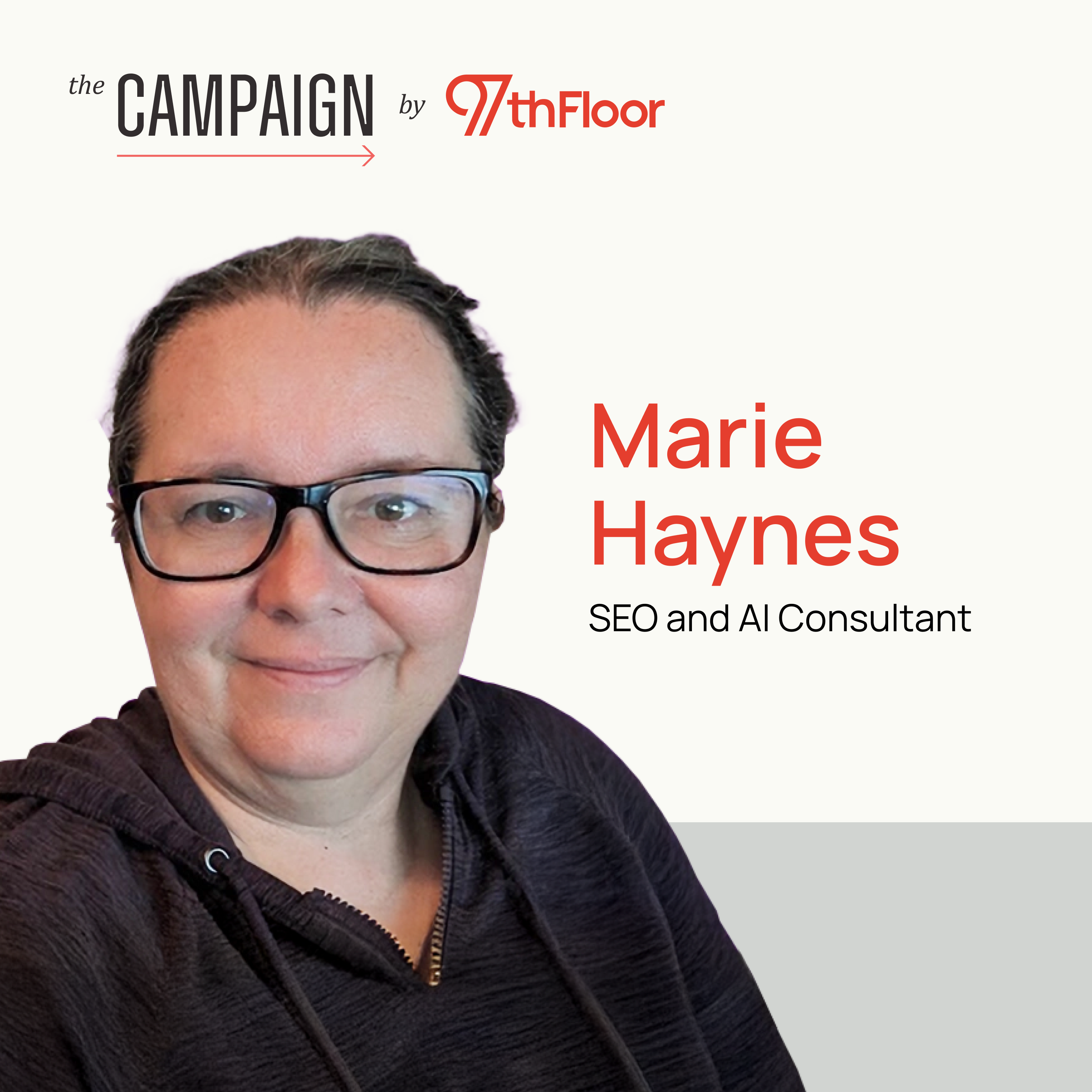
Today's guest is Dr. Marie Haynes. We're really excited to have her back on the show. She's always digging into the latest changes in AI and how it pertains to marketing. As things change at an increasingly rapid rate. You can never talk too much about the latest in AI. This episode we're going to cover agentic AI and language models and Maria sharing some practical advice on how to actually start using AI in a productive way. Let's get into it.
All right, Marie, thank you so much for joining us today. I'm really excited to be talking with you again.
[00:01:02] Speaker B: Yeah, thanks for having me, Paxton. It's always great having a conversation with you.
[00:01:07] Speaker A: Yeah, your episodes are always some of my favorites. I love how you're always looking to explore and try new things and you're very much at the cutting edge of a lot of tech coming out these days. And so I'd love to maybe start off by having you say, like, what are you doing lately? Like, what are some of the projects you're working on right now?
[00:01:26] Speaker B: Yeah, I'm probably working on too many things right now. There's like, there's so much opportunity, it's hard to know where to focus.
So I would say my number one thing that I'm trying to learn more about right now is agents. We talked a little bit about agents last time and I think we're just in the very early phases of agents starting to change the web. So I'm learning. I'm currently taking Google's five day intensive course on actually creating agents, like coding them with Google's agent development kit. And, and it's, it's challenging but I think that they're really good skills to have. So agents. I'm working on my community, the search bar where we have a bunch of us that are just talking. Yesterday we had this fantastic chat about how everybody is using AI to improve their workload and, or workflow basically. And so yeah, working on Community and then I have a small handful of clients that, that I'm helping guide through this transition. Of, you know, there's. There's so much to know about how search has changed. Almost every day, something changes in search. And so, yeah, so it's kind of my job to stay on top of all those things and then communicate that to. To my clients. Not an easy task these days.
[00:02:44] Speaker A: It's not.
[00:02:45] Speaker B: It.
[00:02:45] Speaker A: It's funny, it feels very much like SEO felt back in, like, 2007, 2008 era, when just like, a lot of different stuff would work and then wouldn't work, and there's so much to test and there's so much unknown, and it's really exciting, actually. It's like, so many different tests to run, and it's really like, speed and willingness to forego some of the old learnings and like, adopt new learnings. That's the key to staying on the cutting edge right now versus when things are more stagnant. It's about size and it's about investment to stay on the cutting edge. So to me, I'm like, I'm very excited about, like, what's going on. But you're right, it is a lot to keep up with. And it's. What was relevant just six months ago isn't relevant really today or a lot of it.
[00:03:36] Speaker B: And it's wild, too, because, like, a few years ago, if I wanted to learn what's working in SEO, we had a whole community of people that would happily share, you know, this is what we're doing, this is the success we've had. And now it's all, like you said, it's all kind of new again, you know, and.
And a lot of the people who are actively sharing what's working, like, I don't even. They're not actually providing any proof, you know, and so I think we see. I think it's very difficult to know what, what we should be doing. So I think, I think what you guys are doing, you. You told me, just briefly, a little bit about how your team learns AI and shares with each other about what, what's working like, I think that's the only way to do it.
Test things and then see what works. But even then, all of the AI systems, like whether it's AI mode, ChatGPT, wherever you're trying to. To get seen, they're changing daily too.
So, you know, something that worked for you yesterday might not be successful, you know, a week from now.
I saw a study, I don't know if you saw this href study today that said that AI overviews change every two days and 50. I think they said 56% of the entities that were mentioned in the AI overviews are different every time that they change.
So all these tools that are like, here's how you rank in AI overviews, like, they're, they're. We're really just guessing, right? It's wild, right?
[00:05:09] Speaker A: Yeah, that measurement piece is one of the most, I think, frustrating things that right now where it's like every.
The best thing we can do is sample and extrapolate from that sample. But really that's insufficient when it comes to like actually getting a true status of where things are.
I had this experience going to, like, what I've noticed is conference attendance in our industry has gone through the roof, like, way up from where it was just three years ago. Covid brought it down and it never really came back to what it was, but now it's like, boom. And it's because everybody's like, what's going on?
[00:05:45] Speaker B: Yeah, yeah. And the funny thing is there's like.
[00:05:48] Speaker A: Nobody know, like, nobody really knows. So, like the, the top of the top, they know maybe 5% more than what most people know. And so they're coming to these conferences wanting to know what's going on and they're just hearing like, everyone says the same thing over and over again. It's like, well, yeah, because that's where we are right now. It like all that knowledge was brought boom down and we're at a kind of a new building stage again.
[00:06:09] Speaker B: I have, I'm starting to develop this view, though, that I, I want to share it with you because I think that there's a group of us that have worked really hard to understand how AI works and how language models work. And there's like, there's an article from a couple years ago. Oh, I can't remember who wrote it now, but it's called How ChatGPT Works. And like, it was just fascinating to learn how vector search works. And, and, you know, and so a bunch of us have these theories and some of them have worked like, relatively well in, in terms of ranking for vector search. But then it all comes down to how people actually interact. Like, I'm jumping ahead a bit here, but you know how In Google's the DOJ vs Google trial, there was a whole bunch of information that came out about Nav Boost and about the role of user signals. And so here we are trying to learn, like, how do we make it so that the machines, the algorithms think our content is the best or our website or our business is the best. And then once you get there really all of it. Like the AI systems predict what to put in front of people and then they get fine tuned by what users actually choose. Right. And I think that the industry is missing that last part, which is the most important part.
So a lot of what we are trying to learn now, the stuff that we're learning at conferences, the stuff that we're sharing, is really just the beginning part of looking good to machines when ultimately all that really matters once you're there is that you're like the best result for people.
And so that's where I want to put my focus is I'm trying to spend a bit more time in GA4 metrics, looking at engagement metrics and really looking not so much at like, did keyword rankings improve?
Because keyword rankings, like with prompts don't really matter so much now. You know, like if I've got a 400 word prompt, that's not a keyword, you know, so did I actually improve the amount of time people spend on my site? Did I improve the number of clicks that I got?
Those factors that kind of indicate that I've satisfied users. So I think we're going to see a shift soon where, yeah, we'll still want to kind of reverse engineer like how does the query fan out work and things like that. But it's changing so much that ultimately what it's going to come down to is like, did I satisfy users?
That's, that's really all that's going to matter.
[00:08:43] Speaker A: And it's interesting. That's all that should have mattered.
[00:08:46] Speaker B: Really.
[00:08:47] Speaker A: Really the beginning.
[00:08:48] Speaker B: Yeah.
[00:08:49] Speaker A: Yeah, you're right. It's at a point where, you know, if I'm looking at some analytics and I see some page jump up and get all this traffic, you can pretty well predict if that's going to stay or if it's going to go. By looking at the page, you'll have these very poor quality pages with no good CTAs, no good engagement. You're like, yeah, it's ranking well right now, but I bet you in a month from now or in a couple months, it's not going to be ranking well because it's not going to be getting some good signals from Google. And, and so like Google's testing it out, you know.
Yeah, I think it's one of the most overlooked metrics really in SEO overall.
[00:09:23] Speaker B: I actually think we can do more harm than good by knowing how the AI systems work. Because I think that if you optimize for vector search, I don't know, I can't Remember how much we've talked about that before? But really optimizing for vector search is like understanding the questions users have and making sure you've answered them in succinct. Like it's, it's really that simple. If you do a really good job at optimizing for vector search, then Google systems are going to predict that you should rank well. And that sounds good, right? But if the user signals don't align, like if you've done a great job at convincing the machines, but then users are like, well, this is kind of boring or you know, it's the same stuff I just read in the AI overview or you know, whatever, for whatever reason you're not the right place that satisfied them, then Google's, Google needs to adjust their calculations in terms of where to put you. And so you're essentially teaching Google systems to, to downplay their opinion of your, your site. Do you see what I'm saying is that like, I think that it's almost like.
[00:10:28] Speaker A: Go ahead.
[00:10:29] Speaker B: Yeah, no, I just think, I think it's like, it's like almost like a gambling type thing that you like, you, you feel you have this great success at the beginning and then you want to keep chasing that because you know, it looks really good when you've done a bunch of changes and then you're ranking in the AI overview.
But then if that doesn't stick, it's very hard to, to convince Google that oh, actually this is the page that satisfies users. So, so I'm, I'm, I'm trying to shift my focus a little bit now from yes, I want to pay attention to vector search things that AI likes. But most important, you know, when Google came out with that documentation years ago on creating helpful content like that was the reason behind that, that if those are the things, the list of like there's 20 or so things that Google gives us original insight, original research, that type of thing that people like. So really I think it all comes down to satisfying people.
[00:11:30] Speaker A: Yeah, I agree with that. Obviously.
I think our industry has struggled for the longest time around this debate of optimizing for machines, optimizing for humans. And one extreme is the optimizing for machines. It's terrible content, it does rank. But to what end? Really the other end of that extreme.
[00:11:52] Speaker B: Is.
[00:11:55] Speaker A: Hey, just do good stuff and just trust that it will rank. And there's a lot of cases where that doesn't, so gotta be somewhere in between those. But I agree that I think largely the industry over indexes on optimizing for bots and that's probably due to just we want to be able to predict outcomes and unfortunately there's a certain degree of ambiguity and serendipity that is just involved in our roles.
But anyway, so I love that. I think that's a great focus. I'd love to talk about some of your processes. So actually before we do that, let's talk about agents. When we talked about agentic AI last time, it was a few months ago and I remember walking with thinking like man, so excited about, you know, this to develop.
And then I was just kept getting hung up on like are people really going to be going and building their own agents?
You know like my mom's not going to go build an agent.
And then it was around that time that the DIA browser came out and you know, there was some like basically add ons. So it's like, hey, this is Chrome, but there's an agent built in. And then I realized like, oh, this is where the majority of like agentic AI is going to come. It's going to just be layered into stuff that you're already doing. Yeah, you're however still building. And so I want to know like what is your opinion on that? Do you think we will get to a point where people are building, maybe they're just not doing it in a technical way or is it just going to be like subtly slipped into the tech that we're already using and already know?
[00:13:36] Speaker B: I think the latter is more true for most people.
So I think it's just like websites, like some people build websites, but more people use websites than build websites.
[00:13:48] Speaker A: Right.
[00:13:49] Speaker B: So there's going to be, I mean the agents that I'm building are things that just help me with my day to day work or things that help me assess content like I normally like I would and, and help me do things faster and, and then I hope to eventually be able to sell those agents where, you know, maybe your agency wants to, to, to buy my processes, you know, and it can benefit you. But I think for the average person where we're going to see the most use of agents is in Chrome.
So I don't know if you've used it, I don't have it in Canada yet, but Gemini is in Chrome and right now it's really simple. It'll be something like you can hit the button and go summarize this page like okay, that, that's potentially helpful but it's not world changing.
But just well, yesterday I know you're going to be showing this in the future. But yesterday, as we're recording this, Google announced agentic shopping changes. And so in AI mod, you'll be able to have a conversation and say, you know, I'm trying to plan shopping for my kids and here's what they like and can you compare products for me? And it'll make like a comparison chart of products that's, that's nothing terribly new. But what is new is that you're going to be able to do price tracking. And I can say to AI mode, keep an eye on this product and if the price goes below a hundred dollars, buy it for me.
That's the agentic part. So then Gemini acts as my agent. Price goes under $100. It sends me a message and says, hey, Marie, the price is now $98. Do you want me to go ahead and purchase? I need to give it permission. And then Gemini goes and purchases it for me.
That's kind of wild, right? And so we're going to remove that little bit of friction of like, if I wanted to buy that, then I, you know, in the past I would have to go to the website, I'd have to put it in my shopping cart, I'd have to navigate, fill out my credit card information.
You know, it's removing all of those barriers where now I can just not even click a button. I can just tell my agent, I want you to go buy this for me.
So that's, that's agentic shopping right there.
Now, the other way, I mean, there's multiple ways, I think that we haven't even conceived of the ways that agents will be used.
So, for example, I have a client who, their main revenue comes from lead gen, from a form.
And, and so we're talking about, you know, will AI mode eat them up or will they have an advantage because they're working on building agents that make it so you don't need to fill out the form that it basically connects with.
We're hoping that maybe Chrome will allow us to agentically, you know, fill out the form with what information Chrome's got about you.
Just recently, Google announced that you'll be able to give. I know this can make people shudder, but like your passport information, your driver's license information, and you can have Chrome fill that out for you in forms. And so they want to make it so that they have an agent that you essentially just have a conversation with the agent and then the agent essentially fills out the form for you.
So it takes some of the mundane work out of, out of using that website, basically.
[00:17:21] Speaker A: Yeah.
[00:17:22] Speaker B: Does that make sense?
[00:17:23] Speaker A: Yeah. Yeah, that's very interesting.
How are you using agents in your day to day? And let me preface this by saying I think there's a lot of people who have been very excited about AI and they've jumped in and they've built some stuff and it didn't quite work the way they wanted it and it was extremely frustrating. And they ended up saying, I don't know if I'm even going to do this or I'm not. Maybe they've got something going but they couldn't really say honestly that their life is better or easier yet. I don't think that's true for everybody. And I think that there's some sort of like wall that if you can push past, it will get easier, but it requires some diligence to push past that.
In your experience, do you feel like my, my life is 100% easier? It is so much smoother as, as you've built out all these different systems and agents and things for your day to day work.
And if the answer is yes, I'd be interested to know like what's your thought process, your, like how you, your, your scope on it, your view as you start to build something new for the first time?
[00:18:33] Speaker B: I would say the answer is not yet.
And I think that it's coming. I see people build these incredible workflows with N8N. I don't know if you've used N8N. I haven't yet. And I was holding off because I was like, I only want to use things that are Google or OpenAI approved because I think that even just Google, I think Google will eat up all those tools. But then just recently I saw that you can deploy N8N on Google Cloud now. So that's kind of interesting. Anyways, that's an aside.
I see all these workflows of like it's, you know, taking my email down to one hour a week or something and I'm like, man, that would be good. But I haven't been able to get anything to work. I actually set up. It wasn't N8N. I used Gemini to set up kind of an agentic flow that used an app script thing. It was really complicated and it ended up deleting a bunch of like really important emails and unsubscribed me from, from newsletters that I wanted to be subscribed to. Like it didn't work as expected.
So what's working for me right now is I don't know how much I would call them agents, but just Prompts.
So I use Gemini gems. So gems, in case anybody doesn't know, is you can create. If there's any prompt that you use over and over again, you can make a gem out of it. And you can put. Put knowledge in the knowledge base. So I can put, you know, here's my document on creating helpful content. Here's all the stuff I've written on that. And then I have a prompt that allows me to put a piece of content into it, and then it'll make suggestions for improvement.
So that's. I have a gem that does that. I have probably 50 different gems that I use, you know, on a weekly basis.
One of them, some of them are not even necessarily SEO focused. I have one where I've started doing journaling for 10 minutes every day. I set a timer and I just ramble on about, like, here's what I want to accomplish today. Here's my frustrations. Here's, you know, what? I. I'm not sure whether I should work on this or this. And then I have a gem that I created that I've instructed it to challenge my false beliefs and to help me find direction, and it will find the patterns in all that I've written and say, you know, Marie, last week you were, you were all excited about this, and now you're being pulled in this direction. And, you know, and it, like, it really is a good brainstorming partner for me in that sense.
And then I have, I have some gems that I do client research with. I like to do reputation research for clients.
And regularly I have gems that will go out and find the last month's worth of information they can find on people leaving reviews, people talking about a brand across the web. Now, these are gems which eventually I will be able to put into a workflow. I saw that in Google Docs or in Google Workspace. Now some people are starting to see the opportunity to do workflows, and you can tie these gems together, essentially.
And so I. We're getting to the point where I can do a client report and I can say, all right, I want this agent or gem to.
To go grab me metrics from Google Analytics.
That's another thing I'd be doing is playing with the GA4 MCP server.
This is really, really cool. That's a whole other topic, though.
And then, you know, and then pass it on to this gem which is going to, you know, whether the new content we created is actually getting any rankings or visitors.
And then eventually I can see it where I have a system where they all, all those agents work together and that's what I'm excited about. But I'm nowhere near finishing that yet. But I think that that's how SEO is going to, is going to work, is that you're going to be able to take the stuff that you do, put it into an AI system and then have those, those prompts kind of all work together with each other.
But you're right. Like right now, I don't, I'm not setting up agentic workflows for clients or anything like that yet. I know some people have advertised they're doing it.
I, I still don't think that we're quite at the level where it's, it's consistent enough for me to recommend doing that.
[00:23:19] Speaker A: Yeah, there may be some efficiency gains, but efficacy goes way down.
[00:23:24] Speaker B: And that's important. Right now. Maybe by the time this is published, we have Gemini 3. I've heard a lot of good things that Gemini 3 is going to be. Sundar Pichai said in the last earnings call that they've intentionally taken time before releasing Gemini 3.
I can't remember his exact words, but basically because they, they're going to be pushing out something really good.
And so by the end of the year, we should have Gemini 3. And I think a lot of these things, I actually think that that's part of why Google hasn't made it super easy to chain agents together yet, because they still need to get a little bit better, but they get like just a little bit better with each new model change.
You know, and then there's other things that have come out. Like the Gemini CLI is like, mind blowing to play with, but there's only so many hours in the day to, to do these things. So bit by bit, I think, you know, if we have this conversation a couple years from now, it will be more cohesive that we can say, wow, okay, we could see the, the beginning starting in 2025. And then I, I think within a couple of years it should just be a part of everybody's work workflow that a good amount of our cognitive knowledge and the things that we do that are maybe mundane, like a lot of the, the keyword research, the, like a lot of research that we do should just be replaced with AI, but it's, but we're not quite there yet.
[00:24:55] Speaker A: Yeah. One of the areas that I have gotten stuck at when building projects is when I have something that relies on a large amount of data. Perhaps I'm trying to analyze several call transcripts at once or query you know, analytics data or, you know, anytime I get even a moderate amount of information.
My experience has been that almost every LLM has been fairly lazy and will act as though it's consumed all of the data, when really it hasn't. It will consume maybe the top tenth of it and then respond accordingly. And I'm wondering if you have any tips or tricks. It seems like Google Notebook LM does like, will do a good job of like parsing through all of it, but then the outputs sometimes aren't ideal compared to the other models. So anyway, I'd love to hear your take and what you're experiencing there.
[00:25:59] Speaker B: Do you use BigQuery?
[00:26:02] Speaker A: I don't currently and I really feel.
[00:26:04] Speaker B: Like I should be. There are some new things that Google announced within the last month or so for using AI with BigQuery, and it looks like exactly what we need.
There's just a bit of a learning curve and there's so many things to learn that it's. It's hard to know.
Just yesterday Google announced that there's apparently conversational AI in Looker Studio. And so I think when we're looking at data that we can pull into Looker Studio that like, that's a good place to go.
I think that when we see Gemini 3, there'll be another. Like when we moved from Gemini 2 to 2.5, there was a big upgrade in the context window and how much we could do with like how much information we could put into a tool.
And then the other thing that I think is helpful in situations like this is using the language models to write code, to then use that code to analyze our data because the code doesn't lie, the code doesn't hallucinate. And the problem is that most of us are not developers that, you know, like, I wouldn't know how to, how to write code to, well, to, you know, fully end to end to do something. But I've been able to create a bunch of stuff with. I asked, I was trying to find a good RSS feed reader, like, wait, talk about going back years and years. And I didn't like any of them. Like I. So, you know, I have this newsletter and I'm like trying to stay on top of everything.
And then I asked ChatGPT Codex. So that's a coding tool that you can use that uses GPT5 now 5.1, and it like built a tool for me. It took me maybe a couple hours of back and forth, but my back and forth was like, can we make it orange? Like it was, you know, not coding things. And it works perfectly. I use it every single day.
And now I have this big. This big screen that has, like, every news story from every publication. I can easily add my own RSS feed to it.
So I think when it comes to looking at our data, that will be something that's really valuable is being able to write the code that does, you know, that that takes the information from a spreadsheet and does stuff with it or things like that. So.
So, yes, I think the language models will get better, but I think where we're going to see huge differences is in the language models, writing code.
I don't know. Have you played with AI Studio, the apps builder?
[00:28:39] Speaker A: Only a little bit. And that was to use Nano Banana. I did it in AI Studio, yeah.
[00:28:47] Speaker B: So you can actually create workable apps. Logan Kilpatrick from Google said, within a short period of time, there's going to be millions of apps created every day. Day. And I don't think these are apps where you're like, I'm gonna sell it on the App Store and make a million dollars. I think they're things that help you. So I.
When I record my podcast, I've yet to find an audio editor that I really like. And I use a Chromebook. I know that seems ridiculous, but I like Chromebooks for a lot of things. I have a, like, the highest end Chromebook you can get. But I still don't like Audacity, doesn't work on my Chromebook. And so, like, I've been struggling. Every time I go to record a podcast, I'm like, ugh. But I can't. I don't have an editor. And so I went to AI Stud and I was like, can you build me an audio editor? And I just want something simple that I can listen to it. I can cut out the parts that I don't want, and then it can save the final file.
The first time I tried it, it, like, didn't work. The second time, it had all these bugs in it. I tried it a third time and it was perfect. I got, like, this editor that, like, I could sell. You know, it's. It's pretty amazing. So. So I would just encourage, like, anybody who's listening to this, try to build some stuff. There's an area in AI Studio called Build, and you can go there. Just ask for, like, any tool that you want, whether you want something to optimize images for the web. It would do that. I have a GPT that does that for me.
But yeah, and. And so I think that we will. I'm actually kind of worried about a lot of SaaS businesses because I think that a lot of what we do that we pay subscriptions for, we're soon going to be able to just tell AI, like, go build that for me and it'll be almost as good, you know, it's pretty wild.
[00:30:34] Speaker A: Yeah. I think your experience with that audio editor is pretty interesting. It's. We've been trained or maybe it's just built into us to try a thing and if it doesn't work, then we assume problem with the system, it's not going to work.
And at least that the current setup. We need to develop the habit of trying a thing and it doesn't work and then just do it again and it will be different. Like when you prompted to get this editor, did you change your approach within the three times or was it the same approach? Yeah, you just did it three times. And third time it worked well the.
[00:31:12] Speaker B: First time I did it, my little feature of being able to cut out sections, like if I had a big pause in something because often when I'm doing a solo podcast, I'll. I'll stop for a minute and then think and then I'll cut that out.
And the cut, it would always. The playhead would go back to the beginning of this, the track for me. And no matter, no matter how many times I. This is a tip that I heard from somebody at Google was if you're working with AI to create something and it just won't do what you're trying to get it to do, start over.
And so I started over and in my initial prompt, I said, I want to build this thing. We've had problems in the past with the playhead returning to the beginning, so we need to make it so that when I select an area to cut, the playhead stays there. And so like right from the beginning, that was a mandate for the, for the tool. And then it. I can't remember how I changed it the third time, but I started off the prompt by saying like, this didn't work before.
I really. I think one of the reasons why I've had decent success with using AI is if you treat it as if you're talking to a person, even though I know it's just math, it's just a bunch of numbers that are making predictions on what words to say, but if you actually kind of believe that you're talking to a person, you get more accomplished that way.
It seems kind of silly, but, like, I almost imagine that I have a Developer sitting in a Slack channel or something that I'm like, okay, can you build this for me? And then, and then he or she comes back with a tool and I'm like, oh, it didn't work, but let's try it this way, you know, and, and that seems to be. I think a lot of having success with language models is just trying stuff and believing it's going to work. And then like, a lot of the stuff I build doesn't work. I've built so many things. I sort of have a new rule for myself that if I've been working on something and super frustrated for a number of hours, then I need to stop and either, you know, go back, try it from the beginning again, or just abandon that.
But I think it's really important for us to play with these things because right now it's difficult.
But then all of those mistakes that I made will make my next project easier to do.
My favorite Thomas Edison quote where he says, I haven't failed a thousand or ten thousand times. I've just found ten thousand ways that didn't work.
I think that that's really important when you're working with AI is, is to know that it's not going to be perfect every time, which is not easy for us to, to grasp because we're used to using tools that have perfect outputs.
And so for me, AI is like a brainstorming partner as opposed to like a perfect tool.
Yeah.
[00:33:58] Speaker A: So McKinsey released an article based on a study saying that only 1% of business leaders say their firms are truly AI mature.
And by that they're saying fully integrating technology into workflows. And then gartner predicts that 40% of current agentic AI projects are actually going to be canceled by 2027.
[00:34:27] Speaker B: So I believe that I canceled.
[00:34:28] Speaker A: You believe that?
[00:34:29] Speaker B: Yeah, yeah, yeah.
I mean, I just said, I think, I think out of, if I try a hundred different projects, maybe five of them might work, you know, to something I bring to production. We're in a learning phase. There's a. I don't know if it was that McKinsey study. There's one that says that 95% of businesses that have implemented AI have failed something like that. But that study was done based on 52 interviews, and it's getting quoted all over the place.
So I think there are a ton of people that are building stuff and being successful with AI that aren't publishing about it. You know, they're not sharing their, their successes for their competitors to see.
So I, I do Think we're still in the learning phase. And I don't think this is something that's going to stop. Like, I, I don't think that we can say, oh, well, this is a technology that doesn't work, therefore I'm not going to pay attention to it. If you can persist at this, this point, then when it does start to be, I mean, if you think, like, why are there trillions of dollars being poured into AI by these big companies? Like, they wouldn't do that if there wasn't a strong belief that it's going to, to be the technology that changes the world. Yeah, I think that, I think it's a frustrating time for a lot of businesses because they're pouring money into creating things that, you know, the technology that we've used to create them is going to change a month from now, now.
But I still think that it's important for businesses to be trying and to be testing what they can do.
[00:36:06] Speaker A: Yeah, this, this question may be like, I'm not in finance, you're not in finance. Maybe this is, brings us a little out of our depth. But, you know, everywhere it seems like people are predicting the AI bubble and the AI crash.
You have Microsoft investing in OpenAI, OpenAI investing in Nvidia on the condition that it sells Microsoft its chips. And so you have these, like large sums of money actually just moving around in a circle that make it feel like there's a lot of commerce happening. I don't know that's entirely a true representation of exactly what's happening, although it is happening.
Given that everybody knows about AI, but very few people truly know, you know, the capabilities, how it functions, and, you know, this sort of mass hysteria starting to build around this crash is coming. Curious. As somebody who, you know, you're in it every single day, in the depths of it, and where also you're reading a lot about what's coming next. What's your opinion on the likelihood of a crash and if it does happen, what kind of impact do you foresee that having on these future developments of its capabilities?
[00:37:24] Speaker B: Okay, so you're right that I, I'm not a financial person.
With that said, I have investments and they're all in AI companies and, you know, they're all doing fairly well at this point. And I, I plan to continue that. I really think, I think that a lot of what we read about AI comes from mainstream media that has good reason to dislike AI. I mean, technology changes how we get information.
You know, my husband and I were just watching. We've Been watching this podcast called the Fall of Civilizations Podcast, and it, it talks about, like, throughout all of history, how new technology comes along and it changes, you know, and, and it always causes people to be angry and to fight. And so I think a lot of the predictions that we see are based on this anger and fear. Now, Meta, there was some talk about how they were spending, like, $100 million per employee to bring people from other AI companies in to work at Meta. And the, the. I'm going to maybe butcher what Mark Zuckerberg said, but my understanding was what he said was essentially, if you truly believe that is going to radically change the world in the way that these AI companies do, then money means nothing.
That's kind of hard to grasp. But then I watched the Tesla earnings call recently, and Elon has this. I know, like, it's not very popular. Elon's not very popular. But I think we need to pay attention to what he says, that optimus robots will radically change the economy. Like, radically change the economy. And it's too hard for us to grasp because right now we're talking, talking about, well, I can't even get AI to, you know, like, really optimize my work day. How am I really going to have a robot that, you know, changes my life? But we're going to continue to get better and better at producing AI and producing AI that is able to do things in robots. And so robots will radically, like 10x or more the amount of production that you can get. Like, one person can produce this much much. One robot in a factory or doing certain work can do dramatically more. And so he predicts that the world will get to a place where we have so much production from these robots and from AI that the actual humans don't need to work. It was kind of wild. And there's a, like, even he says, you know, that's one possible path, and then the other path is that things go bad, which is kind of, kind of scary. But I actually do believe that we'll continue. It's hard for us to see because we're in the Earth early stages, we're in the midst of it right now. But that economy will.
AI, will improve the businesses that really stick with it and can use it. For example, my little agents that I'm using to, like, improve content or to, you know, look at Google Analytics, when they start working together, then they're gonna, they're gonna do like a hundred times the work that I could do and help my clients 100 times more than I could, could do and make them more money and that will stimulate the economy. And again, I'm not an economist, but I, I do, I have maybe an overly optimistic view of the future because I, I think that we will go through some difficult times. I think there's going to be some job loss and some, some very challenging times. But I think on the other side, there is going to be an era of, of prosperity.
And I do think that this is why The Meta, Google, OpenAI, Microsoft, you know, and Tesla or Xai are putting so much money into this because the benefits on the other side are potentially huge for society.
[00:41:33] Speaker A: Yeah. Yeah, that's interesting. I, I feel a little bit doubtful about that future of no, humans won't have to work. And I'd say maybe the precedent is the current day where you could go back 100 years and say this Internet's going to come out and these phones in your pocket. You won't have to do anything. And really what ended up happening is we're just now expected to do 10 times more than we were before.
However, there's also much more abundance, I think, than people recognize. Guys, I'm talking to you from Utah. You're up in Canada.
[00:42:08] Speaker B: Yeah.
[00:42:08] Speaker A: And I, we're, we're both in nice air conditioning and we're not, you know, harvesting out in the sun, you know, whatever. So it may be, it may be some mix, I guess, of the two as, as it develops. I hope that I don't, I don't, I hope I have a, I don't have a life free of work. You know, I enjoy work and I want to keep.
[00:42:27] Speaker B: Yeah, I'm with you. I don't think that we're gonna ever get to a point where we don't have work. I, I think that the nature of our work will change.
You know, if you told people 100 years ago that you and I would be doing what we're doing now and that this would be potentially a revenue driver, whatever, like, like that wouldn't, that wouldn't even register on what they knew, you know, and So I think 100 years from now we'll have similar. You know, people will, will have jobs, but they won't be. Be what we do today. I think a lot of. And then I, I get really excited when I think about medicine. I, I think we're living in a, a dark age of like, you know, we've got a pill for this and a pill for that and everybody's eating junk food and, and I think that AI has great potential to improve our health.
Tremendously. And so we're going to look back at this age and go, I can't believe people lived in pain or, you know, with all these vague sicknesses. And I, I do think, think maybe naively that AI can fix that.
[00:43:29] Speaker A: I believe that. Yeah, I think that's true. There's a lot of application there.
Well, Marie, I'd love to end kind of where we ended last time, which is today. What would you recommend marketers be thinking about experimenting with, playing with, to maybe set themselves up well for the next six to 12 months.
[00:43:51] Speaker B: All right, So I probably said this last time is just learn to use the language model and ChatGPT, Gemini and Claude, even Grok.
I use Grok a fair amount, but I would say, like, almost daily you should be just trying to do stuff with them.
And, and because it's almost, it's. It is like learning a new language, like learning how to communicate. I was at a conference recently and I was talking about something I was doing with ChatGPT that like, seemed really normal to me. And, and a woman looked at me and she's like, like, you and I do not use AI the same. And I realized that, like, it's just sort of again, like, like a new language, you know, trying to communicate. So learn to use the language models.
What else? I. I would recommend that everybody tries to code something, learns to vibe code.
A good place to start is at first to learn the basics of Python. Google has a really good free crash course on Python that is really worth learning. And I, I think that we're going to have this era where anybody can code something and for a little while, the people who can code stuff can sell that stuff that, that, that you've coded or can use it to, to give you a big advantage. And so you're you. I already see, like, people all over the place saying, no, don't vibe code. There's like, security issues, there's whatever th. Those will. I mean, they'll be there, but AI will also make those improve.
So I think that if you can learn to vibe code, and one of the best ways to do it is to take your favorite language model and say, I'm brand new, like, teach me, walk me. One step at a time. If it gives you this massive output of like 15 steps to do, I usually say, remember, I can only do one thing at a time.
Pretend you're my assistant sitting next to me and give me the next step. Step. And, and I went from like, not knowing how to code at all to Chachi BT saying, Like download Vs code and here's how you install it. And like, you know, and now, you know, I can create some stuff that I can use. I'm not actually selling, although I'm working on some stuff that like I actually think will be very, you know, able to, to sell. So yeah, so I would say learn to code and then I would say pay attention to what the AI leaders are saying, not what the media is quoting them on because they will grab a quote that. And then, and then you think like I saw a thing recently that it was an interview with Sam Altman and the guy said, are you building a bunker? Did you see this? The guy said are you building a bunker like because of the fear of what AI is going to do to the world? And Sam Altman was like well no, I have a basement. And the guy was like well does your basement have reinforced walls? And he's like well yeah, it's, it's a well built basement. And then all of the media was like, Sam Altman's building a bunker because he's afraid of what AI is going to do. So I would encourage people to. So what I do when I'm cooking dinner every night is I have some type of, you know, AI leader and I'm listening to what they're saying.
Yes, they might have some incentive, some financial incentive to, but, but they, I do believe that they believe that they're changing humanity. And so I would say pay attention to, to the AI leaders and what they're saying.
[00:47:21] Speaker A: Okay, Some great takeaways. I love that.
Marie, thank you so much for the work that you do and thank you for joining today and sharing a little bit about what you're working on.
What would be the, the. Yeah, what would be the best way for listeners to reach out to you?
[00:47:38] Speaker B: I'd love to have you join me in my community. It's community. Marie Haynes.com and I share all about like everything that I've learned about AI is in the free area and then we have a paid area with a, a small group of us that are just building stuff and learning how to, to do things with AI. You can find me on X and LinkedIn as well, Marie Haynes.
And yeah, I'm always happy to share my thoughts and answer questions.
[00:48:05] Speaker A: Okay, great.
Yeah, please reach out to Marie, join her community. There's so much great information and yeah, she is spending a lot of time reading patents, reading news, staying updated and then turning around and sharing that with people. So a lot of value to be gained by joining. So yeah, great. Marie thank you so much. We'd love to have you back again. This has been a pleasure.
[00:48:29] Speaker B: Sounds good. Yeah. Great to chat.
[00:48:31] Speaker A: That's all for today everybody. If you enjoyed this episode, please consider leaving us a five star rating and subscribe so you don't miss future episodes. Thank you to Dr. Marie Haynes for joining us today. You can find
[email protected] to read her blog and check out her newsletter. You can also find past episodes of the campaign and examples of our work at 97th floor.com. you can also learn more about the agency and get in touch with a marketing specialist if you want support for your own marketing campaign.
That's it for now. Thank you for listening. Until then, keep innovating, keep converting.