[00:00:00] Speaker A: Hello everyone, I'm paxton gray, CEO of 97th floor and this is the campaign.
Thank you for joining us today for another episode of the campaign where we talk with marketing leaders about better knowing your audience, innovating beyond best practice and converting visitors into customers.
The campaign is produced by 97th Floor, a world class digital marketing agency designed to build organic and paid channel strategies for mid level and enterprise organizations. You can find past episodes of the campaign on YouTube, iTunes, Spotify
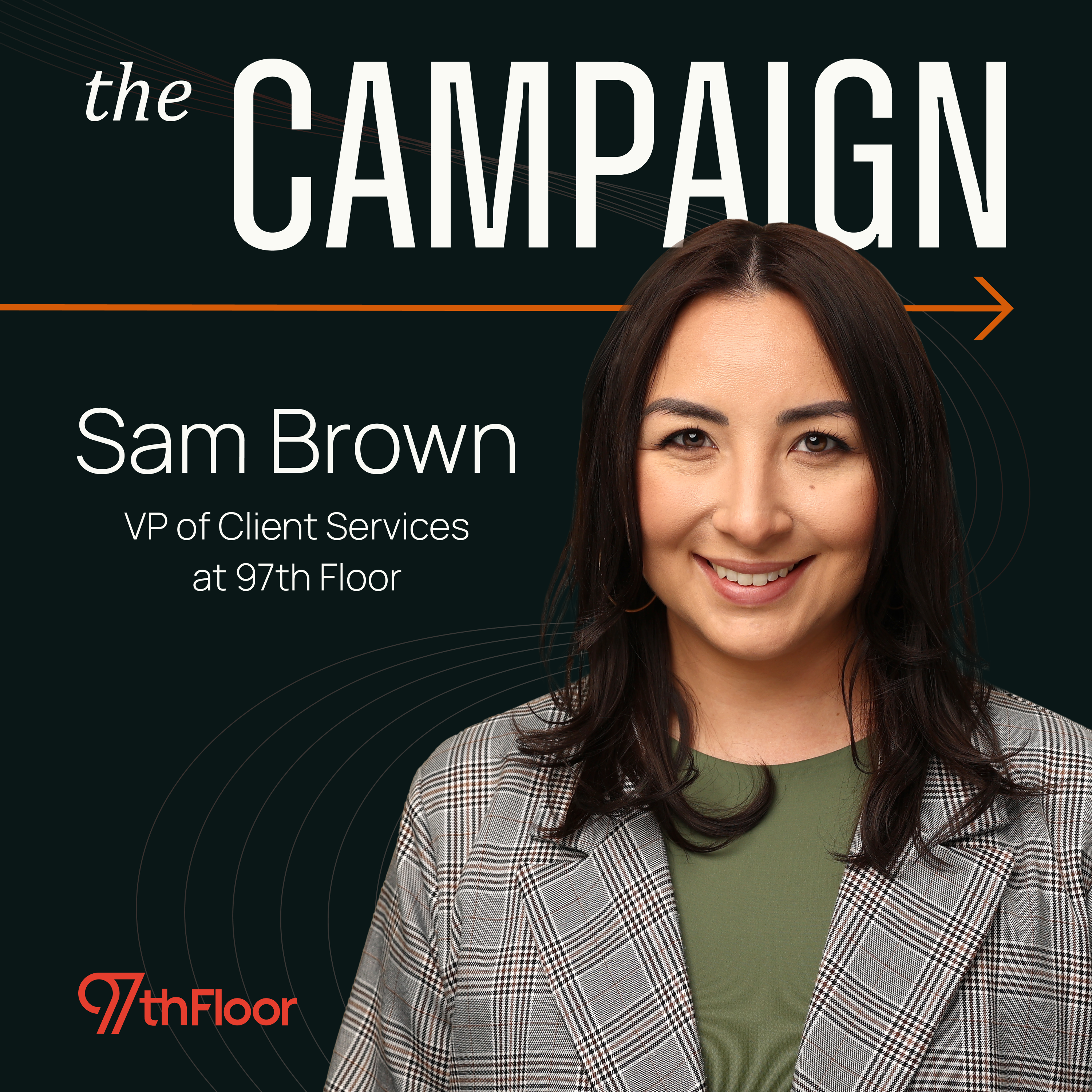
[email protected]. Today's guest is Sam Brown, VP of Client Services here at 97th Floor. Her early career was dedicated to developing and executing on results focused marketing campaigns for enterprise clients in an agency setting. In her current role at 97th floor, she leads our fulfillment teams focusing on nurturing a thriving culture, enhancing client experiences and is passionate about fostering career growth and empowering her team to reach their full potential.
In this episode we break down zero click search, the attribution problem it can create and why audience research is the foundation that holds it all together. Let's get into it. Sam, welcome on the show.
I'm excited to talk with you and I want to have you on this a lot more often.
[00:01:18] Speaker B: I was going to say it feels weird that it took so long to get me on here.
[00:01:20] Speaker A: It is weird. Yeah.
Not for lack of trying for the record.
So today we're gonna Talk about attribution 0 Click in Marketing and you have a really great insight on this with how close you are to the client work and what we're seeing across our clients. We wanna sit down and kind of hear your perspective on what the issues are and ways around those issues. So let's start with zero click first. What is zero click? I mean I think most people know but just for those that don't. What does zero click mean?
[00:01:53] Speaker B: I have this conversation with my clients weekly. Zero click is the new environment that we find ourselves in where consumers or buyers, users, anybody using the Internet is spending more time on off site research than they are on on site research. So that can be they're getting all of their information from a social post YouTube video or as most people are doing right now in any type of AI search using any type of LLM.
[00:02:19] Speaker A: I'm curious as we have been exposed to this idea of zero click and I've looked at my own behavior online and thought, oh man, I, I researched this whole subject and haven't actually visited a site. What has been your personal usage like? Have you noticed that you don't visit sites as much as you used to or do you get around it? How does that impact your own browsing behavior?
[00:02:41] Speaker B: So I search most of the time from mobile for any personal searches. So anytime I'm going to make a purchase, and even for making B2B purchases when I'm doing research, I'm still using mobile and it goes straight to AI mode. I cannot remember the last time that I clicked on an organic link that was not for work and most likely tied to one of my clients.
I've been thinking about this a lot. I also can't remember the last time I did a search that was just a one or two word phrase. Everything's a question and everything's a follow up question.
Sometimes even if I'm like searching something for the first time that day, but it's on a topic that I've already searched on recently, I go back into my AI mode, go back to that conversation just like I'm doing in my chatgpt.
[00:03:25] Speaker A: Interesting. I, I didn't even know you could do that. Yeah, I always find it. I never use AI other than Google's like AI search to learn information. I had a friend who's his son cut his knee open, he fell and like he got a big gash and he told me, hey, I was going to put hydrogen peroxide on it, but chatgpt said don't do hydrogen peroxide, use soap and water. And I was like, my mind was blown. I would never, ever, ever use ChatGPT to learn something like that. And I would never, especially for like health and wellness kind of stuff. I wouldn't use it for that. But I think more and more people are doing that today. That's beyond just like buying behavior, but it includes buying buying behavior for sure, like doing that research.
[00:04:07] Speaker B: Another thing about buying behavior and using LLMs for our search, whether it's AI mode, ChatGPT, anything, there's also a zero click ecosystem in that platform. What I mean by that is there are citations, but just speaking from my personal experience, I never actually click through to any of the citations. And unlike you, I do health searches all the time and I'm never clicking on the citations, but I'm just looking to make sure that citations that I trust so that I'm seeing the WebMD or I'm seeing Healthline and then I'm comfortable with that, but I'm not clicking through. And so one thing that we've seen a lot is people want to prioritize showing up as citations, hoping that they'll get the click through. And I'm not saying it doesn't happen ever. But it's definitely still on the rare side. Zero click is still really prominent in LLMs if you show up.
[00:05:00] Speaker A: So what are you with clients today? Like how are we nice and floor measuring success within the zero click landscape? Like, particularly with AI search specifically, you mentioned citations as being a thing that we track. Like what do we track to show that things are improving.
[00:05:19] Speaker B: Yeah. So from a numbers perspective, citations are really easy to track. You can also set up Referral channels in GA4 to make sure you can see when you're actually getting a referral from those channels. And there are plenty of clients reporting on plenty of traffic coming from those as well as revenue being driven from those referrals, which is awesome. But what we track mostly is brand mentions. That's where we put all of our efforts and that's where we're watching things the closest with the bet that if we're showing up as a brand mention for a query or for a prompt and we're coming up as like a recommendation or top provider, then our theory is that we're optimizing for that second search. So the user is doing all of their research offline, they're learning about each of the different companies and then they're performing a second search. Maybe that's direct traffic, typing in your URL. Exactly. Or doing a branded search and coming in through paid if you're bidding on your branded keywords or coming in through that organic listing. So we really view it as a critical brand awareness play and supporting the users as they're doing that research and as they're trying to make that buying decision. So those brand mentions are super important to us.
[00:06:28] Speaker A: Do you have a story in mind where we've seen work and impact in AI search having an impact on those like second searches and how we measured that?
[00:06:38] Speaker B: Yeah, we're seeing it across a lot of clients right now. One in particular that I was just looking at today, we've been seeing a steady decrease of organic traffic and a steady decrease of organic bookings, which is their conversion. However, site wide bookings is through the roof. It's doubled in a year over year period.
So even when we take seasonality into account, there's massive growth. But a lot of that is being attributed to paid. Well, what's being attributed to paid is that they're spending a lot more on brand because their brand is getting a lot more search volume. And what we're also tracking alongside this like whole story is the fact that their brand visibility and AI has increased a tremendous amount again. Our theory is we increase the brand mentions, we make sure their reputation in AI is strong. Right. So not just that they're showing up, but they're showing up as a recommendation, as a top tier company to move forward with. And that's how we're seeing it translate. So it's just, it's a huge picture that we have to be looking at where multiple channels have to share the credit versus one channel sharing the credit. And if we were to look at that differently and not look at the big picture, so only look at organic traffic decreasing and organic bookings decreasing, the story could be something with organic isn't working, but then you bring in keywords, you see keywords are increasing in ranking and again the AI visibility, and you see that organic is one piece of the puzzle. It's still a critical piece, but it's just not a channel that people are going to as frequently as they were. It's a channel that when you invest in it, such as investing in content on a website to ensure you're showing up in AI, that's translating to bottom line revenue and growth for the business, which is the most important thing in marketing.
[00:08:26] Speaker A: So I think that idea of attribution and having a more holistic view makes sense. Uh, and I think a lot of people can wrap their heads around that. However, sometimes when the rubber meets the road and it gets more like sometimes there are some practical issues with that. You know, for example, we as an agency will do, we do search, we do advertising, we do content, someone will come to us and say, hey, I need you to help improve my search. And the way I'm going to measure that success is whether or not organic traffic goes up, which I think makes sense. But what you're saying is that could introduce some problems where our work in organic search will impact paid, it will impact direct, it will impact all these other channels. So how can a marketing leader think about attribution and credit in a way that allows them to be intelligent about where budget is being allocated while still avoiding some of these siloing effects of credit within different marketing channels or even marketing people?
[00:09:28] Speaker B: I think that this presents an opportunity for us to all get really great at marketing again. And what I mean by that is, is when marketers started getting separated by specialty SEO, advertising, product performance growth, you know, pick your poison, that's when the need to separate and isolate performance became really prominent because you had all these different players and each of them needed credit. But I think that that need for credit distracted from the bottom line, which is that Marketing needs to grow your business, it needs to grow revenue.
And instead it turned into this game of how do we give credit to these people? How do we prove that they're doing well? And then that translated, I think all of us are familiar with this. That translated to SEO specialists who are still marketers, only focusing on organic traffic, no matter what the quality. And then that transition to leaders and executives saying, no, we really, really care about quality, but then still forcing them to stick to a goal around organic traffic. I mean, every week I still hear executives or marketing leaders complaining that organic traffic is not the same as it was two years ago. How do we get back there? And my question is always going to be, well, what was the quality of that organic traffic two years ago? What was the revenue of the business two years ago? And what was the conversion rate? What role did organic traffic play in that revenue? And that's not always a question that they can answer. So I think that we've gotten really, really distracted by the need for credit, and it's forced us to be worse market. Again, some ideas that I have for things that we can be doing better is for marketers to refocus on bottom line. Of course, again, that still creates this credit issue of, well, who's contributing to it? Shouldn't we all be contributing to the bottom line? And imagine a world where instead of tracking credit in that way, we are tracking outputs and then tracking the correlation of those outputs to the performance, instead of worrying about perfect attribution, which, by the way, I've worked with hundreds of companies, never seen perfect attribution, never had a point of contact who told me they trusted attribution. So that hasn't been a great model that we were relying on to begin with. So if we can blend some traditional aspects of attribution, understand that we're all focused on this bottom line performance, which is revenue growth or whatever your goal is, and then have just more discipline around tracking what initiatives you have and when they've gone live, what bets you have related to those initiatives, and then track, did that actually get us better revenue or not? Increasing that discipline, I think is where we actually need to be playing. If we talk about this idea of removing credit from specific channels, which is super limiting.
[00:12:29] Speaker A: I'm a big fan of that. I agree a lot with that. Take like 100%. Part of me wishes that some of this ambiguity leads into a new era that's more about message. It's about brand. You know, in your own example, when you're talking about doing the research and looking at citations, you're like, I don't click on them, but I look at the brands to see if I trust them. So then the question is, well, how does a new brand become one that you trust if you're not clicking right? And now we get back into the same problems that we were trying to solve before this whole attribution thing entered. Talked to these companies, and I worry that it's like a losing battle. And it's weird because I think everyone agrees, but still a losing battle. You know, I had lunch with this VC guy and I was talking about this problem of attribution. And he goes, I need to know that if I spend $1,000, that I'm going to get $2,000 back out of it. Exactly. And exactly how that happened, I was like, I think you're just leaving money on the table if you look at it in that way. So correlation, I agree. I think that's probably the best way forward. And I think if you looked at it from an expense perspective, how much time and money are being wasted seeking this perfect attribution, which is unattainable. And it becomes you get diminishing returns very quickly versus if you took all of those resources and efforts and just plunged them into building the brand, sending the right message that you know your audience will resonate with and getting stuff out, I think you'd have a bigger return, you know, but it's a hard sell, especially when budgets are tight. I think people in that fear and in the restrictive nature, that's when the desire for attribution goes up, which is odd that it's happening at the same time that the ability to attribute is going down.
[00:14:22] Speaker B: Yeah, it's totally a hard ask. And going back to what you mentioned around how ambiguity could be our opportunity to embrace this, I mean, I think it's going to force us into it. And the fact is that goal setting in any circumstance, no matter what the role, is a challenge.
It's not easy to set goals, meaning it's easy to set goals. It's not easy to set the right goals, I should say. But setting the right goals is critical to actually making sure that you're taking the right actions every day and every week to achieving that goal. And if you set a bad goal, then you're going to make the wrong bets, you're going to make the wrong investments, you're not going to do the right things. And so even though it's hard to navigate this new idea of, okay, if it's not organic traffic or if it's not organic conversions even. What does that goal need to be? And how can we get it as close to the bottom line as possible?
It's worth it. Like, it's worth taking the time as a leader to post to your team, hey, if organic traffic isn't what we should be looking at, what should we be looking at instead? And then also just revisiting that conversation all of the time.
So I view what we do moving forward as it's a leader's responsibility to ask what should we be looking at? And it's the marketer's responsibility to have an answer and to be willing to defend that answer or change that answer as needed. And the closer we can get to bottom line, the better. And what I mean by that is the journey of SEOs is like organic traffic, okay, all that traffic is terrible. Then organic conversions, which we felt so much better, but it like wasn't meaning you could still get organic conversions. Or Specifically speaking about B2B, now you'll get conversions or you'll get leads, but those leads aren't quality leads. But the SEO team is still reporting on that. So that still wasn't great. And if you're betting on that, then it's possible that you're still betting on the wrong behavior and you're still encouraging the wrong behavior. Whereas instead, if an SEO specialist or an entire marketing team focused on improving conversion rate of leads that turn to sales qualified or leads that turn into just plain old closed revenue, going to be better. Like, if they look at those metrics, and I know that it's still going to be really tough and there's still going to be arguments of credit or like placing blame on why that metric isn't improving. But the fact is, is that there's normally always a baseline that you can operate off of.
So if as long as you're operating off of that baseline and say, hey, we want to improve that, I don't really care if it's the sales team that got a lot better at their jobs or if it's the marketing team that got a lot better at their jobs. Either way, they're both focused on that number and the number's increasing. Like that's a huge win for us. So just have them focus on the bottom line and not worry about that credit as much.
[00:17:12] Speaker A: One thing that I feel like sets nice and floor apart is our focus on audience, which I'd love to hear your take. But I feel like in the more ambiguous nature of attribution and building out strategy, the audience becomes More and more of the bedrock, which is kind of how it should have always been. But if we don't know where to grasp, like grasping on our knowledge and building our knowledge of the audience is going to be what everything should be built on. We've worked hard at the agency to push that idea forward. When I get on sales calls or I talk with other people, I think it comes off as like, well, yeah, and it doesn't really land with people. And I think I don't. I'm not sure why. I think it feels a little fluffy. It can feel like, you know, we talk about like having empathy for our clients, customer and really understanding them. And you know, I'm curious your opinion one, in practice, why do you think it feels fluffy sometimes? And then in practice, I know your team has had a lot of success with that being the foundation of your strategy. So first, why do you think some people just kind of write that off when they hear it at the beginning?
[00:18:22] Speaker B: I think it's because people think they know their audience and they don't. They think that they are basing their marketing decisions off of their audience, but they don't really know them. How many times has that person actually spoken to a customer and how often are their campaigns actually being tied back to what that audience cares about most? Because the fact of the matter is, is again, because we're all driven by goals and performance, we are so in the weeds of just how to drive that number. And for a lot of our clients or even agencies and our teams, it's that number that we're focused on all of the time. And that's not usually a bottom line number. It is usually traffic leads, MQLs, maybe MQLs to SQLs, maybe even beyond that, but it's still a number.
So they think they're basing it all off of the audience and that feels like table stake to them. But it's not until you actually get into the weeds and say, okay, well if you were really thinking about your audience, your campaigns would look like this, not this.
And the keywords you're going after would look like this, not this. And so you have to be able to show them the distinction between the two rather than saying, we focus a lot on audience because everybody just feels like they're doing that.
[00:19:38] Speaker A: Yeah.
So I think the like, audience work gets a bad rap because it can be like, oh, Personas fill out these docs, they're kind of fluffy and they just sit there and don't get used. I know your team's had success with. Again, like building work on audience. Tell me a little about like what that looks like actually in the weeds. Like what are some of the tactics that you guys have had success with that stemmed from audience understanding?
[00:20:08] Speaker B: One area that we've seen a lot of success with audience research is actually generating results with Geo.
So with traditional SEO, you rely on keyword research that's only one to two word phrases. There's like a big index of that. You can see the search volume associated with those keywords. So you have a huge database to work with to figure out your strategy. That's not the case with geo. With Geo, you have to really understand your buyers intimately in order to be able to understand what questions they're asking throughout each stage of the funnel to ensure that you have content that can meet them where they're at in that journey. So that's where audience research has really come in clutch for our team because we're able to really get into the weeds and understand what questions they're asking when ways that we do that, interviews with the sales team, interviews with customers of our clients directly to understand again, what are those questions they're asking, what are their pain points, what are they worried about, what other competitors are they looking at and at what stage? And being able to have that information allows us to perform what would otherwise be guesswork. Because again, we don't have that database of information.
There are plenty of tools out there that you can use to help surface some of those questions and act as a part of like the brainstorm process. A couple of like tips and tricks that we do here is we look at Google search console and look at those long tail queries that are showing up and we check that regularly. There's a statistic out there right now and I imagine honestly that the number is even larger, which is that 15% of searches that happen every day are brand new searches that have never been searched before. To me it feels like that should be like 95% search of searches a day or brand new searches. But that's why we check those reports. We also check search terms, reports from advertising campaigns to see if we see themes coming up around those longer tail queries. But combine that with audience data and we're able to basically show up for searches that we don't even know are happening, meaning we don't have proof that they're happening. But just because there isn't any data to support 10 people search this thing this month, that doesn't matter at all anymore because people are searching differently. So there's not going to be a data set that's like 10 people search this exact question, this exact way, because everybody's changing that. And so being able to start with the audience as your foundation has led to all of these content ideas that our teams have been putting together, launching those on client sites, and then that's turning into a lot more brand mentions, not just citations, which a lot of people are tracking the actual brand mentions, where our clients are coming up as like the top recommended company for that solution, that pain point. And it's been huge in terms of translating to bottom line results and increased revenue.
[00:22:55] Speaker A: So moving forward, as ambiguity seems to continue to grow, what would you recommend to a marketing leader to get the best performance out of their team in this ambiguity? Or how would you help them make it maybe less ambiguous for the team? Like, what would you recommend to other leaders, leading teams of marketers?
[00:23:15] Speaker B: I have a little bit of a wild idea here, and it's not that wild. And it's also a little bit more in the future than being able to start this tomorrow.
But with AI being a tool that all of us can use and how quickly it is becoming more and more sophisticated, we have the opportunity to blend our roles rather than focusing on specialties we hear all the time in the industry.
Product marketers are becoming engineers, designers are becoming developers. Like, those lines are blurring in a really good way, in my opinion. And that's what I meant earlier when I said that I think that marketers have the opportunity to go back to doing really, really great marketing because I think it was the specialties that killed us a little bit. Specialties in marketing were created because there was only so much that an individual could do. Right? But now that technology is where it's at and we can blend those, I say get your team focused on those bottom line metrics, focused on revenue, or focused on some version of revenue. Again, improving the conversion rates, improving close rates, accelerating how quickly deals move through pipeline.
Because you have so much great information that are at people's fingertips using LLMs about your company. Like, those are things that you could influence if you just took the time and got creative with the goals that you're setting. Blend the roles on your team so that you don't have these people fighting for credit of like, well, I did this thing and I did this thing because it doesn't matter, that credit doesn't matter. The only thing that matters is that you have a group of marketers that understand the audience and can get that audience to move with your company can get that audience to make a buying decision.
[00:24:57] Speaker A: I love that. I love that because one, it's exciting. Like what marketer doesn't want to have a bigger impact and do more things? You know, number two, it seems like in this changing landscape, the worst thing that we could do is keep doing what we've always been doing. And those marketers that are going to say like, I am this channel and I just keep my head down and stay in this channel, they're not going to end up winning long term. And frankly, there's probably going to be new channels or maybe even ways of dividing or defining these things. And if we're not open to reforming the way things have always been done, we won't be able to take advantage of that changing landscape. So I love that.
And then obviously my mind goes to now practically, how do we do that? And I think about how do we do that at the agency? How would a leader do that? And I think that maybe remains to be answered and figured out. But I agree, I think that it's kind of the embracing of the ambiguity rather than running from it.
[00:25:55] Speaker B: Yeah. And with marketing, I think there's also a lot of room to improve on defining and taking the time to define the job to be done for that role or for that team.
So at 97th floor we have department heads and that's a role that it can be difficult to define that jobs to be done. But ultimately it comes down to our department heads support multiple departments, fulfillment, sales and marketing, with the goal of creating better client experience.
How do we measure better client experience across all of those departments? One would be measuring retention of first time contracts or measuring typical opt out, baseline opt out and lowering that number.
So it's really important to identify that jobs to be done and then we can see, okay, where can they actually influence things. So an example might be a job to be done for a marketing team might be identifying that a business's reputation needs to be improved. And the way you identify that is, okay, we have a lot of presence, but it's all negative presence. And that we believe is influencing our conversion rate. We believe that's then influencing our pipeline. Because then as you as buyers get into the pipeline, they're doing this research and they're seeing that our reputation is bad. Okay. The jobs to be done for that team is to improve reputation. And the bet that we're taking is that that improves reputation will lead to these three metrics improving. I don't think credit's difficult there because ideally your sales team is the same. So there is a baseline to work off of it and can measure that. I just think we overcomplicate it.
[00:27:30] Speaker A: Yeah. And focusing on that bottom line outcome is really all that matters in the end.
[00:27:35] Speaker B: And then you have a more unified team. So another thing that I've been thinking about a lot lately is this pain point in marketing where attribution has never been perfect, but people want the attribution and they want to give credit to one thing. Another pain point with that is it creates a lot of organizational issues internally. It makes teams work against each other rather than with each other. And nothing slows down a business's ability to grow more than that. So if we can solve this in marketing, I definitely think that there's a carryover effect to all, like how an entire organization works together.
[00:28:11] Speaker A: The culture. Yeah, the culture of the team.
Love that, Sam. So we end the podcast with the same question every time, which is who's a marketer that has had a big impact on the way you view marketing?
[00:28:26] Speaker B: Wes Ko is somebody that I follow really closely. I don't think that she would label herself as a marketer. I'm not sure of her complete history. She specializes in executive coaching. But a lot of the time, like a lot of the things that she writes about or talks about has to do with writing and persuasion and influence. All things that fall within an executive's realm. But all of those are super important to marketing. So she is who I share. Like she's probably the only person that I forward her newsletter to. Other people. I love her that much. I type her name into Spotify to find podcasts that have featured her.
Love her. So that's who I would say.
[00:29:04] Speaker A: Okay, great. Sam, thank you so much for being on.
I thought it was a great discussion. What's the best way for people to reach out to you or connect with you or follow you?
[00:29:13] Speaker B: Definitely via email is the best. Samantha97floor.com and obviously connect with me on LinkedIn.
Great.
[00:29:20] Speaker A: Thanks Sam.
That's all for today. If you enjoyed this episode, please consider leaving us a five star rating and subscribe so you don't miss future episodes. Big thank you to Sam Brown for joining us today. You can find her on LinkedIn if you want to talk more with her about attribution and zero click search. You can also find past episodes of the campaign and examples of our
[email protected] there you can learn more about the agency and get in touch with the marketing specialist to get support for your own marketing campaigns. That's it. For now. Thank you for listening. As always, keep innovating, keep converting.