Episode Transcript
[00:00:00] Speaker A: Hello everyone, I'm paxton grace, CEO of 97th floor and this is the campaign.
Thank you for joining us today for another episode of the campaign where we talk with marketing leaders about better knowing your audience, innovating beyond best practice and converting visitors into customers. The campaign is produced by 97th Floor, a world class digital marketing agency designed to build organic and paid channel strategies for mid level and enterprise organizations. You can find past episodes of the campaign on YouTube, iTunes, Spotify and a 97th floor.
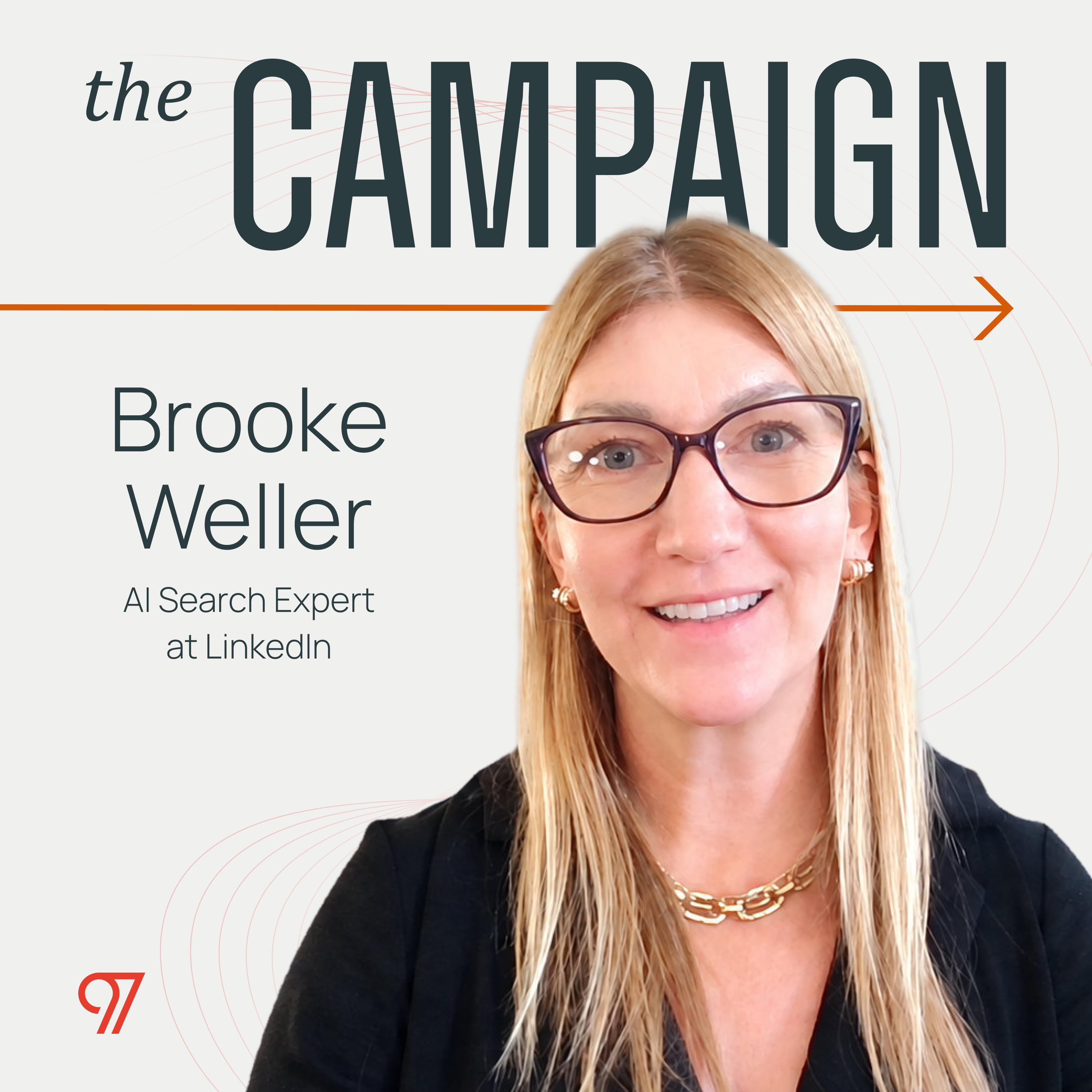
Today's guest is Brooke Weller who leads AI search at LinkedIn. She shapes how the brand shows up and gets cited across AI search platforms and trains marketers to turn AI search insights into real strategy. In this episode, Brooke is going to talk with us about some of the ways to measure the impact of AI search, some of the things that they have done to test how to improve LinkedIn's AI search strategy, and finally, what some brands can do on the LinkedIn platform to improve their own AI visibility. So let's get into it. Thank you so much, Brooke for joining us today. I'm excited to have you on and talk with you.
[00:01:04] Speaker B: Likewise, thanks for having me.
[00:01:07] Speaker A: So I'm looking forward to talking with you because you are doing something that a lot of people are doing as kind of like part of their job, but it's your whole job. I'd love to learn about how you landed in this role first and then what are some of the things that you started to tackle as you took over that job.
[00:01:24] Speaker B: Thanks, Yath. So as AI search strategist at LinkedIn, I still pinch myself that I'm in this role, to be honest, especially with a company like LinkedIn. But really I had left my agency about a year and a half ago and I, I've been in corporate America for, you know, a 9 to 5 strict across multiple agencies and brands and I just decided to go out on my own. And at that time it was right when AI search AEO geo started to become a thing and I had, I had the time to do all of the research at the same time. I had become an AI user to try to, you know, launch more clients, more small business clients on the agency side. And I was talking to everyone in the industry, I was calling people from my previous agencies and previous brands and just getting a better understanding of AI search. And one of the people that I talked to on a regular basis was Ina Meklin, who is the head of organic growth and web at LinkedIn and her and I worked together at Adobe probably 17 years ago and we just were, you know, kind of talking industry updates type stuff and she asked, you know, what about AI search, what about aeo? And I said, oh, this is what I know, this is what I've been doing. And I had told her at that point that my culmination of all of my experience across digital marketing was positioning me in an amazing place because I feel like I understand SEO through and through from a technical on page standpoint. I also understood and practice digital PR for several, several years as well as launching organic, social, paid, social, paid media. So I felt very lucky and very informed in my understanding of AI search. And as her and I continued talking, I was just helping her as a friend. She was saying, here's what we're facing at LinkedIn, here's the problems that we are butting up against with our traffic. And I was just for a long time just talking with her and I would tell her, try this, try that. She's like, we're using this tool, what do you think of that? I'm like, brand new tool, let's test it, see what's going on. And ultimately she said, I need to hire for this role. My organic growth team has a full time job, all of them, and I need to hire for the role. I even went as far to help her with the job description the whole time not thinking of myself. And then finally on a call she said, we can't find the right fit. And she was like, can you just come over? Can you do it? And at that time I really didn't want to go back to a 9 to 5. And so we worked it out in a way that I am consulting with LinkedIn and part of the team, but I also free to do my own thing which I've done a lot of thought leadership in this space since joining LinkedIn.
[00:04:09] Speaker A: Oh great. So in many ways you're kind of doing something that there hasn't yet been kind of a very clearly established playbook for. Yeah, there's a lot of overlap between SEO and AI search visibility optimization. But what were some of the things that you decided to tackle first as you landed in the role for LinkedIn?
[00:04:29] Speaker B: When I first joined, I did look at everything from the lens of an SEO. LinkedIn has several B2B web properties and products and at first it was like drinking from the fire hose, not understanding, you know, how are these websites even built, what are their technical limitations? And I started going into content and immediately I was like the new shiny object. Across all of the product teams they were asking, what do we need to be doing in AI search. And everybody at that point had kind of adopted AI search A E O G E O. And so I was advising on content at first and I was looking across the web content against specific prompts or customer intent topics and I would find that like none of the content and not to down LinkedIn at all. They had done an amazing job of on the SEO side, but there was no question and answers. There were topics that were, I could tell, meant to be built for SEO and they didn't have a ton of meat, to be honest. And so that's the first thing I noticed is I said these AI search agents are pulling in. They really want con, they don't want content, they want the microscopic details of what makes one company different than another.
And they want to answer customer questions. And so if the content on the web pages doesn't answer those questions, I figured that these AI search agents are going to go find it elsewhere and it might not be accurate. And so the first thing I tackled was content and of course hundreds of thousands of pages on LinkedIn. On the B2B side there were, you know, that was overwhelming. And so I thought I'll write a content guide, a best practices guide and then we can give it to all of the different team members and they can implement their own content with their content editors and their agencies and whomever owns content.
And upon doing that there was another guy on the team who was really technical and was starting to build with AI. And so together we built a content review system, one of the many things you can do with AI and SEO right now. And we built this content system that reviewed web pages all the way down to the schema markup and the on page alignment to topics.
We let it out into the world internally at LinkedIn and it was just a massive success. So I did focus on the SEO side and the content and kind of cleaning up what needed to be reconfigured for AI search.
[00:07:01] Speaker A: I love that. And if you can't share, this is fine. But I think one of the biggest problems that a lot of people in search are having right now is this data problem where they used to rely on a certain data set to help them ideate what kind of content they might produce. And now there are these prompts that just don't fit nicely into a keyword strategy. And there's not really, really great sources of truth around what prompts are and are not being searched. And so there's a lot of like guessing. I'd love to hear your Take in what kind of data you use to help formulate what kind of content or questions that you need to be answering, given that a lot of it's kind of opaque right now.
[00:07:44] Speaker B: Yes, at LinkedIn we are quite forensic with our measurement approach. And by that I don't mean we have the complete picture, but what I mean is that we care more about how LinkedIn shows up in the conversation and where LinkedIn is not showing up in the conversations. And so we have created a sampling of all of our prompts against specific topics that cover all, all B2B marketing topics, hiring, job recruiting related topics. So fortunately, LinkedIn has a larger budget for prompts, which is great. But we don't necessarily care as much about the overall AI visibility score because what we have seen, especially in the last couple of months, like we've seen it going up and down and up and down. And so it's harder to manage that when you're talking to your senior executives. And so what we've been trying to reframe internally is we basically made up our own AI search health score. And it's, it's an aggregate with different weighted averages on different AI search metrics. We also include referral traffic as well as how that referral traffic converts at the end of the day. And so we've built our own system that we can share out and say, here's our influence that we're having on AI search agents. And then we really care, like I said, about where LinkedIn is not showing up in the conversation, or let's say where LinkedIn is showing up in a negative light. And we've started to, over the last year and a half, we've combated so much of that from a sentiment standpoint. And then we've evolved from the owned standpoint to what's going on with our YouTube channels, what's going on with our G2 profiles, what can we improve across almost every search landscape where there's customer touch points? And that's why I think AI search is here to stay. I've recently heard, hey, AI search is a distraction, but I think AI searches repackaged digital marketing. And I like to say that I did not name it AI Search and I did not rebrand digital marketing, but the world did. And I'm here to try to measure it and try to figure out more about how the AI search agents even retrieve data and how to get into that retrieval set. And so we're looking at topic level gaps. We have a little heat map that shows, you know, where we're we're hot and where we're cold and then we just, we work backwards to develop content and content strategies. We work with third party publishers, we work with LinkedIn's partnership team. There's so many opportunities, I think out there for all brands to partner with the people they already have relationships with to get content out there across different surfaces besides just their own website.
[00:10:41] Speaker A: Yeah, that's interesting. I like that take of building your own kind of algorithm and own score to help everyone wrap their mind around what's going on rather than dealing with, you know, seven different metrics that together can show how well you're doing. I like that kind of wrapping it all together.
That point about the AI visibility score from tools I think highlights the fact that a lot of people don't really know what's going on, including these tools. And they are changing their own way of weighting it, which means any historical data becomes irrelevant. So you get this like up and down effect. I'm curious, as you've been testing things, what are some tests that you've run where the results surprised you? Or maybe if I could also twist that a little bit and say what are some tests you've run that you think run counter to what general best advice is right now? In AI search
[00:11:33] Speaker B: there was like a schema apocalypse or something like that where it was cancel culture against schema. And I know Google publicly said that we don't care about schema, but the problem with thinking in terms of the mindset of, of what is happening in the industry and just basing it, basing your strategy off of that is challenging because it was just a couple weeks later that Google said, oh, here's a guide to how to improve things. And it included schema markup.
[00:12:01] Speaker A: So
[00:12:02] Speaker B: be careful with what you're seeing on the Internet as far as what's going to move the dial and definitely put your own roadmap together based off your data and run your own isolated tests where possible when possible. But back to your question on the, the test that surprised us. So I mentioned schema because that is a huge project that my coworker Emily and I, we just rolled out and she led a lot of the technical side of that. But you know, thinking in terms of web pages not having the right schema, we had old schema on pages so cleaning things up and the results were very surprising to me because I thought that that was one of those basic check mark things that you wouldn't think mattered as much. And it did. As far as our citations and Visibility go. And then the other one was, this is kind of funny, but we saw a 4% increase in our health metrics when we added our own or updated and added our own LLMs TXT files. So that was a while ago. But those little things, I feel like it's the micro level optimizations that you can build upon that you can see results against. And then another thing that has surprised me a lot, which I haven't seen a lot of industry chatter about. I feel like I need to probably publish something or maybe you can with given all of your clients that you work with, is citation decay. So all of the AI search visibility channel or tools right now are starting to show you not only the citation decay of a given channel like YouTube or LinkedIn or Reddit, they're starting to give you citation level decay. And one of the largest surprises that we faced was we worked with our comms team to produce these, you know, more polished third party published articles and reports and we saw them peak and we were, oh, we're so smart. We got it down. We did that, we did it. Here's our AI visibility stuff and here's our lift, here's our citations. And then literally maybe two weeks later, three weeks later, it just plummeted. So and then the other strange thing we're seeing coming through on that note, that's a bit of a test shocker is publications that were written in 2019 are surfacing. So it is a bit of a cleanup game and a gamble. But we're focusing a lot on citation decay and we're trying to figure out this is an incrementality test that we're working on right now. Is there a category entity that needs to be produced and implemented and deployed at the same time as a one strategy, like a strategy versus a tactic, for example, and take that third party publication for my example. Had we also posted similar content at that Same Time on LinkedIn, on social, had we had our like executive voices talking about it at the same time, could it give that one publication a longer life is the question. We're trying to answer that
[00:15:17] Speaker A: right now.
Interesting.
That brings up another question that I'd love to hear your feedback on. We've been in search between us a long time and one of the big no nos in search is duplicate content.
And what I have not seen anyone talk about or test and I really want to test, but I have not tested yet is whether or not that has any impact in AI search results.
And the reason I'm I want to ask you is because my bigger question is LinkedIn itself is being picked up a ton and cited a ton. And so should brands be publishing content on their blog and then publish it again on LinkedIn?
And I mean, there's the classic penalty that we're trying to avoid of like duplicate content. But like, is that relevant today when it's more about like getting AI to see this information and pick it up and then cite it? I'm curious. I'm glad you
[00:16:13] Speaker B: mentioned that because it's one of my soapboxes that I stand on when people say AEO is SEO is. The rules have changed and we need to adapt to those changes. And duplicate content is one of them. I firmly believe. And I'm sure I could pull the data and we could run studies on it to prove it. But I think throw that duplicate content playbook out the window. Number one, Google AI mode now accounts for way more of the actual search experience. I think I read just last week or this week, it's like 89% is Google AI mode. And Google AI mode works very similarly to other LLMs. And they're pulling content from everywhere, not just the Google index. And the second thing is that, yes, think about the proliferation of surfaces that your customers are on and the fact that an AI agent is trying to act on behalf of your customers. And so it's going to constantly try to pull in the correct answers because it doesn't want you to leave, it doesn't want you to go to its competitor. And so it wants to be right.
And so it's pulling in all of these different surfaces and trying to build a response based on everything that it sees. If you're only writing about that on your website, I think that's limiting your citations ability. And so I would say yes, everyone, take your blog that you've written over the last decade and you're the expert in all of your topics. You're roasting coffee like a madman. Take that and turn it into LinkedIn articles. Take the LinkedIn article, turn it into seven to 10 posts, write about it on Reddit, post a video on YouTube, have your LinkedIn article link back to your YouTube and then embed that same video on your website. I think duplicate, duplicate content, please. Reuse content, repurpose content, build a content machine. You can do it with AI. Don't, don't let it all be written by AI, especially not on LinkedIn. But you know, there's ways to extend the life of a content piece.
[00:18:26] Speaker A: Love it. All right, I've been talking about this a lot I'm going to clip this, I'm going to send it to people every time they look at me like I'm crazy.
And I'm going to tell we should, we should maybe publish something and we can co author. We
[00:18:35] Speaker B: should.
[00:18:36] Speaker A: Yeah, a little something. Yeah. So there's probably a lot of people listening right now who are struggling to get mentioned by AI, like as a solution to someone's problem. In your experience, where's the best place to start? Is this normally like a technical thing where they have to look at their LMS txt file or is this a content thing? Is this an alignment thing? Like where do they start?
[00:18:57] Speaker B: So I run an AI search master class and this is outside of LinkedIn. I run a lot of mini audits is what I call it. 5. I find five things wrong that are blocking their ability to show up in responses and then I come up with five extra new strategies that they should deploy. And I will tell you, nine times out of 10 of these audits that I'm running, there's inaccurate information about brands out there coming up in responses. And if they're not coming up in their competitors, I run a brand audit because in that, in those cases it's most likely because the, the, the agents don't understand what the brand does.
And I'll use white coffee as an example. So I have a coffee company client and they do, they roast regular coffee and they roast white coffee. And if you search for what is white coffee like, sometimes the AI search agents get it right. But white coffee can describe a lot of different types of coffee. There's a white coffee in Malaysia that's an entirely different. There's a white flat coffee and then there's coffee beans that are called white coffee. And so the AI search agents just don't even know what's happening. And so a lot of the content that this company has to put out is literally what is white coffee. It is not this, this, this and this. When we talk about white coffee, we mean this. And it's like very prescriptive. And you wouldn't really think that a blog about what is white coffee would be successful, but that's the number one thing getting picked up by AI search agents for them. So I talked to a lot of brands that just, they're using so much jargon in the way that they talk about themselves. AI search agents don't really like or care for any of that fluff. And you can see that for your own brand if you look at Microsoft Clarity, which is like a first party tool, it's your data. It's not like profound or a peak AI.
And you can look to see what those grounding queries are. And so if you're typing in my fancy marketing, you know, the marketing jargon that's out there and synergistic integrations, especially with AI right now, you'll see that the AI agents look at that whole big mess and they truncate it down to like five words and then they go and they search their index. So if they don't understand what your brand stands for, they can't truncate it into a grounding query. And if they do, they're going to get it wrong. And then what they bring back is not going to be your brand, it's going to be something else.
[00:21:35] Speaker A: Okay, I love that. That's, that's great advice. So the alignment is really where to focus first. And there's also most multiple benefits to alignment, like really outside of AI search, like getting your brand aligned and helping people understand who you are, what you do, who you're for. There's tons of benefit in there.
So I'm going to ask you another question that I would guess is probably the number one most asked question of anyone who works or has ever worked at LinkedIn, which is how often should I post, what should I post about, what kinds, what should my strategy be? And I want to do this with an AI twist. So LinkedIn is again, it's becoming one of the most cited sites which incentivizes people to go and share content on there. So if you want to improve your AI visibility via content on LinkedIn, what are some tips that you would offer to people as they build out their content strategy on LinkedIn?
[00:22:30] Speaker B: Okay, again, I could be very long winded or I can be straight to the point. We just published a guide A e O for LinkedIn, how to get sighted and why. And I'm so proud of the LinkedIn Thought Leadership Team because we wrote that we on the organic growth team inside of AI search, running the experiments using LinkedIn as one of our channels ourselves, we wrote that based off of thousands and thousands and thousands of posts being reviewed and we figured out what works and what didn't work. And I'm so proud of the team because they didn't add fluff to it. They don't have any objective other than to just help people write better content on LinkedIn with the likelihood of being cited by AI search agents. And Google, Google is pulling LinkedIn like crazy right now in their, in their, like what's happening. What's the news? What are people talking about? Thumbnails. Search features. But I would say we are seeing articles cited more than we are seeing posts. Posts and articles are being cited. I'm about to publish on Search Engine Land, kind of a technical SEO guide to LinkedIn, like what's actually being crawled or retrieved, which can help people build out things like your profile, your tagline on your profile. My best advice for individuals is to make sure all of that aligns again, like alignment. Make sure your service section, your about you section, your tagline, your image. Make sure you know the things you say about the job that you do. Make sure all of that rolls into like one role. I have that problem myself. I do multiple different things. And so I really had to narrow it into this AI search world because that's what I want to be known for by the search agents and humans. And I would say there's, there's some things that we tested with articles around word count. The bullets work. I mean, LinkedIn articles is very similar to optimizing your blogs like old school SEO. So think of it as an extension of your own content when you're writing for LinkedIn. And then one hack that we found when we were testing, I was taking content. And also, by the way, if you want to show up for AI search, make sure your content matches the prompts you're trying to track. If you do your own experiments.
I look at a lot of customer data as far as like analyzing their posts to see if they were cited. And a lot of times they're writing about something like, here's our summer special.
And then they are like, we're not showing up in AI search. Well, you're not showing up in AI search for the professional query that your buyers are asking because you're over here posting about your summer special or something unrelated. So make sure to think about that in terms of your business objectives and write content that, number one, you're an expert in. Number two, you have a unique pov.
And number three, that you could talk about it without the use of AI. I think that's important too, to be really authentic. And that to me is probably the best advice I can give somebody because I've seen it work and I've seen it work very well.
[00:25:39] Speaker A: Your research found that individual pages perform better than company pages.
What should companies be doing with their company pages? Given that fact,
[00:25:49] Speaker B: I would make sure that the company pages have accurate information and it doesn't have outdated information about services and employees or has really old posts I would give it a refresh. I wouldn't spend all day on it. In my opinion, I would have your voices within your company. Doesn't have to be a senior executive. It can be somebody that's junior. That's the best part about the democratized world of AI search is that I can post. And now I have more followers than before. But when I was posting at 2,600 followers, I was still getting cited when we first did the testing. And so anyone can post about something. And I recommend, like I said, content entity. So here's my category. This person's posting, this person's posting. A little bit of a variation of it, but don't stray too far outside of what you want to be known for.
[00:26:43] Speaker A: Okay, I like that. There's also some stuff in your research that talks about original editorial content that AI loves to cite.
And I think that's pretty well documented that, you know, new things or fresh takes. I'm curious, like, based on your experience, what makes content original, quote unquote, in the eyes of these LLMs, to encourage that citation? Is it about combination of words? Is it about unique numbers and actual data? Like, what. What are you seeing as the thing to raise the flag? This is original content.
[00:27:17] Speaker B: I think data is really important. The statistics become stale very quickly in the world of AI search. And having data points is very valuable.
Think about it in terms of, like, what customers are looking for as well. We still have a lot of awesome studies that were done on LinkedIn, but they were done in early 2026 or late 2025. And, you know, it's like the content engine has this insatiable desire for new content. And so we need to be publishing new studies. We need to be putting more things out there to stay relevant against, you know, what other people are publishing. So there is a relative differential there within your own space. So knowing what your competitors are talking about and then trying to figure out what your unique selling proposition is, I think that's one way to get original data. The other thing that I would give advice to people is there's probably a lot of old ladies like me in your company or people that are older that have a lot of knowledge about your company, about the industry, like, you know, talk to them, interview them, get, get their individual pov, because if they haven't said it online or they haven't written extensive blogs or a book about themselves and their experience and their point of view, then AI agents don't have that yet. And so I would recommend that people interview within their company, their founders, understanding the story and get that content out there, because it doesn't have it yet.
So that's another way. And then one last thing I'll say is there's a lot of survey companies out there that don't cost an arm and a leg. And you can run valuable surveys that are valuable to your customers, and you can produce statistics from those surveys. And it's not a huge lift. Like, you know, we surveyed 100 people or 500 people, and we asked them these five questions about this topic, and this was their response. That's the kind of new content I think AI search agents like to pull in.
[00:29:19] Speaker A: I love that.
Yeah, I'm a big fan of that. I'm not sure if I agree with this classification of you as an old lady, but I do love this take of ways to produce some original research and content. I think that's awesome. So to wrap up, one thing that I think is tripping up a lot of people in this industry is, you know, there's a lot of factors going into what is showing up. And many of us don't come from research backgrounds.
And, you know, running a test sometimes means, like, I think we get, like, false confirmations when it's like, hey, I did this and this happened. Therefore, because I did this, this happened when it's like, actually, those two things are completely unrelated. Do you have best practice for people who are trying to figure out what does and doesn't have an impact as you're running tests in LinkedIn? Like, what do you try to have in place either before measurement or rubrics for, like, what does and does not qualify? Successful tests? I'd love to hear how you think about testing.
[00:30:18] Speaker B: So I at LinkedIn am fortunate to have a STRAT team that does a lot of our analysis for us when it comes to testing. But I will say that rumors can spread very quickly. And if we say something worked, especially with multiple BU's, there's like one BU, we test something small and we say, oh, this worked in for this bu, for this topic, for this. Like, this is the confines of like a small moment. And then, you know, every BU in the company wants to test it or wants to roll it out. And so we have to pump the brakes and say, this was a great indication of a success, but let's now make it a true, accurate test that we test against, like, real testing, rigorous. Um, so I feel like, yeah, I hear what you're saying on that as well. And again, sometimes results can be instantaneous on AI search, you can publish something, or you can change something on your website and see results, but then maybe seven days later, those results aren't coming up anymore. So you have to be really careful about saying, like, I know this is going to work, even though I just said that a minute ago about LinkedIn articles, be careful about saying that. And for anybody internal in a company that is, you know, trying to A, keep their job and B, be impactful for the company, I would say it's not necessarily about finding what works all the time. It's about having a nice testing roadmap. And maybe testing isn't the right word. Having a roadmap, going through an audit and saying, here's the five, 10 places, like, we're not showing up and here's what I think is the reason why. And just actively trying to fill those gaps and then present it to your stakeholders as, hey, these are the things that we did. Here's how it might have moved the needle. But yeah, AI search is tough. We don't have the whole universe of prompts. So if you're trying to have content show up for one prompt because your competitor's showing up for it, you might be changing content and missing out on another prompt. So it's a challenge. Definitely.
[00:32:24] Speaker A: Yeah. That's some good advice though, around, you know, not following just the initial result, but then testing and verifying that, that does have an impact. I think that's a. That's a great place to wrap up. Brooke, thank you so much for taking the time to join us today. I think you've laid out some really helpful information and some good directions for people to go. If listeners want to learn more about you, learn more about what you're up to. Where should they go? How can they connect with you?
[00:32:48] Speaker B: Connect with me on LinkedIn 100%. I'm really active on LinkedIn. Obviously it's part of my role. DM me there. We can ch. I also have a free school community, which is school learnai search. And the more the merrier. We post a lot about industry updates. What's going on, my point of view. And again, I'll run your little mini audits for people if they want them.
[00:33:12] Speaker A: Very cool. Okay, great. Well, thank you for sharing that. Thank you for joining us today. It's been a pleasure talking with you.
[00:33:17] Speaker B: Yeah, thank you for having me.
[00:33:19] Speaker A: That's it for today, everybody. Thank you for joining us. If you like this episode, please consider leaving us a five star rating and subscribe so you don't miss future episodes. Big thank you to Brooke Weller for joining us today. You can find her on LinkedIn and join her AI search community at skool.com that's S K-O-O-L dot com. You can also find past episodes of the campaign and examples of our work at 97th floor.com. there you can learn more about the agency and get in touch with a marketing specialist to support your own campaigns. That's all for now. Thank you for listening. As always, keep innovating, keep converting. Thanks.
It.