[00:00:00] Speaker A: Hello everyone. I'm paxton gray, CEO of 97th floor and this is the campaign.
Thank you for joining us today for another episode of the Campaign where we talk with marketing leaders about better knowing your audience, innovating beyond best practice, and converting visitors into customers.
The Campaign is produced by 97th Floor, a digital marketing agency designed to build world class organic and paid channel strategies for mid level and enterprise organizations. You can find past episodes of the campaign on YouTube, iTunes, Spotify
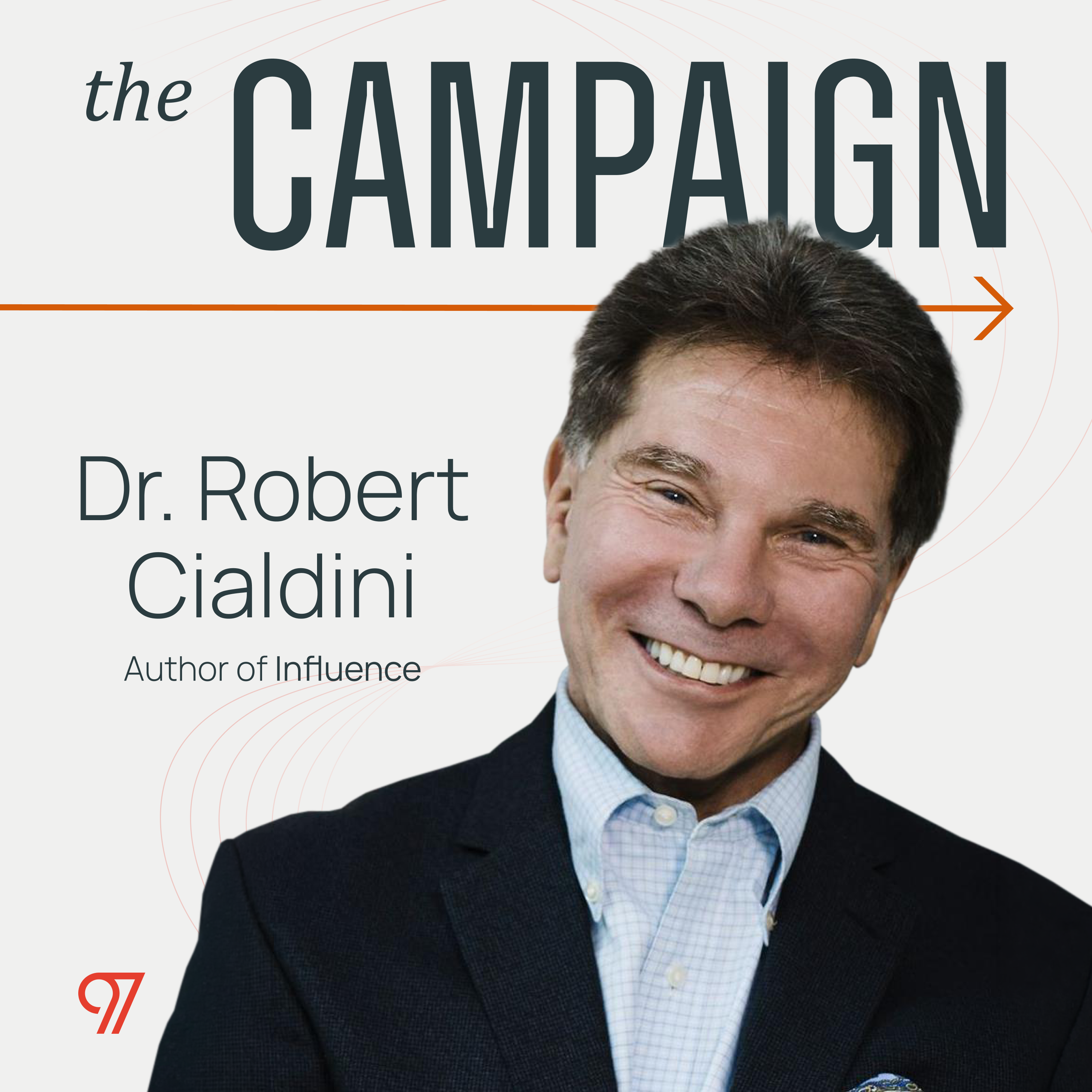
[email protected] Today's guest is Dr. Robert Cialdini, a thought leader in the field of influence and persuasion. He has spent his career publishing scientific research on what causes people to say yes to requests. The results of his research articles and his New York Times bestselling books have led to his election and to the National Academy of Sciences and the American Academy of Arts and Science.
His seven principles of persuasion have helped multiple organizations grow their influence ethically. In this episode, Dr. Robert Cialdini gets into how his principles of influence apply in the age of AI, what marketers consistently misunderstand about authority and how to be more persuasive without crossing ethical lines. Let's get into it. All right. Dr. Cialdini, so great to have you join us today. I have to say I've been looking forward to meeting with you and getting a chance to to ask you some questions based off of all your research and and your writings. Thank you for joining us.
[00:01:31] Speaker B: Well, I'm looking forward to the opportunity to interact on these topics.
[00:01:36] Speaker A: As I was preparing for this, I was thinking what are some of the questions that I could ask Dr. Cialdini today that the Dr. Cialdini of 20 years ago could not answer. One of those questions is tell me about the impact of all your writing and all your publications. What have you seen happen? Because what you've done is really foundational to sales and marketing and beyond. I'd love to hear what have you seen change in the world because of what you've put out there?
[00:02:05] Speaker B: I think what I've seen is that somehow the information about the seven principles of influence has become more popular. Even though the book that I first wrote about it was quite a few years old. The citation rate is going up and I think I could explain that in terms of the rise of AI and technological ways of moving people in our directions and people trying to see how they might best fit those principles of human behavior into the patterns that you will hear in response to a request for information from a bot or an AI agent or one or another LLM.
Those Those questions being integrated into the kind of responding that you get has caused a lot of people to say, well, how do we best ask that question so that we get the best response from this new source of information about how we present something, the style we use, and of course the content that we present.
[00:03:16] Speaker A: So, you know, influence, like I was saying, is so foundational, I think, to everything in marketing, to the point where, as you say, AI knows the principles, AI knows the content.
And I want to know, how do you feel about that? Are you happy that that's just spreading more of the message, or do you feel a sense of, hey, listen, this is meant for humans, it's not meant to be scraped and, you know, and, and then distributed that way.
[00:03:44] Speaker B: I'm not opposed to enhancing the effectiveness of a persuader, provided that the work that's being employed arranges for an ethical use of those principles of influence. Otherwise people aren't going to return to us. If they haven't had a good experience, if their outcomes haven't been properly appreciated and attended to by the communicator in giving them information that leads them in proper directions, then they're unlikely to want to come back to that communicator or that route. So we have to lace whatever we provide, including that which comes from technological systems with an ethical component, to make sure that this is something that allows for both sides to derive positive outcomes.
[00:04:39] Speaker A: You've drawn a lot in interviews that you've done this clear distinction between ethical influence and manipulation.
Over the course of your career, do you feel like AI is making that line harder or easier to hold, or is it simply just amplifying intent?
[00:04:56] Speaker B: No, it's just, it's making it harder to hold. When I think about what the best way for a communicator to determine what persuasive appeal is going to be optimal. It's not simply to ask the question of the model, well, what can I do here that will best sway that individual in my direction?
It's to add the addendum according to the best research on the topic, that narrows the band of information that you're going to be getting right? Because the AI is preloaded not just with research, it's preloaded with opinions and speculations and hunches that people have written about in, in their own works. It takes a look at all of that information, even the stuff that's just not true, just based on a one time example that somebody remembers or misremembers even. It's, it's the gold standard which is properly conducted Properly controlled research that allows us to say with confidence, this is the causal factor that's likely to be successful in this particular situation in bringing about ascent to a request.
[00:06:19] Speaker A: Is there any of your principles, either from the seven principles or just something from your writing that you've seen people latch onto and, and maybe take it in a different direction, that you're like, wait, you haven't fully grasped this yet, that you would love to like, set people straight on, hey, this isn't the proper application of whatever this principle is or this, this idea, right?
[00:06:41] Speaker B: I think the, the place I see it most often is in the principle of authority, where people don't make a proper distinction between being in authority versus being an authority.
And being in authority is a matter of power. You can coerce or you can bribe or you can penalize or you can push or draw people in a particular direction. But it doesn't last that people don't like being pushed around. They don't like being the, the object of a power maneuver with them as the subject.
And so when you're not around, if you don't have that, that ability to exercise your authority over them.
The other principle, the other way of thinking about authority is being in authority. Being in authority, excuse me, being someone whose knowledge and experience and expertise they can rely on to make a good choice and that person's advice will stay with them even if that person isn't there any longer to implement that advice. That's the thing. The difference between power and persuasion is in being an authority. For persuasion versus being in authority. People make that mistake, especially inside organizations, managers, team leaders, executives, and so on make that mistake. And I think that's the one I see most often in my own observations
[00:08:16] Speaker A: is being an authority. Is it all about what you know? Is that how you amplify?
[00:08:23] Speaker B: Yeah, that's really a good question because it's about that and one other factor. It's about your perceived competence, experience, know how, and so on. That allows people to say, well, I want to listen to this person because this person is going to reduce my uncertainty about what's the best thing to do here. This is an expert on that topic. So that's the one thing. And the second is trustworthiness of that expert information.
Your credibility is determined by your expertise on the one hand and your trustworthiness on the other. And so being an authority isn't just the knowledge and the experience and the credentials you have. It's the perception that you're not trying to line your own pockets with this expert information. You're giving out, but you are trying to accurately depict reality for your audience with that expert information. If you can get those two things operating in concert, no one can beat you as an authority communicator around the world. That's what we found.
[00:09:36] Speaker A: I heard this quote recently, the world won't trust you until you trust you. And I'm curious, in your research, have you run across people who, in terms of this authority, they know what they're talking about, they're trustworthy, but they haven't yet built that self confidence. And how does that relate to these principles of influence where it's like they do check those boxes, but they just doubt themselves and that detracts from their ability to influence.
[00:10:05] Speaker B: Yeah, you've put your finger on something with the word confidence. Because what the research shows is that people who, who portray and who deliver a sense of self confidence on a topic are more persuasive, holding constant what they say. It's not just about the facts, it's about the perception of you as being knowledgeable about those facts to the point of being self confident in your presentation of them. So the thing that you can find, for example, if you are that person, you do know these positives and negatives about the topic that you're, you're considering, but you're not projecting as well as you should be. There's a small behavioral device you can use to increase that perception. You increase your rate of speaking by like 20 to 25%.
Not a lot.
That's enough to cause people to perceive that what you are saying is something you're not having to question yourself about.
So you can practice that.
[00:11:15] Speaker A: Yeah, that's a good tip. Speak, speak a little bit faster. In your experience, what, what are you seeing right now? Like is the biggest gap between what the science is actually says, influences people and what you see marketers doing.
[00:11:30] Speaker B: So here's what I think it is.
It's asking themselves an initial question which is what do I know works on persuading people in the kind of situations that we're in and it could be based on research versus what do I know works to persuade people in this situation.
That's an inherent part of this situation.
That is if I know scarcity and urgency. Is scarcity and urgency a genuine feature of this situation?
That's the one I should use.
How about social proof that I've got a big market share or a trend in my direction, Is that true? That's the one I use. How about if I've got a lot of experts who have testified in my behalf that, that my product or service is a worthwhile one. If that's true, that's the one that you bring. So I just had a, an email exchange with a woman who had finished a large scale training her company had with a big customer, hundreds of people, managers, and they were, were trained in the seven principles of influence and asked to employ them.
And at the end of the experience they did get the kinds of changes they were hoping for, but almost always to a greater extent. If the principle that was being used by the manager was one that was inherent in the situation, all they had to do was point to it. And that was so much more effective then constructing a situation so that there was scarcity or a rush or urgency or something and that always would win the day.
So that's the one. I, I would say think of those, the principles of influence you know about, they don't have to be my principles of influence and ask if they're truly present in the situation.
That not only allows you to be effective when you point to it and raise it to consciousness so that it can take flight, it makes you ethical.
Yeah, yeah. You haven't fooled anybody. You haven't coerced anything. You've informed them into ascent. Both sides win under those circumstances and people really appreciate that. Yeah.
[00:14:15] Speaker A: So the act now there's only three left or you only have seven minutes to book this thing. Where does that sit?
[00:14:25] Speaker B: If it's true? If you have real time constraints where you have to get something sold by a certain time or only a limited number of items and so on.
Bring that to the surface.
There was a study of 6,700 online commercial sites where they looked at factors that worked. If you included one this factor, you got more conversions than if you took it away. And I'm happy to say those that were at the top were the principles of influence. But of those at the top was scarcity, true urgency, true dwindling availability. And by the way, what they found is what other research has found. Limited number works more powerfully than limited time to make a choice because of that component of rivalry that exists within limited number appeals that doesn't appear in limited time appeals. If you have a choice, choose limited number.
[00:15:31] Speaker A: I love that. I heard in another interview you talk about a McDonald's study. Is that something that you could share here?
[00:15:39] Speaker B: Yeah, it was a study done in the countries of Colombia and Brazil.
McDonald's locations there and they did something that I thought really applies to the rule for reciprocation that says people Want to say yes to those they owe. Which means that we need to give people benefits and advantages and information and effort first, not after they've signed the contract and say, oh, that's a nice thing. Now here, let me give you a reward for being one of us. Or at the end of an exchange, providing a nice reward, do it before they decide, which makes them more likely to decide. Here's the study.
For one week, every family that came into one of these McDonald's, each child was given a balloon. For half of the families, they were given a balloon as they left as a nice thank you gift for frequenting McDonald's. The other half were given a balloon as they entered. And Those parents bought 25% more food. They had been given something first.
They were grateful, there was an obligation to be filled. Oh, well, I have to give back.
If you give something to my child, you have given something to me.
[00:17:04] Speaker A: So where do you think brands today could look at the reciprocity, especially with that in mind, where it's like, give early. Does it matter what it is? Or does the context matter? Does its relation to your offering matter?
[00:17:21] Speaker B: Yeah, it does. So for example, at another fast food chain, there was a study done where people waiting in line for their order were given either a nice cup of yogurt while they were waiting, the other people got a nice key ring, about the same price as that cup of yogurt. Economists would say those people who got the yogurt would buy less food because they already had some. The opposite happened because why do people go to a restaurant because they're hungry? If you give something that's tailored to their current situation, they appreciate it more. And that's what happened in, in those that fast food restaurant. So what I always say about the rule for reciprocity is what you give first should be something that is meaningful to them, is tailored to their particular situation, and is unexpected there. Then they say, wow, these people really care about me. I didn't expect to get this on what I am here for. And it's meaningful because it helps me solve my particular state of hunger that I'm in at the time in this situation. And by the way, another thing is just giving information that would be valuable to somebody in this particular arena. So let's say you work in financial services. The first thing you could do is send them a piece of information about what to look out for in making choices among financial instruments of one sort or another, what mistakes that people make. Right? Not directed toward your company, just a general piece of information that they're interested in because otherwise they wouldn't be there looking for financial services. Give them a tip sheet.
Right. To start out with. They'll feel grateful and they'll feel that you have just demonstrated your knowledge on the topic.
[00:19:30] Speaker A: Yeah.
Throughout these years, do you feel like as culture has shifted, do you feel like human psychology has changed to the point where some of these principles become more or less effective over time? Or do you feel like these are foundational to the way the human brain works? And no matter what technology comes and goes, perhaps how we apply the principles might change. But these are how we function as humans.
[00:19:59] Speaker B: I'm going to choose that one.
But I am going to say that certain kinds of technologies allow particular principles to be more accessible to us to, to use. So social proof is the example that we follow the lead of what those around us, like us, are doing or have been doing in a particular situation.
Well, in the old days before the Internet, we didn't know what a lot of people.
Now we can look on, we can see star ratings, we can see, we can see all kinds of opinions and feedback and groups that have correspond with one another on a particular topic. We get that information from a few clicks. So we can get social proof anywhere easily. And that's the one that's going to work I think very powerfully because people can access it so well. So one of the things we have to be sure, sure we do, is to tell others those people were interested what other people like them have said or done with regard to your product, how, what kind of ratings they've given, how many stars, what comments they've provided, what testimonials they've agreed to let you use, and so on. But here's the little deviation from that. Instead of saying we have just. In the last year 255 star reviews, say in the last year we've had 255 star reviewers. Think of the different images you put in somebody's mind.
Reviews, things just pieces of check marks, star rating, pieces of paper, reviewers.
That's 250 people like me.
That image is the one that you ought to be employing for social proof.
It's people, it's not check marks. Check marks are easily done and even faked. But if you have the image of a group of 250 people, that's going to be compelling.
[00:22:25] Speaker A: Yeah, we've, we've read your book as part of our, our book club here at 97th floor and I'm curious what you would like, you know, if, if marketers could walk away changing the way they think about one thing.
What would be, especially right now in this somewhat pivotal time, what would be like one thing that you would want them to walk away knowing or changing the way they think about?
[00:22:51] Speaker B: Because we have experienced enormous growth in technology that we use in our lives. We work in front of a screen, we shop in front of a screen, we entertain ourselves in front of a screen. We're being separated from one another by this technology and we are hungry for connection, human connection.
So the one thing I would recommend people try to do in their appeals is humanize them.
So remember I was telling you about this study of 6700 commercial websites where they were trying to increase conversions. If they put a welcoming statement on the landing page, they got significantly more conversions before people read a word because there was a warm welcome of approval. And we're looking for that now. It's getting stripped out of our interactions. We don't have the same human connections as we do. So everything you could do to create that connection with, build it into those technological devices and, and, and, and, and approaches to communicating, build it in.
So for example, there's a study that was shown of hospital radiologists who were given a, a scan images of a patient, right? And they had to judge and evaluate it and make recommendations about future tests or, or strategies to take given this image. If they were given the patient's picture next to the image, they gave three times more recommendations.
There's a person there.
And that humanity is very powerful for us.
You know, when I, when I send emails, I don't just have my name at the bottom of the email, I have my picture at the bottom. So people know there's a person here. It's not just some typing some font on an email screen. No, there's a person. Speaking of emails, do you know that if you make the same request by email as in person, you're 16 times more likely to get a cent in person than on email? Because an email is the most bloodless communication path we've ever developed. No, no. So if email is a great way to send information, it's not a great way to get a cent.
People are looking for connection there.
Now you can't go to everybody's office if you can do that.
But you know how you reduce the ratio from 16 to 1 times more effect, right? Make a video call and that reduces it to 2 to 1.
Now a face to face interaction is only twice as effective, not 16 times more effective. So again, we use existing communication strategies, but we Build humanity into them.
The more that we can do of that, the more successful we will be.
[00:26:33] Speaker A: It's a great takeaway especially, I mean we've got the loneliness epidemic and it's only growing.
[00:26:41] Speaker B: You're exactly right.
[00:26:44] Speaker A: Seems like there's a correlation between the growth of technology and communications and the growth of loneliness. I'd love to end these episodes by asking about who has had problems, perhaps the biggest impact on the way that you think about marketing.
[00:27:01] Speaker B: Yeah, that's a good question. And I, I would have to say that I'm not going to give you an answer about a marketer per se, but someone who has redefined how I have to think about marketing. And that is Daniel Kahneman, the Nobel Prize winner in economics of a few years ago. He was asked if there's one thing that you think people would be well advised to know in order to direct their choices going forward, what would it be? And he said nothing is as important as you think it is while you are thinking about it.
That is the idea of focusing on something, on thinking about something gives it more impact and importance in your mind. So this is the whole concept of pre suasion that I wrote a separate book about where what you focus people on before your message, that is that when they encounter your method, message will be found there. Let's say it's scarcity or urgency, right? If you first focus them on the idea of scarcity, then when they get to your message it's more important to them. It's been made, it's been raised in consciousness.
So Norwegian Cruise Line sent out emails about an offer they had that was time limited. It was only for a particular number of days.
If the emails had two small ticking clock emojis in the subject line, 16% more people bought the package because they had been focused on time and dwindling availability and scarcity. A time limited offer, then when they encountered it, time was more important to them. So that's the whole idea that he also raised to my consciousness. And I researched enough to write a book on what do you do before you send your message that increases its acceptance before you send it, before people have experienced your message?
[00:29:16] Speaker A: I love that. Yeah, he did a lot of great things and I think those that that research is, is fantastic. The book Thinking Fast, thinking Slow I think is remarkable.
Anyway, yeah, thank you for, for bringing that up. Dr. Cialdini, thank you so much for taking the time to, to meet and share your your thoughts.
[00:29:37] Speaker B: Well, I've enjoyed our interaction, I have to say.
[00:29:41] Speaker A: Likewise. So tell us about what you're working on today. Where can we send people to see, see what you're doing?
[00:29:47] Speaker B: Yeah, we have a new company called, it's called the Cialdini Institute and it helps people determine how to be more effective and persuasive and ethical at the same time. So what are the, what are the research based findings that tell you how to become more convincing and how to do it in, in ways that are never unethical? People can find
[email protected] okay, great.
[00:30:13] Speaker A: Yeah. And we'll, we'll be sure to link that in the show notes as well.
Thank you so much for, for taking the time. It's been a pleasure.
[00:30:19] Speaker B: So long for now.
[00:30:21] Speaker A: That's it for today everybody. If you enjoyed this episode, please consider leaving us a five star rating and subscribe so you don't miss future episodes. Huge thank you. Thank you to Dr. Robert Cialdini for joining us today. You can learn more about his work for the cialdini
[email protected] that's cialdini.com you can find past episodes of the campaign and examples of our
[email protected] there you can learn more about the agency and get in touch with a marketing specialist to get support for your own marketing campaigns. That's it for now. Thank you for listening. As always, keep innovating, keep converting.