[00:00:00] Speaker A: Hello everyone, I'm paxton gray, CEO of 97th floor and this is the campaign.
Thank you for joining us today for another episode of the campaign where we talk with marketing leaders about better knowing your audience, innovating beyond best practice and converting visitors into customers. The campaign is produced by 97th Floor, a world class digital marketing agency designed to build organic and paid channel strategies for mid level and enterprise organizations. You can find past episodes of the campaign on YouTube, iTunes, Spotify
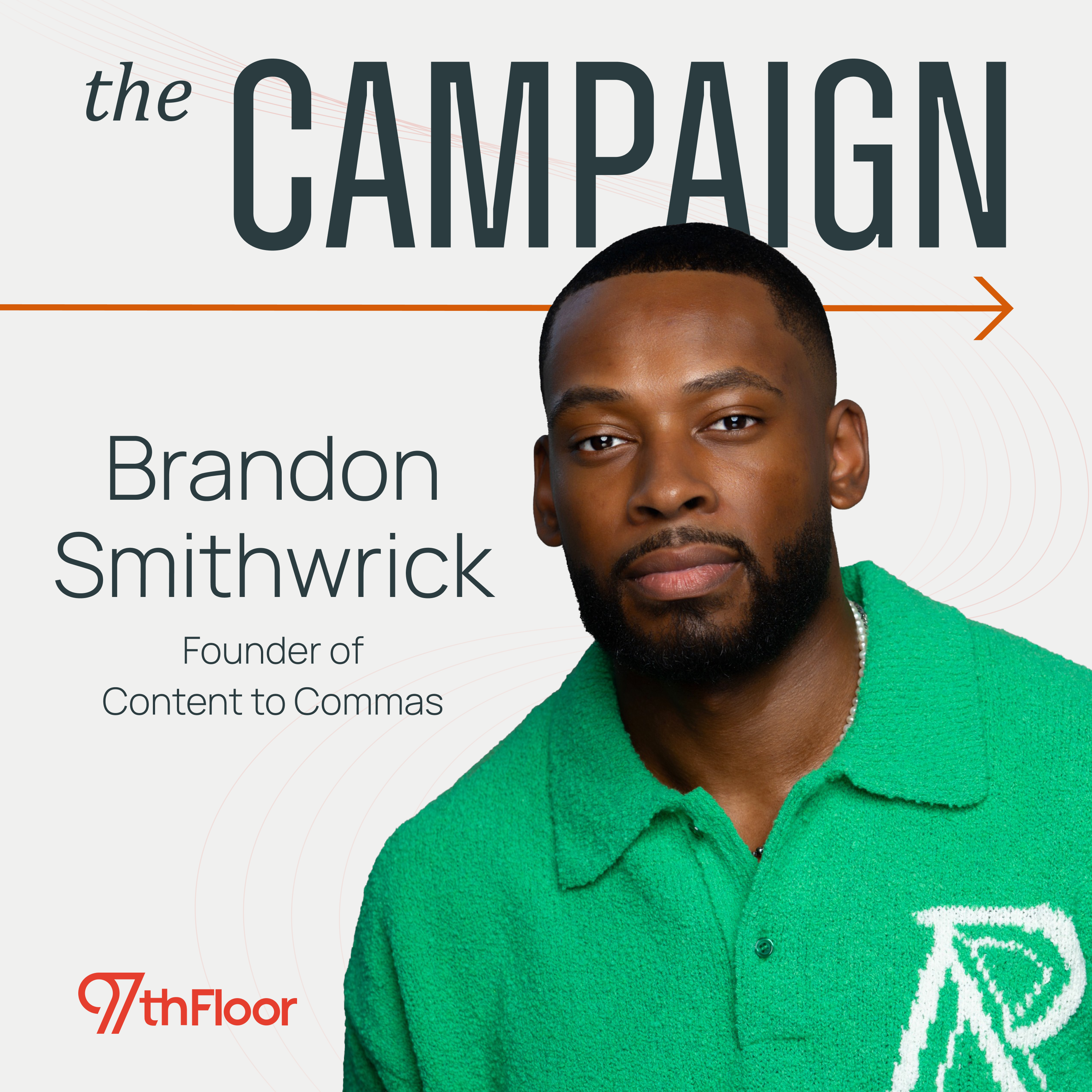
[email protected]. Today's guest is Brandon Smithrick. Brandon is an award winning marketer and creator of Content to Commas, a weekly newsletter sharing content playbooks for founders and entrepreneurs.
He has been named Forbes 30 under 30 for marketing and advertising and has had his work featured in Adweek, Fast Company, Adage and Complex.
In this episode, Brandon breaks down building a personal brand that actually gets you hired, developing a strong point of view even when you feel like you have nothing to say, and how to turn your social media scrolling into intentional research. Let's get into it. Hey Brandon, thank you so much for joining us today.
[00:01:09] Speaker B: No worries. Thank you so much for having me. Pax.
[00:01:11] Speaker A: Yeah, I'm really excited to dive in personal branding and building out content for that. I think it's something that so many people want to do but a lot of people get hung up on. Could you walk us through your story with building a personal brand? Where did that start and what were some of the first things that you did where you started to have success?
[00:01:31] Speaker B: Yeah, so actually it's a unusual start, I'll say. So basically I went to school for fashion. Actually I didn't study marketing, which is the field I've worked in my entire career. But I was sitting at graduation and I literally saw like the thousands of students in like the audience. I'm just like, oh, this is. And maybe it's like a competitive thing, but this is my competition. Like, we all just graduated and in the fashion world we're all going like the same big name companies in New York, right. We want Calvin Klein, Tommy Hilfiger, Nordstrom. Like everyone's really going after like four types of roles, whether you want to be a buyer and be a merchant. This is like retail was so big. It's like visual merchandising. Right. And I was just like, what's going to set me apart? So in very simple terms, my goal was when people think of X, I want them to think of me. And my ex at the time was fashion. Like when people think of fashion, I want them to think of me.
So whether that was through Instagram content or whether that was through going to an event, I wanted to make sure that when people thought of like men's fashion, they thought of me. And I didn't know it at the time, but that was really like my first step within personal branding, like really having those associations. And. And I never actually went to the buying world I studied so hard for. I actually did an internship. I was like, this is so much Excel.
And then I got a internship doing like social media marketing for a footwear brand at the time and just loved it. And then through that, actually showed off all the marketing stuff I was doing.
We did a pop up shop and they were like, hey, let's have the intern just come up with ideas. Like, I came up with an idea for a pop up shop and did that, or I would like manage the stores. All right, how can I make foot traffic come in?
And like, what experience do we do? And I figured out we can do like this series where we shoot customers, like wearing the shoes in the shop. And it was like a humans of New York for like our little pop up shop, which was in Williamsburg at the time. And I would talk about that online. So I was never really too shy about sharing what I was doing, but it was for the purpose of building because I knew I had a lot to prove.
[00:03:42] Speaker A: That's a really cool background. Tell me what you feel like your background in fashion has brought to your the way you approach personal branding.
[00:03:54] Speaker B: Yeah, I think it's just even like beyond personal branding and marketing in general. I never look at like what my direct competitors do, did or do. Right. So in fashion, when I worked at Ralph Lauren, we would always look at like, what Valentino, what Tom Ford, what Prada is doing.
When I went into the tech space, I was also looking at like, what are the beauty brands doing? Like, because beauty's crushing it online. How can we do that for tech? So even when it came to personal branding, like, I wasn't so focused on like, what are other people doing within my niche. I'm still looking at the industry at large and figuring out like, all right, I want to take that from beauty, take that from the automotive industry, take that from the marketing industry and blend them. Even as I build my personal brand or I create marketing content and work with a brand, I'm always looking at the larger ecosystem. Because even though we're all in different niches, all have different interests, it's still one social app, it's still one social feed. So they're going to Go from seeing a Toyota ad to a Nike ad, to their friends content to my content, right? So I always think about it like I'm not just speaking to my people, I'm speaking to people all over. And that just like really informed my thought process, I guess.
[00:05:04] Speaker A: Do you have a systematic way of approaching that consumption or is it. Do you just like spend time?
[00:05:12] Speaker B: No, I think over time, right. Doom scrolling has become the term. So now you're like, cool, I gotta like stop the doom scroll as much as I can, dude. Like, it's so bad. So now what I say is you can scroll intentionally.
So I basically turned my Instagram and I think we all do this to some degree. Turn my Instagram. It's like a Pinterest board in the back end, right? So I've saved folders, but each like collection or save folders for something different. Some is for ad copy, some of for content creation, some is literally for like angles of content. Like, I literally turn my scrolls into research.
Like, I love the way this content looks. I love the hooks. Like I actually have a folder just for hooks. Like if a video stops me in the first five seconds, I can adapt that for my content and like, I'm just gonna save that hook.
So it's now kind of formulized like my scrolling time and at the same time, I know. All right, cool. I saved enough posts for the day. That's good. So like now that's kind of how I'm viewing it. But still, again, like, we're all still using social media.
[00:06:10] Speaker A: Sure, yeah, yeah. But it's not just like a passive consumption. You're like looking for, like.
[00:06:14] Speaker B: Yeah, yeah, it makes you just feel better about, you know, the hour or two hours I just spent scrolling.
[00:06:19] Speaker A: Yeah, yeah, I like that. So I know dozens, if not maybe hundreds of people who, they really want to start building their personal brand. They want to start publishing some stuff. Maybe they've tried. They. They posted three, maybe five things didn't really get traction. They feel discouraged and they just never get in. So I want to get into some of the roadblocks that I've seen pop up for, for those people, myself included, and have you kind of say how to like, get over that roadblock. But I think a great place to start is like, maybe go through some of the benefits that you've seen for yourself and for other people of building a personal brand. So like, what is, what does the pot of gold look like at the end of that rainbow?
[00:07:03] Speaker B: So just to give, you know, listeners more information, when I started Building my personal brand. It was just for the purpose of getting jobs.
Again, like that fashion student mindset. I was like, we're all gonna be applying for the same roles.
How can I get the recruiters to see what I'm doing?
So I had this idea that if I was posting on LinkedIn, I talked about like, Instagram just launched Instagram stories. Here are three ways brands could be using Instagram stories. And mind you, this was like years and years ago.
And then if a recruiter from Google or Microsoft or Apple saw that, they would then want to come hire me. Right. That was like a crazy idea. But that's really how I thought about it. And I intentionally connected with everyone that had talent recruiter people in their title, all these big companies. And I would just talk about content, talk about marketing, talk about my thoughts in the space. And at the time, LinkedIn had this domino effect algorithm where even if you didn't work in those departments at the company, if someone from marketing liked the post from Google, their entire network of people at Google would see it. So this really kind of expedited my way of getting hired.
So one of the key benefits I saw was there was times I got reached out to by recruiters because they saw my content. I didn't really apply for jobs, if I'm being honest with you. I focused on creating content that would get me hired.
And that's a, you call it strategy, tactic, hack, whatever you want to call it that people don't consider.
But what I think when we look at the job market today, that's still very prevalent. Most jobs are not always posted on a job board because they know thousands of people are going to apply. There's headhunters on these platforms. So if you're talking about something connecting with people, kind of building your brand in a certain niche or topic, subject matter, that's how I think you can skip the line when it comes to getting hired for a job.
[00:08:57] Speaker A: I love that. Yeah, I think a lot of people got dive in because they're. They say, like, I want to have influencer, I want to go viral, get a bunch of likes. And maybe they do, but then it's like empty.
Yeah, like, you know, yeah, yeah, yeah.
[00:09:11] Speaker B: Never the first goal.
[00:09:13] Speaker A: Okay, so here's some roadblocks that I've seen pop up for some people as they've tried to dive into this. So the first is a little bit rudimentary, which is, what if I feel like I have nothing to say?
What do I say? I don't even know what to post. How would you answer that?
[00:09:30] Speaker B: I would say speak to the you five years ago.
So if you're going to talk to someone who wants to be a CEO and, and they don't know, like, how it even takes to get to that CEO path, tell them what you wanted to hear five years ago. Like, being a CEO isn't just for, like, the press and the glam and glory. No, like, you really got to care about people. You really have to have a vision for the business.
You really have to know how to grow people up. That way your company is always succeeding. Like, I would always think about what did Brandon not know five years ago that he knows now? I. I would talk about how posting on social isn't just for a post. You want to have a purpose behind that post, whether it's something you learned or. One thing I do often is whenever someone asks me a question, I see that as a content opportunity. Because if one person asks you a question, you're not the only one on this planet with that question.
It doesn't matter what niche you're in. If you're in marketing, you're in sales, you're in finance, healthcare. If someone asks you a question about how do I balance a checkbook? I don't know why my example is so old right now, but, like, if someone asks you how to balance the checkbook, you could have taught 100 people how to balance a checkbook. Right? So now people thinking, cool, how do I save my worst, my first $1,000?
They're not the only person with that question. That's. That's like amazing, fundamental content. That's when you reach the masses.
[00:10:49] Speaker A: I like that. All right, here's another concern I've seen pop up. For some people, the fear of putting yourself out there exposes you to risk. There's a bit of a downside. Like, what if I say something wrong? What if, you know, whatever. Like, how do you. How do you think about that?
[00:11:04] Speaker B: Yeah. You know, you can't be scared to look stupid. That's definitely part of the. Definitely part of the job. But I do hear that, you know, putting yourself out there, putting your thoughts out into the space. Social media is still social media.
So if I share something online, people can either like it or dislike it. They can comment positivity, they can comment negative negativity. Not everything I say online people agree with. And it's not for the purpose of being contrarian or having a hot take. But I do think it's very important and powerful in your entire career to have a Strong perspective. If you're just a go with the flow type of person, building your brand is going to be tough. But if I have a distinctive view on something, it doesn't mean everyone has to agree with it. But I have to stand on my morals. I have to stand on my point of view. I said things like, you know what, I don't think everyone should be starting a substack. I think actually now startup substack is the new worst advice.
And people are like, I totally disagree, but that's fine. Like, I have points for you, I have ideas. But that's also just part of the job of, you know, sharing your thoughts online.
I would just say don't, don't be too scared. Yes. You're putting yourself out there. You just gotta get comfortable and you have to stand on what you believe.
[00:12:16] Speaker A: Yeah.
So that brings up another common objection that I've heard people say, which is,
[00:12:23] Speaker B: and it kind of ties to the
[00:12:24] Speaker A: first of, like, what if I feel like I have nothing to say but maybe a little bit deeper? Which is how, how does one develop that point of view where it's like, yeah, you could say what you would say yourself five years ago, but when we're getting into a contrarian point of view or a strong. Where you get that, like, fire in you, it's like, this is really how I see the world.
Yeah. Sometimes there are people who are just like, I don't feel that. You know, and so how, how does somebody develop that?
[00:12:51] Speaker B: I would say don't force it. Like, don't try to have a hot take for the purpose of having a hot take. Like, I think that's where you get a lot of pushback. But there has to be something that you just don't agree with within this. Within, like your space. Right.
Some doctors recommend 10,000 steps a day. And you're like, I'm from the school of it's not really about the steps. It's about the quality of what you eat. Right. Whatever that is.
You have a perspective that goes against someone else's narrative.
Some people will say you need to post every single day. Like, social media is a volumes game. You don't know what post is going to hit, so you must just like spray and pray. Right.
And my strategy is, well, I think it's more important that you optimize for saves and not likes. And I think as you do your job, start thinking about those things that maybe you see that other people may disagree with. Maybe it's just because, like, the marketer in me is just so critical. I don't know, like where I just see things, I'm like, I'll do it differently. And like, maybe it's just a muscle you train over time, but I think that's what it really is. It's not really just a muscle you train over time of just seeing a different point of view or you're seeing things differently and you're just going to train like within your industry, within your niche, whatever topics you want to cover that you know what, I have a difference in opinion to say. And then you just have to be able to feel comfortable saying it. And if people don't agree that they don't agree.
[00:14:12] Speaker A: Yeah, yeah.
I love, you know that point about optimizing for saves. I've heard you speak about that a lot on different interviews. You've also talked a lot about value and being like the main thing that you strive for.
[00:14:26] Speaker B: Yeah.
[00:14:27] Speaker A: Do you have. Similar to how you have, you know, you find hooks that. And you save those hooks you print. Probably build some formulas for hooks. Do you have a formula for value or a litmus test or any kind of framework around whether or not something is providing value?
[00:14:42] Speaker B: I think I would say that's a really good question too. I never thought about that. I would say, I guess it's like live field testing. So, like over this past weekend, I did an AI workshop here in Jersey City. And when you're talking about AI, like, the space is just so vast. Like there's an update every 30 minutes. Like, it's hard to keep track of all this stuff.
And what I was sharing with people was just like my approach. Right. My theology when it comes to whether it's prompting, whether it's come to work with AI agents building workflows, systems, and Adam seeing people's thinking face and people are like, whoa, I never thought about it that way. The things that are normal to me, people telling me like, that is mind breaking. And that's when like, okay, cool. That was it. Right. So if I'm just talking to myself, I probably won't know it's valuable. Like out. I'm just doing what I do, it's my norm. But I have to go out there really in the field, talk with people, help them get their use cases.
Because when I talk to a tech founder, it's gonna be different. When I talk to someone who's a travel creator and I talk to a travel creator, it's gonna be someone different than someone who's a marketing professional.
And I have to really stress test all these different routes and strategies and tactics to kind of figure out what works for them.
But I guess that's what really shows me, like, all right, there's value here. Like, if it actually works for people, number one. And number two, if people literally just communicate with you, like, that's. I've never heard it put that way. Like, that's where, you know, okay, I need to return to this.
[00:16:09] Speaker A: When it comes to value, AI gets brought up a lot in the conversation as, like a proxy for low value. And, you know, I've seen your content, and I feel like there are some ways in which you fully embrace AI and there are some ways where you say, no, this is not the place to apply. What does that line look like for you when it comes to personal branding? Where does AI come in and play a strong role? And where do you insist that this is a me thing?
[00:16:41] Speaker B: So I heard someone speak about cognitive offloading, and since then, like, my mind towards AI has totally changed. Basically the concept is, like, the more I have AI do task A for me, the weaker I get at task A, Right?
So you know you're cooked when, like, you get an email. But I don't want to reply to this email. So I'm in front of my computer, I tell ChatGPT to approve this email.
Like, you should be able to just write that email, respond in the moment, but you don't feel comfortable or you doubt your own abilities in this thing. Until AI double checks your work, that's when we know, all right, I'm actually losing the ability to do this.
So if writing is inherent to me, I can't outsource all my writing to AI because then my words start to change and now I second guess my own voice. And now I don't even know my voice. Let me check, like, ChatGPT, does this sound right? Like, that's when you know that you're really just kind of losing your sense of self when it comes to building, like, AI workflows. Like, yes, I want to save time. Like, for me, it's. I don't need to be putting this number into a spreadsheet. That's not like my zone of genius. I can have AI do that for me if it comes with, you know, maybe there's like an automation. I have something I said this is like a super simple automation. I shared online.
I have an AI prompt or agent where every Friday at 5 o' clock, it scans my downloads folder and deletes anything that says screenshot. As a market, I just screenshot things all day. It organizes My, my desktop, my downloads folder. And just if I haven't opened something in a couple of days, it deletes it. But like, it knows kind of like how I also manage my entire drive. But that's just like it just cleaning things up for me, like dragging a file to a trash folder. I'm going to ask for that.
But when it comes to, like, your personal brand, whether it's writing, whether it's creation, whether it's brainstorming, if you feel like you inherently want to own those things, then use AI for the things that don't matter so much to you, but never outsource, like, your true gifts. I think that's when, like, we kind of go a little bit overboard. Truly.
[00:18:44] Speaker A: I like that. So kind of just like amplifying your area of strength and then outsourcing the stuff where it's like, I don't really care to get better at X or whatever. Right?
[00:18:55] Speaker B: Yeah. And I guess like, part of that equation to what you just said is also like, knowing your strengths, right? Knowing like, you know what? I'm really good at this strategy element. I can't just outsource strategy to AI. It's gonn feel hollow.
Like, I. I'm the person who understands strategy and I'm going to feed that to AI maybe. But really, like, I need to own this 360. So I did like a delegation task list where I wrote down every single task I did and said, I don't want to own this or do I want help in this area? Do I want to delegate this or do I want to own this? Like, that kind of exercise, yes or no, if you want to outsource this or not is super helpful.
[00:19:32] Speaker A: Yeah.
Another roadblock that I've seen come up for people is I want to get into personal branding, but I work at X company and I'm concerned that I can't say whatever I want or I'm so tied down or, you know, if I missed up, there's one thing to have a personal impact, but it could now have an impact for this whole company. So you've been in kind of like all different situations as far as your personal brand with other companies. How would you overcome that objective?
[00:20:00] Speaker B: And this, I don't shy away from this answer because this is a delicate dance for a lot of people. The first thing I'd say is don't lose your job over trying to build a personal brand. You know, like, I don't want you to lose your job prematurely when you're trying to test things out. I Think a lot of people also forget that whether it's in your contract or things you've signed, you are still a representative of the company. Like, I can't just have a hot take for the sake of having a hot take and makes the company look bad. So there are times when I was creating content on my own, I still have to think about the company that I'm representing or if I was doing a brand partnership. I can't do a brand partnership with a competitor of my company, you know, so you do got to be super mindful about these things. I know another layer of this people may not want to say is, like, I don't want my coworkers seeing, like, everything I'm doing. And that's also another element of kind of this awkward face.
But really, for me, it was more about, all right, I'm going to use my personal brand to amplify what my company's doing. And that's more strategic, right? If we have a campaign, if we're doing a out of home ad, if we are having a physical presence at like CES or Comic Con or whatever conference there is, how can I use my personal brand to also upload the company? That makes them a bit more comfortable with, like, what you're doing outside of work.
But yet again, I was also very transparent online and within my company that I schedule a lot of my content. Like every Saturday at this time, I sit down for two to three hours and I take all those questions I got earlier in the week. I take everything from my save folders, I take everything that I just thought about and I just write and I create all my content schedule out for the week and I go back to my day job. And I did that for at least two and a half years.
And I was very transparent online about that. I think that kind of helped me. But also at a certain point, you get hired with companies knowing about your personal brand.
So when I started having these interviews, I was very upfront that, you know, I am very visible online. That won't stop. And there are some companies that were not okay with that, and there's some companies that were, but you had to kind of make that decision for yourself.
[00:22:06] Speaker A: I like that. That's a cool tip too. You know, spending a couple hours gathering the questions, spending company hours writing out the answers. I'm curious. You know, building a personal brand means so many different things tactically to so many different people. You could be. You get into speaking, you could get onto podcasts, you could write articles. It could just be posting on LinkedIn or any other social platform. What would be like, the first steps to building the brand? Where should they start? Getting louder.
[00:22:36] Speaker B: I would say start with your story. And that might sound like a cliche answer, but I was talking to a VC founder. She had raised a $23 million VC fund and never told her story within her content. Like, she was posting content, doing a ton of stuff. Went from X Facebook, X Google, to running her own fund, and then thinking about, like, I don't know if I have anything to say. So, like, literally, someone at that level still struggles with everything else we all go through when it comes to, like, personal, personal brand content. And I'm not saying your story should be post number one, but don't wait too long. You know, if I'm talking about working on Ralph Lauren, it hits different versus me talking about that now than 10 years from now.
Totally different. So before all that content either feels out of date or that experience or those lessons expire, I think you should really lean into your story, your unique value.
I'm gonna still talk about fashion school when I'm in my 50s or 60s. Probably not. Like, I don't know anything about fashion at that point. Like, the industry's probably gonna change, but right now that's still very relevant because it's like part of my journey when I worked at Ralph Lauren. Squarespace, LED content, Kickstarter, Forbe. Like, these are all things I can kind of lean on right now because they're fresh. And probably in a couple years, I'm gonna be a parent. I'm gonna be a founder or CEO of another company, and I'm probably gonna be running something else. So I'm going to want to talk about those stuff. Like, I don't want to cannibalize my future opportunities. So leverage all your personal stories, all your lessons, career lessons, how you got promoted, how you got to the space you're in. Even if it's, you know, content that helps people within, like the day to day of what you do on the normal. I'm going to leverage all of that right now because who knows when that's going to be obsolete.
[00:24:23] Speaker A: There's an expiration date to that.
[00:24:25] Speaker B: Yeah.
[00:24:26] Speaker A: I want to know what is an app or piece of software that you just feel like you cannot live without?
Something that's like a little off the beaten path.
[00:24:37] Speaker B: Well, let me think of a good one. I mean, I have. I can go on tools all day. The one I probably use the most, it's called Whisper Flow. It is probably the best Voice of text dictation app on the market. I don't type a single thing anymore.
From my newsletters to emails. Like, I'm literally just like, talking everything out. And it does it perfectly every single time. And now I'm creating AI workflows faster because I'm basically like, talking out for like 10 minutes my entire system. Like, here's how my Google Drive operates. We go from year to quarter to partner name. Then the folder has subfolders, like contract agreements. Like, I literally talk everything out. And that way, like, I'm. Now, this might sound a little crazy.
I gave AI its own email address. And I told it, whenever I forge you an email address here, based upon everything I've told you, you know, where to put this file, what to do, what to add to which calendar. And that only happens because I literally just, like, talk everything out. Now, something that's like, the easiest tool I would use. Yes. I'm using cloud, like almost every single day at this point.
But Whisper Flow is probably one of just, like, the coolest ones in my
[00:25:48] Speaker A: opinion, that has been on my to do list to download and start using for, like, weeks. And I just haven't had a chance to dive. I mean, I've had a chance, but I haven't done it yet.
[00:25:57] Speaker B: Yeah, no, it's. It's like a small one, right? Like, that's like a super easy one. But you will notice how quick you're going through things. Like, imagine instead of writing a brief, you're just like, talking it out.
Like, it's just. It's so much easier.
[00:26:11] Speaker A: They just need to make it so that Whisper Flow talks back. And now we're. Now we've got Jarvis. You know, you just walk in, hey, sir, here's what you've got on the docket.
[00:26:21] Speaker B: Oh, gosh, that's. It'll be assumed early 27. Yeah, yeah, for sure.
[00:26:26] Speaker A: Okay. And then I want to end by asking who has had the biggest impact on the way you think about marketing?
[00:26:33] Speaker B: It's tough in a way, because I never studied marketing formally. I just learned from experience.
But I will say, like, I've had a lot of great managers, and even when, like, they were tough on me, I knew they were super tough on me because of the potential they saw in me.
So I would say my very first CEO, Ryan Babinzine, he started Grates, and then he went out to actually start Jolie, the showerhead company. But that man understood, like, marketing, timing, et cetera. And when I was super early in my career, I would be managing Social media. And the minute I didn't perform, I was like, we got pivot, it's not doing well. I was so optimization focused and he was basically just breaking down to me that one post not doing well doesn't mean that the whole thing should be thrown away. Keep trying, keep iterating. And so many lessons just casually that we would chat about really shaped how I saw marketing differently to even market a shower head with a water filter in it. It's like such a simple idea, but he did it in such a cool way.
So honestly, like props to Ryan like that the lessons I just learned over the years just like watching really impacted the way I see marketing.
[00:27:47] Speaker A: What did he do to be hard on you but also let you know that it was because of the potential he saw in you versus you just writing it off as, hey, this guy's
[00:27:59] Speaker B: just, he's just a. Yeah, no, for sure. I was a junior in college and they basically, I wasn't full, I was a full time intern, but I was interning like three days a week and even doing some things on the weekends sometimes because like I just like love where we're at. And they just kept giving me more responsibilities as an intern. I was planning photoshoot campaigns and styling photo shoot campaigns and doing pop up shops. And they did the collaboration with Nordstrom's and they, they said, hey, like you're gonna travel with Nordstrom's on like this roadshow. So basically they just gave me like some weighty tasks. And as an intern you wanna be like handheld through everything.
Like, you don't wanna mess it up, you wanna make sure that you're crossing every T dotting every I.
And you could go the path of like asking a question every 10 minutes like most interns do, or they're gonna be like, figure it out. Like, we're all busy, we're all heads down. Like this is a culture where we move fast, we figure it out.
And almost them not babying me all the time at that level where I felt like I didn't know enough. They were just teaching me to trust my gut. Like trust your instinct, like you're here for a reason. And later on my SVP kind of broke it down for me where he said, like, a basketball in my hand is worth nothing. A basketball in LeBron's hands worth 20 million. Right? You have a natural talent where I don't have to coach you through every single thing. Like you actually really understand content.
So when we're giving you this, and maybe a manager doesn't understand or this person doesn't answer, you don't have anyone to go to. It's because, like, you know the answer. I don't. I just feel like that grew me up professionally in a different way, and I didn't realize that until we talked about it right now.
[00:29:40] Speaker A: That's a really great takeaway.
[00:29:42] Speaker B: Yeah.
[00:29:42] Speaker A: And as you know, have. Have you led teams before? Like, have you tried to be that person? And.
[00:29:49] Speaker B: Yeah, you know, as a manager, I try to do so much because I think we hear so many stories about bad managers that when you finally get the chops to be a people manager, you're like, I'm going to be one of the good stories. I used to have people read, like, fill out a Google form so I could understand their communication style, how they like to be celebrated, how they want to be motivated. Like, I kind of overdid it so I wouldn't get anything wrong. As a manager, sometimes you're still gonna get things wrong. But my goal was to really observe and understand that, that my style of management to the person, but also help them beyond this job. I think that's one thing at my first company, they did. When I even told them, like, I have a new position, he said, like, where you going? And, like, typically, you don't tell your company where you're going. But I said, like, I'm gonna go to Ralph Lauren. And he was just like, wow. Okay, for these next couple of weeks, I need you to learn, aim for everything you can. Because, like, he knew that was the big leagues.
So he said, like, whether you got to learn what amplitude does what the paid marketing does, like, learn it now, because that next company, they're not going to have as much grace as, like, you. We saw you as an intern that we hired you full time. Like, I really kind of grew up there for four years of my career.
As I'm talking about this, my mindset, like, blowing. I never thought about these things ever.
[00:31:08] Speaker A: Yeah. Yeah. Just caring about people and their success, even if it means beyond your walls, you know?
[00:31:14] Speaker B: Yeah. Like a great leader. All about.
[00:31:19] Speaker A: Okay, Brandon, tell us about what you're doing today. Like, what could we direct listeners to if they want to read more about you, read more about what you're doing.
[00:31:27] Speaker B: So because I am a writer at heart, and I do care so much about, like, the social media content space. I do have a soft spot where online today is so tough. Like, like, if you run a business, if you have a product, whatever it is, you have to really be good at content to be seen and I don't think that's fair. So I started a newsletter called Content to Commas where each week I give you a free playbook to increase scale, grow your revenue through content.
So content the commas. You google it. ContentTheCamas Co is the site you can subscribe. Everything is literally free. I have like over 60 playbooks on there. Everything from TikTok just got adopted. What do you do next? Instagram changed their toolbar. Like, how should we be thinking about our contracting?
Everything from substacks to how to grow your first 1,000 email subscribers, how to get your first $1,000 in sponsorships. Like whatever it is you're struggling with when it comes to content marketing in the social media space, I have a playbook for it.
Okay, great.
[00:32:27] Speaker A: I love that. We'll leave a link in our show notes so that you guys can check it out.
Brandon, thank you so much for joining us today. This has been a really great conversation. Appreciate you sharing your perspective.
[00:32:37] Speaker B: It's been a great conversation, so thank you so much.
[00:32:40] Speaker A: That's it for today everybody. If you enjoyed this episode, please leave us a five star rating and subscribe so you don't miss future episodes.
Big thank you to Brandon Smith Rick for joining us today. You can find him on LinkedIn. If you want to learn more about personal branding and content marketing, you can also find past episodes of the campaign and examples of our
[email protected] there you can learn more about the agency and get in touch with the marketing specialist to support your own marketing campaigns. That's it for now. Thank you for listening. As always, keep innovating, keep converting.