[00:00:00] Speaker A: Hello everyone.
[00:00:00] Speaker B: I'm paxton gray, CEO of 97th floor and this is the campaign.
Thank you for joining us today for another episode of the campaign where we talk with marketing leaders about better knowing your audience, innovating beyond best practice and converting visitors into customers. The campaign is produced by 97th Floor, a digital marketing agency designed to build world class digital marketing campaigns for enterprise organizations. You can find past episodes of the campaign on iTunes, YouTube, Spotify
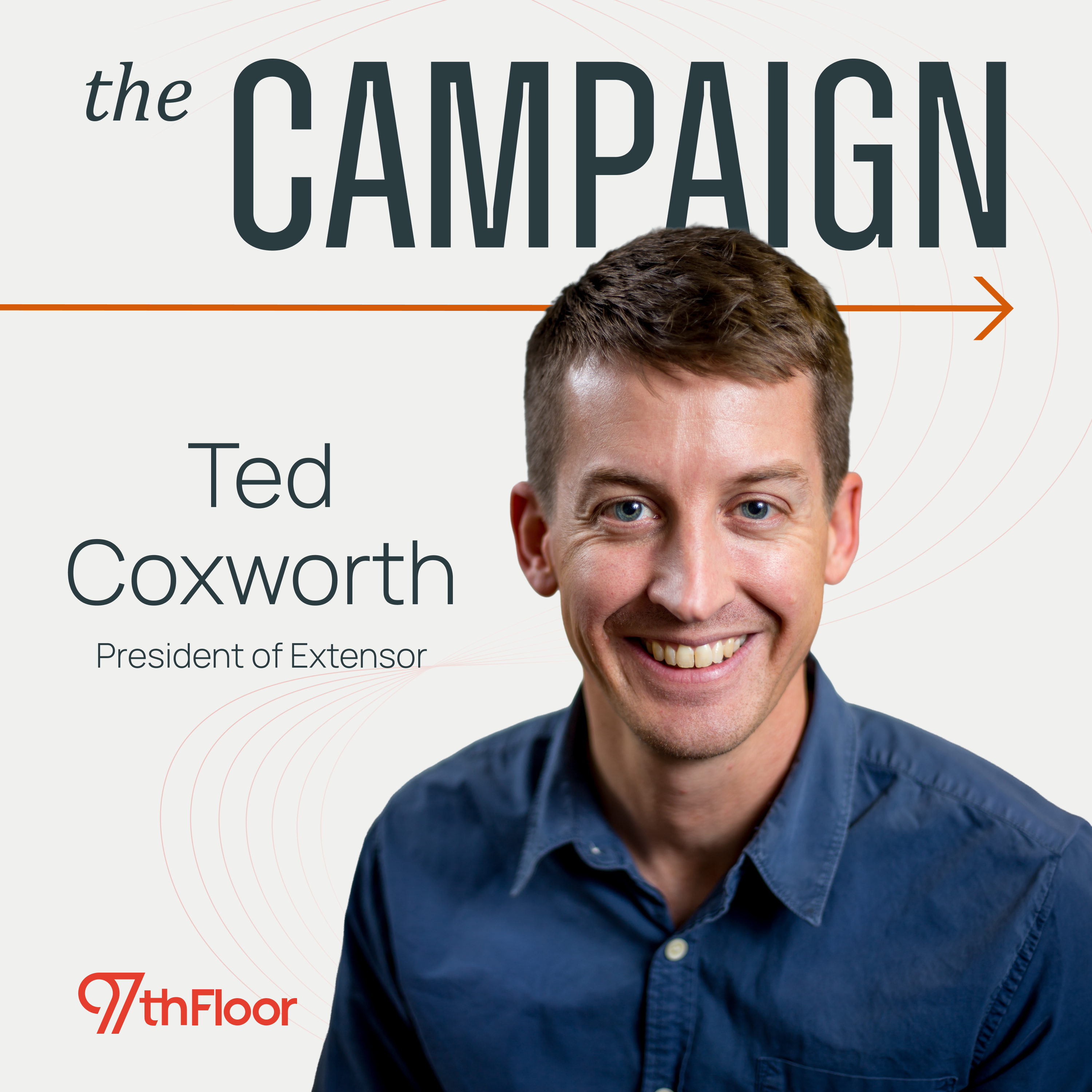
[email protected]. Today's guest is Ted Coxworth. Ted is the president of Extensor, a marketing measurement firm that shows brands what's working, what's not, and how to get more from their media budget. He works with marketing teams to assess channels ranging from Google and Meta to billboards and radio, giving him front row seat to the measurement challenges businesses face. In this episode, Ted and I are going to get into media mix modeling. First we're going to talk about what
[00:00:53] Speaker C: that is, how to set up for
[00:00:54] Speaker B: your brand, and why it's so important for brands. As AI continues to come in and change the face of what it means to measure in marketing and, and an AI search.
[00:01:03] Speaker C: Let's get into it. Ted, thank you so much for joining us today. I'm really excited to talk with you. Attribution is a big, big item in the marketing world and it's continue to become bigger as things change. So I'm excited to hear your point of view.
[00:01:16] Speaker A: Likewise. Yeah, exciting to talk with you as well. Paxton and I couldn't agree more about attribution being a thorny issue for a lot of marketers. So excited to talk to you about some of the details there.
[00:01:26] Speaker C: So let's start off talking about what's happening. Right now. We've got AI search that has pretty bad attrib.
There's a lot that we can't see. We've got tons of zero click searches going along with that. Cookie regulations and requirements are becoming more and more tight and analytics is becoming more and more vague. So we've got this big attribution model. What are you seeing from your clients and when media mix modeling or mixed media modeling comes into play as the solution?
[00:01:54] Speaker A: Yeah, so I'm gonna, I'm gonna take that topic in kind of two chunks. So I'll start out talking about cookies. This has been something that a lot of marketers have grappling with probably for the last 10 years, I would say. As privacy regulations have slowly gotten a little bit more restrictive. Apple kind of led the charge in terms of letting consumers say don't track me everyone's been seeing a whole lot more direct, or what they would call organic in their kind of multi touch attribution system showing up. And a lot of people are saying, wait a minute, that used to be 10% and now it's 40%. That doesn't quite make sense. So MTA has gotten way harder because of that. Mm. Media mix modeling is something that I've been working on for the boy since 2013 with different, different brands and companies. Old technique, one that's been around for a while, totally gets around the issues of not being able to track someone as they go across the Internet. So rather than having that little digital signifier associated with a person, we can look at generally correlations between where we're getting impressions, where we're getting sales or leads, and look at how those two things line up. So that's an approach that a lot of brands are starting to use if they haven't already. It moved from kind of the brick and mortar hybrid space. Now it's becoming part of the digital landscape as well. And we're seeing some good results with that for our clients. Very powerful tools, been around for I think something like 70 years at this point, so well proven out. So that's kind of the cookie question. Definitely needs to be solved. The sooner the better. And I think we do have some good solutions there. And the other point that you brought up was kind of, what's the role of AI overviews in all of this? We just felt like we were getting a good handle on measuring organic generally over the last 20 years, we'll call it, and now all of a sudden, it's gotten much fuzzier and I couldn't agree more. We have a couple of tools at our disposal in terms of measuring these things. A lot of people have favorites. My perspective on that is that at the moment, it's very early days. So some of the data that we're getting from big names like a crossfill or a profound, those are helping fill in the gaps. But in terms of the level of resolution and quality, we're still seeing some areas for improvement. I was just actually reviewing an MMM with one of our clients where we did pull in some of the AI overview.
You can always tell when a brand sees issues with data because they kind of give you this one particular squint and we were getting some of those squints looking through some of those data points together. So I think still more, more to come when it comes to measuring aio.
[00:04:17] Speaker C: So you have talked about some of the, of a Last click model, which is what I feel like most companies utilize to measure impact. There's also, you know, first click and there's weighted and lots of different kind of models there. Do you feel like MMM is a tool in the tool belt or it should be the thing that replaces it? Like, where does it fit within the stack of maybe analytics and attribution?
[00:04:41] Speaker A: I think generally every model has some utility and every model is wrong. There's a famous quote along those lines. In the statistical world, MMM is a very useful tool in the tool belt. Is it right for everybody? Probably not. There are plenty of businesses that do a very good job of performance marketing and just staying right at the point of I want to make a purchase. What's my best option option? Not spending anything on kind of consideration or brand awareness at all. So for them, MMM probably not worth the effort. But if it's a brand that's doing some investment, kind of mid and upper funnel, that's where MMM becomes super powerful. Last touch, first touch, uniform distribution of touches. They're all ways of looking at these things. But as marketers, it's very clear that more than one thing tends to influence your customer. And that's where MMM's very good at giving the appropriate weight.
[00:05:29] Speaker C: Let's take a step back on MMM for a second, and can you give us a short rundown on what MMM is for those people who, you know, maybe they haven't thought about it since their marketing class?
[00:05:39] Speaker A: Absolutely. Yeah. So media mix modeling, sometimes called marketing mix modeling, is an approach to measuring the effectiveness of your marketing program that looks at, I like to describe it as correlations.
So across time periods and across markets, generally marketing programs are going to show more or less spend by different marketing channels. So maybe you're spending a lot on Google in Salt Lake City, and maybe you're spending a little bit less on Google in the Houston dma. For example, what do the sales look like in those two places across time? And can we see a correlation? When you spend more on Google, you get more sales. So we're looking at all these correlations across platforms, across media types, and seeing how they relate back to the KPI that a marketer cares about, whether that's sales, revenue, leads could be just about anything. So a very different approach than mta. We're not looking at a single individual. We're looking at these patterns across time and across markets and seeing how they correlate with one another. Obviously, there's a bunch of fancy math that goes into this, but generally that's the Approach. It's a series of correlations that tries to untangle the relationship between all the marketing activity that's going on and the sales that come in. One of the things that's really nice about MMM that you generally can't get with something like MTA is you can also account for non marketing factors. So pricing, competitive behavior, all sorts of non marketing stuff like macroeconomics that can all get put into the model to build a more, I would say, picture of what drives sales in a given business.
[00:07:04] Speaker C: I remember we were working on a project together and you were building out some MMM for this client and you had brought in applications because this was a, it was related to tourism and travel. And that had a pretty significant impact on the attribution model, if I remember correctly. And so, and that that opened my eyes to like the power of MMM bringing in things that do have an impact, but we don't traditionally account for in most like analytic and attribution models. What are some of the interesting data sets that you've pulled into your MMM as you built it out?
[00:07:37] Speaker A: Yeah, so kind of apart from marketing, there's a whole world obviously of competitive data. One little wrinkle that's kind of surprising in the, in the competitive data landscape is that I think a lot of people assume that any business their competitors are driving through their marketing activity is detrimental to my brand. That's the assumption that just about everyone I talk to about competitive data comes into the conversation with. I would say the overwhelming majority of cases show that more competitive spend oftentimes results in lift for your brand. So kind of the idea that more awareness, category awareness, that rising tide lifts all boats, that's what we tend to see, surprisingly enough. So anyway, competitive data is one element. Different industries will show a lot of responsiveness, surprisingly enough to weather data. So we will pull in. You know, one of the examples from way back in my Nielsen days was kind of raid bug spray. You pull weather data in, all of a sudden you can really explain what's going on with sales. That's true in a lot of different industries. So I do plenty of work with, with the legal industry and weather becomes an important consideration there. Other kinds of seasonal effects will happen that aren't related to weather. Always want to pull those in. And then economics can really play a big part for kind of sort of purchase that isn't a necessity necessarily. How much cash do households in the US especially have to spend outside of necessities? So those are kind of some general categories that we tend to pull in usually we find some surprises whenever we look at these things. Like I mentioned, weather can be a real shocker. But also competitive data can work in different ways than you'd expect.
[00:09:11] Speaker C: A lot of marketers are doubling down on first party data to solve this attribution problem. Do you feel like that's enough on its own or is there like a gap still left by that that MMM can come in and fill?
[00:09:22] Speaker A: Well, there's certainly a lot of flavors of first party data that people rely on. Every company knows when their sales happened and where, which is phenomenal first data. A lot of folks are doing some survey work with their customers. How did you hear about us? Those data points can be really valuable. And I'm of the opinion that when it comes to how customers make their decisions, the more perspectives you have on that, the more lines of inquiry you have on that, the closer to truth you're going to get. So I'm a big fan of all of those. Typically, those are going to privilege certain marketing channels, which has been my experience at least. So if we talk about surveys in particular, oftentimes that is going to act a lot more like a last touch model than you might think. Or it can be the kind of survey question that tends to land on just the platform where you've spent the most money. Most of these surveys that I've come across aren't going to allow customers to nominate more than one thing. So typically what ends up happening is they'll say Google or they'll say the billboard on 15 and that's it. But again, we know that in marketing it's more than one thing. So that's one of the limitations that I see in terms of first party data that can be really powerful for understanding how marketing works. That isn't an mmm. Some brands have really invested heavily in their, in their marketing testing program. And I think that's a great idea. And I encourage every marketer I speak to. If you haven't run an incrementality test that looks at increasing spend in a channel and measuring just your sales in the place where you're running that test, give it a shot. It might change your world for the better. So all of those tools can be useful. I don't think any of them do a great job of telling the holistic story that MMM can tell.
[00:10:58] Speaker C: You've talked about MMM incrementality testing and MTA is like a three part system rather than like competing options. Can you talk more about that and more about what incrementality testing is and how that works?
[00:11:11] Speaker A: Sure, yeah. So I'll start with the two pieces that we've, we've discussed already and then I'll move into incrementality testing. So MMM is very good, like I just mentioned, for telling a story. You've got a lot of things going on at once as a marketer, all happening in the same markets most of the time. And so how do you tease those things apart and give partial credit to the different efforts? MMM is great at that. It's also great at pulling in non marketing factors and helping tell that story. It's not just the media budget that drives sales. That's a real strength of mmm. Great for media planning, great for simulations, scenario analysis. It is based on correlations though. And so correlation and causation, not necessarily the same thing. Two things can move together and be caused by something else entirely. Incrementality testing closes that loophole in mmm. So when you set up a really well designed incrementality experiment, let's say you have matched geographic markets test and control about the same size. Sales tend to come in the same way or similar ways and in one of them you spend on a new channel and the other one you don't. If you see an increase in sales, you can say pretty clearly, as long as everything else is the same, hey, that additional spend drove those sales. It's causal. And I know what the incremental impact is on my KPI. So that causal relationship and incrementality test, super powerful. Never going to get that out of an mmm. So the way that we like to do work with marketers when it comes to getting more efficient is to use an MMM to find opportunities and then go build out incrementality tests of those opportunities, whether that's a new channel, existing channel that maybe had more spend in the past and they closed it down because they didn't see a last touch lift. We like to use incrementality tests to prove out the signals that MMM is picking up on. Both of those take time, whether it's an mmm which is using couple years of historical data, or it's an incrementality test that's probably going to take you four to six weeks to complete. MTA is great for managing day to day operations. So if you can say this channel gets 10 last touch sales, but I know that it probably drove 20 total sales, you can look at your MTA, look at that last touch number and extrapolate out and say, is my holistic CPA or my holistic roas for this channel where it needs to be. And if not, I can go take action today because MTA is always on and it's very quick to give you results. So that's how we think about those three pieces kind of working together and making your marketing program more effective.
[00:13:30] Speaker C: Are there certain patterns or requirements that you've found that must apply to a company to get the most out of?
[00:13:39] Speaker A: Mm, absolutely. Taking that kind of an approach, taking the approach that MMM leads you towards requires a system in which you're constantly trying to learn more through tests. So an MMM is only as effective as the actions that are taking down, taken downstream of it. I mentioned it earlier. We like to build an mmm, find opportunities, test those opportunities and then exploit them. So having a program that's set up to do that, that's willing to do that, is critical. I would say one of the biggest stumbling blocks with having a really effective marketing measurement system is making sure that everyone's bought in to taking action on the results. Data without action, not very valuable. So having a program that can go from data to insights to actions to reap that efficiency, absolutely critical. And I'd say a lot of brands are moving in that direction, which is good news. I've often found myself having conversations with marketers where they're ready to go make a change, whether that's a test or a change in total budget allocation. Pretty quickly. Maybe 15, 20 years ago, that wasn't the case.
[00:14:41] Speaker B: Let's.
[00:14:41] Speaker C: Let's talk about AI search. You know, we touched on that a little bit at the beginning, but I dive a little deeper. What are you seeing? Some of the limitations around AI search being for brands, you know, is.
And mmm, the. The way around that. Are there still shortcomings there? Tell us a bit more about the. The AI search side.
[00:15:03] Speaker A: Yeah, so AI search is. Is very early in its formation, I would say, both in terms of how it's being used by people. People are still kind of adapting to AI search results, and then also the data that are available to marketers to measure its impact. So both of those are still forming, I would say. AI search, of course, contrasts very cleanly with search engine optimization. So what are you getting in terms of just organic results out of a search instead of seeing brands right off the bat? In most AI overviews, you're going to see a whole bunch of content with a couple of citations, and you're only going to see a brand if you click on those citations. Typically, obviously it varies a bunch. So in terms of a brand's role in AI overviews, it's not as crisp as, say, SEO would have been, where the website is, boom, right there. So in terms of consumer behavior, it's not totally clear the value of a citation in AIO versus the value of an impression an SEO. We've got consumer behavior, customer behavior changing to adapt to this new search landscape. And then we've got the measurement challenge. So when we think about SEO data, if you're a marketer, you can go look at the number of impressions that you got in a time period and say, okay, where was I ranked? What were the keywords? How much volume was there? In the world of aio, I haven't seen any tool that's able to do that yet. The closest we've been able to get is to say, for a set of prompts, for a set of topics, on a certain date, were you in the citation list or not? Which is a little bit different than saying this many sets of eyes saw your brand as a consequence of this keyword search. Whether it's an MMM or a different way of measuring the effect of aio, we still have, I think, some ground to cover there. We've seen this kind of citation data really pop for some people, which is great to see as their SEO or their organic volume is not doing what they expected. We're seeing an increase in their AI overview citations, and that explains their sales very well. For other brands, not so much. At least in part, I'm sure, because of how AI overviews are generated. And that's a little different from SEO.
[00:17:12] Speaker C: So you talked about consumer behavior changing. Like, if Google comes out and says, hey, we're actually getting rid of the 10 blue links, Sol AI, or maybe there's economic fallout or just some, like, big drastic pivot point, does that then, like, ruin the model and does that make the previous data invalid or unhelpful? Or what kind of impact does that have on the efficacy of the model?
[00:17:35] Speaker A: Yeah, it definitely has an impact on the model. That's the. That's the short and sweet answer. And we like to track those changes very closely with our clients to see the estimates coming out. Let's just say about organic traffic. How important is this for your brand? When we see a shift like what we're talking about with AI overviews, that relative importance is just going to start coming down very crisply, run after run after run. And so there are a lot of options for how we handle that with our clients. One thing is to say, hey, let's just not focus on this particular channel as something that really needs to be invested in Right now because the return is not what it once was. That's one of the things that we will do with our clients. Other clients just don't even want to see it anymore. So if they have a channel that was performing really well for whatever reason, and then there's a big shift in their market and that channel does not even come close to operating the way that it used to. We've seen some of this with affiliates in particular over the last six months. We can just pull those out of the MMM entirely. And that helps marketers get a sense of. Okay, so here's what's addressable for me today as opposed to two years ago. So there's a lot of techniques to make sure that the utility of the model is still there as these changes are being made. But absolutely, we want a model system that's responsive to those kinds of pivots.
[00:18:51] Speaker C: Okay, well if you had to make the argument directly, like why is MMM specifically well suited for the AI Search Geo era and where so much is invisible in a nutshell, why it's well suited for that.
[00:19:05] Speaker A: Absolutely. AI overviews in particular I think are probably the most extreme case for digital content, at least where people are very non trackable in this world. SEO is kind of like that as well, but I think AIO takes it even more extreme. You're never going to get kind of a last click attribution system to say, oh, it was the AI overview that brought them to your web page. That's where MMM can really shine. Whenever we get into these measurement challenges where you can't link an index individual purchase to digital behavior, MMM becomes the answer in a lot of cases. So looking at those relationships, the correlations between AIO citations and the KPI of interest is really your best tool for the job in the current moment.
[00:19:48] Speaker C: I love this. One of the biggest problems that I'm seeing happen in the marketing world and the business world in general is this over reliance on attribution and overinvesting in channels that, that are perceived to have a high attribution or like high correlation. There's this study that was released by McKinsey. They do it every year where they say like what percent of your marketing spend is going to these different efforts? And it's been amazing seeing the change. Since 2023, Bend for Martech has gone down, Spend for Labor has gone down, Bend for Paid media has gone up, in fact of the entire marketing budget. But in 2023 it was sitting around like 20% and in 2025 it's now 30%. So a massive increase. And it's continuing to grow at like the fastest rate of any channel. And my assumption is that, that it's going to Facebook, it's going to Google, because their platforms say, look, that conversion came from us. So my question for you is, as you've had a chance to work with companies who have lots of different channels that they're investing in, have you been able to unlock information that has helped them see, hey, you know, maybe pull back on? And I have nothing against advertising. We do advertising, we do SEO, we do content.
But I just think, you know, I hate to send more money to Google and to meta when we don't have to. Have you seen some kind of cool unlocks for people as they've had a chance to dive into these models where they've pulled back spend on what was seen as like a very attributable source and invested something less attributable thanks to this model, and then had success with that?
[00:21:27] Speaker A: Absolutely. So. So one of the, one of the traps, I think, in the marketing world that we've been able to help people step around is the idea of this is working in my measurement system and I'm just going to keep doing it until it doesn't work anymore. Totally understandable how people get stuck in that position. They have the conversation with finance any more budget because we got to get the number of leads up and finance goes, okay, where are you going to spend it? And show me why that makes sense. And so they get stuck with the channels that you're talking about, which have very effective targeting mechanisms for people that are right about to buy. They don't tell you whether that dollar was incremental or not. They don't tell you whether that person was going to come into your business a different way. They just say, hey, we served this person the ad. You're telling us that they converted. We did a good job. But that rapidly becomes exactly the kind of situation that you described in the McKinsey Report. Once you get on that treadmill, it's very hard to get off because you're not really driving a lot of demand. You're just capturing it, which can be very efficient at first, but once that demand starts to slow down, all of a sudden it's not so efficient anymore. So the system that we like to use tends to show more utility for mid and upper funnel efforts. Whether that's content on your website, talking about the category, content on your website talking about the brand, how that influences some of the traffic that then comes in lower down in the funnel and gives people the opportunity to go invest in the things that generate demand as opposed to just grabbing the demand as efficiently as possible. But it's always a mistake to think that investing more in harvesting demand is the same as investing more in generating demand.
This is one of the areas where both incrementality tests and MMMs are super powerful at showing the relationship between mid and up funnel investment and the KPI that really matters. Whether that be leads, sales, revenue, whatever it could be, that's how you kind of help people step around the trap of over investment in lower funnel, hyper efficient campaigns.
[00:23:17] Speaker C: If there's a CMO or marketing leader listening right now who is thinking, all right, yeah, I got a date, dive into this, I want to do this. What are some of the first steps to getting closer to building a model like this?
[00:23:29] Speaker A: Yeah, some of the first steps, number one would be if you have a data repository of some kind, you are way ahead of the curve. So being able to say confidently, I know what my sales are and that is a very important foundation. I know what my sales numbers are by day, by geo, whatever it might be, that's super important. Once you've got that in place, making sure that you have obviously good tracking around your entire marketing program. Where are my impressions coming from? What's the spend looking like? Being able to relate those two things together and then trying a test of some kind is a great first step in this direction. Whether that's an in platform test, Meta and Google have great tools for in platform testing, or it's something more sophisticated where you're building out a GEO holdout kind of experiment. Heading in that direction first generally means you're going to get a lot of buy in in the organization.
It's also going to give you results you can be really confident in and you can build on that success. So MMM is a big investment. It's going to take four weeks, maybe, maybe a little bit more to get results. But with a test you can get really solid, actionable insights very, very quickly and use that to build some momentum and start heading in the direction of having a really comprehensive marketing measurement program.
[00:24:38] Speaker C: If you could get every brand side marketing leader to change one thing about how they think about measurement today, what would that be?
[00:24:46] Speaker A: Number one thing I would say is figure out a way to show that your marketing efforts require more than one touch or more than one platform to lead to sale. That can take a lot of different forms, but we all know that's true for most brands. So how do you Prove that to the finance team. How do you prove that to the executive team? So that's going to make you a much more efficient and effective marketer because then you can go spend on the things that you know are important without having to have too much discussion around what's working and what's not. So I would advocate for that very strongly of that.
[00:25:17] Speaker C: And then, you know the last question to end, who is someone who has changed the way you think about marketing?
[00:25:25] Speaker A: Absolutely. So a lot of names come to mind. One that's taught to everyone in every marketing program, which is John Wanamaker. He's the guy who kind of highlighted the fact that marketing isn't always doing what you think, which is a big part of what I spend my days doing. Hugely influential on me. But leave him to the side for a minute because I think every marketer is very aware of him. Mark Randolph is a guy that I pay a ton of attention to. He was the first CEO and also the co founder of Netflix. So he's worth listening to just for that reason.
Got a lot of great insights in terms of building a business and marketing effectively. But the reason he's been so influential to me is that he is very good at meeting his audience where they are, both in terms of his content and the platforms he chooses to use to reach them. I see his stuff on LinkedIn all the time. I'm kind of his audience as a business owner. And one of the things that he really emphasizes that I think is true for all marketers in addition to meeting your audience where they are, is honesty in marketing is so important for so many levels. Levels. On so many levels, authenticity is something that we all pick up on super quickly. And so having a message that's authentic and then when it comes to converting someone into a customer, if your marketing doesn't tell the truth about what's going on, that's going to be very, very hard. So in the interest of being efficient, making sure people get what they want, always be as honest as you can with your marketing. It'll pay off.
[00:26:42] Speaker C: Love that. That's great. And not someone I'm currently following, so I'm going to have to add him to the list. Ted, where would you like to direct listeners?
[00:26:49] Speaker A: Yeah, absolutely. You can find me on LinkedIn. Ted Coxworth. I think I'm the only one. That's the upside of having a unique last name. Happy to talk to anyone and everyone about their measurement challenges.
[00:26:58] Speaker C: Okay, great. Thank you so much, Ted, for coming on the show and sharing your wisdom.
[00:27:01] Speaker A: Thanks, Paxton. Appreciate the opportunity.
[00:27:03] Speaker B: That's everything for today, everybody. Thank you for joining. And big thank you to Ted Coxworth for joining us.
[00:27:08] Speaker C: You can reach out to him on
[00:27:09] Speaker B: LinkedIn to learn more about what he's up to. You can find past episodes of the campaign campaign and examples of our
[email protected] there. You can also learn more about what we're up to and how we can help you with your marketing efforts. That's all for now. Thank you for listening. As always, keep innovating, keep converting.