Episode Transcript
[00:00:00] Speaker A: Hello everyone. I'm paxton grace, CEO of nice m floor and this is the campaign.
Thank you for joining us for another episode of the campaign where we talk with marketing leaders about better knowing your audience, innovating beyond best practice, and converting visitors into customers. The campaign is produced by 97th Floor, a marketing agency designed to build world class organic and paid channel strategies for enterprise level organizations.
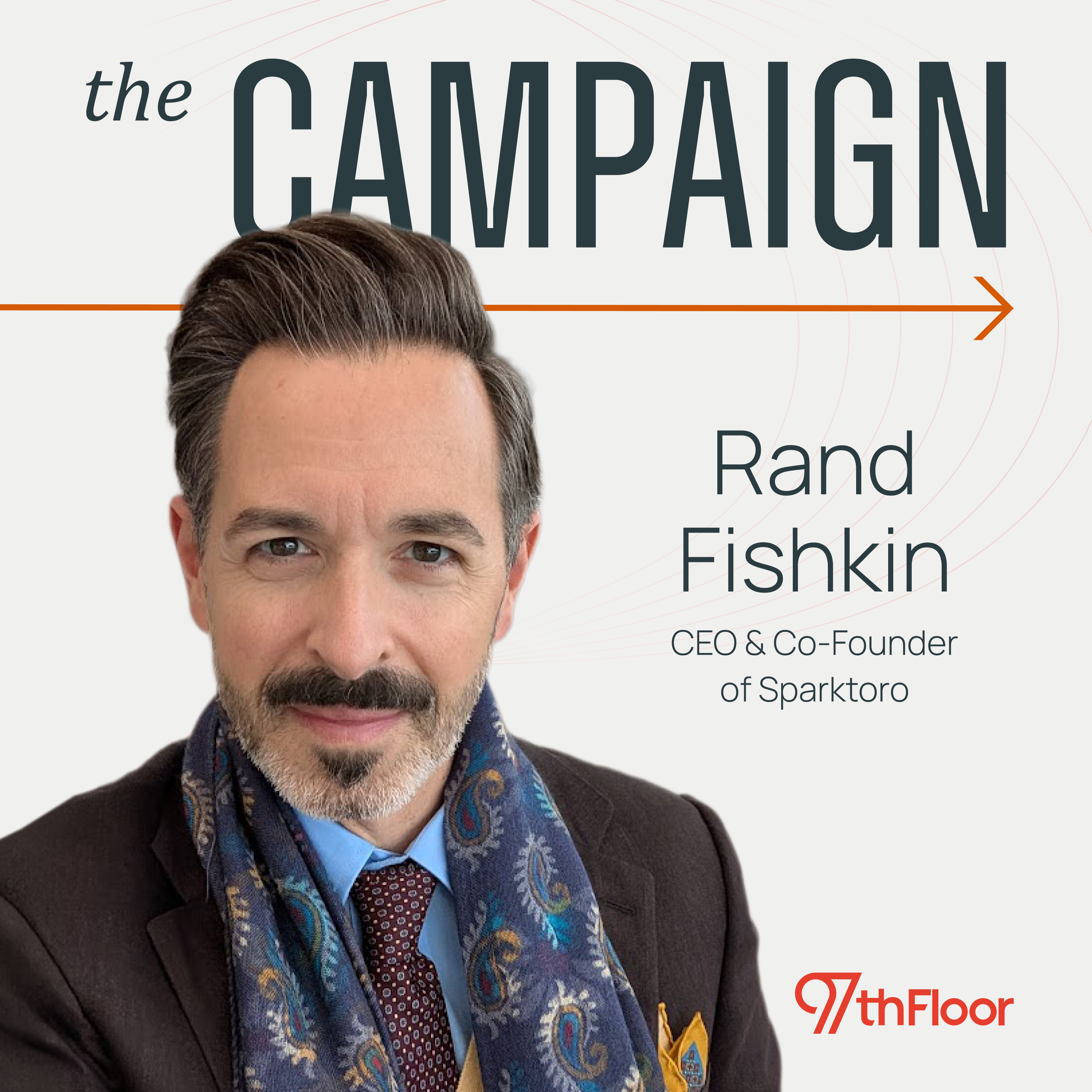
You can find past episodes of the campaign on YouTube, iTunes, Spotify and at 97th Floor.com. today's guest is Rand Fishkin, CEO and co founder of SparkToro audience research platform AlertMouse and Snackbar Studios. He's also the author of Lost and Founder, a Painfully Honest Field Guide to the Startup World. And Rand has a new book coming out that he co authored with Amanda Natividad called Zero Click Marketing. It details everything brands need to think about as clicks stop flowing from organic search. In this episode we're going to talk with Rand about the rise of zero click search, why attribution is broken, and how Rand is applying audience first thinking to all his different businesses. Let's get into it. Rand, thank you so much for, for joining us again today. Really looking forward to talking with you.
[00:01:11] Speaker B: Yeah, it is my pleasure. Paxton, I, I love your show, man.
[00:01:14] Speaker A: Yeah, I appreciate that. It's been a about a year since you've been on and the last time you were on kind of the big news was the daedos report that you guys had put out and a lot of the findings, a lot of it was contrary to the narrative kind of in the social world or I guess the media.
So I'm really curious to know if you have any updated data or trends on that. Yeah, I think last time the big counterintuitive thing was everyone was saying that traffic is disappearing and you're saying that's not really the case. AI is not taking away all this traffic. So I'm curious what you're seeing now, if anything different.
[00:01:56] Speaker B: Yeah, well, so AI is definitely taking away a lot of traffic now, but not necessarily in the place you expect.
If you're thinking that AI is taking away traffic because people are switching from, you know, whatever, Google OR Bing to ChatGPT and Claude, that's not what's happening.
Those tools are popular, they continue to grow, but so does Google.
And in fact, where AI is taking away traffic is inside Google. And it's not just Google either. Pastor, I don't know if you have done this lately, but if you go here, let's pop right in there. So if you go into your Instagram right And you perform a search. I'll just, I'll just do a little search for Greek chicken marinade.
Instagram. TikTok does this too. This is a little instant AI answer, right? Which is, which might preclude you from scrolling and learning and I just find that fascinating. Right. This is when you think of search. I don't, I don't believe anymore that that is Google and Bing and DuckDuckGo.
Search is an activity that happens on every social platform, on every e commerce site. It happens in AI, it happens in the traditional engines, although they're becoming more AI centered too.
Like they have. It happens in YouTube, it happens on Reddit. I just think search is way bigger. Yeah, there was this, this marketer from the uk, Ashley, I can't remember his last name, but coined the term Search everywhere optimization. Right? The SEO should stand for Search Everywhere optimization.
That's the thing that makes the most sense to me.
[00:03:36] Speaker A: Interesting. Say, say more about that. Like what doesn't make sense?
[00:03:39] Speaker B: Well, you know, if you are, if your job is trying to help businesses get more customers, more sales, which I, I assume is the purpose of, of every marketer, I, I think that we have to disconnect the idea that your job is you get rankings in Google and get traffic from those rankings. Those, those days are over. Like that, you know, it's like it's, I don't know, it's like we're in 2010 and you are optimizing for, you know, hot button lycos. Like it just. The time has passed, my friend. Right. We need to, we need to move on and recognize that the instant answer, the zero click era, is formally here. It is fully here. You know, Google is sending out less than one third of all searches result in a click to anywhere. Right? That's the similar web research that we just completed a couple months ago.
AI tools send out less than one in a thousand visits. Like they keep 999 people on, on the platform. Your own behavior I'm sure is, is similar whenever you use these tools. Social networks are similar, right? They're keeping 98, 99 out of 100 people who start an Instagram session stay in Instagram, they don't go anywhere else. LinkedIn, you stay in LinkedIn. Reddit, you stay in Reddit. YouTube, you stay in YouTube. Facebook, you stay in Facebook. TikTok, you stay in Tikt. It just Twitter, hopefully you've left, but everywhere else, you know. Yeah, yeah, it's zero click.
[00:05:11] Speaker A: And I believe the data, your data has shown that that has grown just in the past year, hasn't it? Wasn't it like 60% last year now,
[00:05:20] Speaker B: two years ago, so 60%, yeah. So 58, 58% of Google searches ended without a click in 2024 and now that number is 67 point something. So yeah, I mean, we're talking about a more than 10% or nearly 10% increase in just two years. That's the fastest growth we've seen in the last 12 years since we've been doing this. I think my first study was 2014 or 15 when back when I was at Moz.
And yeah, this has just been rising and rising. It's kind of, it's kind of amazing that Gabriel Weinberg, right, from DuckDuckGo, coined the term zero click search back in 2011. Like he was, he was the first person who popularized that and way ahead of the curve, right? And he was talking about like the Google weather widget or the, you know, the sports scores that would come up when you, when you Googled, like how'd the Mariners do last night? Or whatever it is. And yeah, it's come, it's come a long way.
[00:06:16] Speaker A: It really has. And I'm wondering if you, you know, when you're saying like, those days are dead, do you feel like we, we are advancing or are we going backwards when it comes to what we know? It seems like we know less or like more is being kept from businesses.
And, and I wonder if there's something to be learned from a hundred percent, the ad agencies of the 70s and
[00:06:42] Speaker B: 60s, you know, oh, I, I mean this is, this is exactly what zero click marketing is all about. That the book. So yes, I think there's a ton that we can learn from past eras of marketing when, you know, there was no way to know exactly how many people drove by a billboard, how many of them saw it, how many of them took action based on seeing it, how many of them like that billboard better than the billboard in the other town, right? Like it was. You could measure, right, you could measure lift in same store sales in a region around that billboard. But attribution, no one even tried that, right? Like nobody said, hey, we saw Rand driving by that billboard and one of our spotters had his binoculars out and he wrote down the license plate number of Rand's car as he went by. And then we followed Rand to the grocery store for the next three weeks and we saw that he did indeed buy some diet Coke. You know, like what? That did not happen.
It's totally unrealistic to try and do that at scale and so what did the Coca Cola Corporation do? They, they looked at same store sales and they saw know, lift and incrementality and, and measurement based testing. And that stuff should be back with a vengeance, but unfortunately it's not. And I think that is because we had this brief era, these like 15 or 20 years Paxton, where, and you and I built tons of these, right? We built these attribution dashboards where we, where we would like show, you know, our CMO or in your case, a lot of clients. You'd be like, look, LinkedIn is driving this many visits that resulted in these content pieces being consumed, which led to this many email signups, which led to this many conversions. And if we take the total conversion path, we can see that LinkedIn contributed to 16% of all of our signups. You can't do that today. That would be, that would be insane because in those days when you put stuff on LinkedIn, you sent a visit to your site.
Today there's two problems. One, LinkedIn is hiding the referral data for a bunch of organic visits, right, which we saw in our study with really good data.
And two, people are staying on LinkedIn so they consume your content there.
And if you put a link in your post, it's going to be seen by fewer people, it's going to be engaged with by fewer people. You're limiting your reach. If you don't put a link, you have greater reach, greater potential, but you'll never see, you'll never see the influence in an attribution friendly way.
So yeah, this is, this is why, you know, measurement and attribution, huge problem in the zero click era. We still haven't evolved past that. So many folks are still stuck in this cycle of attributing everything. And because of that paid has gone through the roof, right? Because paid media, right? When you, when you buy a LinkedIn ad or a Google Ad or a meta ad or a Reddit ad or a TikTok ad, you get the click.
And you don't just get the click, you get the attribution and it looks real pretty in your dashboard and you can bring it to your CMO and be like, look, let's spend another 10k with TikTok. You know, like, yeah, it's just, it's very different.
[00:09:47] Speaker A: I wonder if it's, I mean it's not accurate. You know, they say here's better attribution when you pay for ads on Google. And yeah, there's maybe some more data than there is on the organic side,
[00:10:01] Speaker B: but it's still they send you the keyword. Yeah, right. Like, yeah, supposedly, right. Wasn't what you, you remember this, you remember this era when like Matt Cutts was like, oh, no, we'll never take away, you know, more than 5% of all your keyword data. You know, they take away all of it. And then, yeah, not provided. Keyword, not provided. And then they claimed it was for privacy reasons. They were like, well, this is to protect people. It's for privacy.
Which is the biggest load of crap in the world if you're just going to keep providing the keyword data to anybody who pays. Like, it was just a. I don't know, it was gross.
[00:10:35] Speaker A: Do you think that the marketing world, and by that I mean the output of the marketing world is better with that, the attribution we had from 2012 to 2017? Or is it better today with less attribution? So think about that for a second and then I have an additional question there, which is, do you think we ever really had attribution or did we just have an illusion of attribution? And it's like that just pacified us enough to allow us to just act and now people are kind of like paralyzed.
[00:11:11] Speaker B: The latter for sure. There was an illusion of attribution. There were always channels that were never. That were not attribution friendly. And then there were channels that were quite attribution friendly. And it turns out that, you know, whatever you call inbound marketing or content marketing and SEO, that flywheel was quite measurable and attributable for a while.
And then, you know, I would argue potentially from like 5,06 all the way up until 2017, 18, 19, you know, even you could, you could squint, maybe even make it work in 2020, but lots of other channels. You know, we're on a podcast right now. Some people who are watching this podcast on YouTube or listening to it, you know, in their headphones, they're hearing this stuff and they're like, oh, that zero click marketing book sounds really interesting. And so they, maybe they go to Google or maybe they go to SparkToro's website and they look for it, or they search for Rand Fishkin or Amanda Natividad and then they're gonna buy the book. And like that that was broken from the jump, right? Like that that attribution of person was on podcast led to sale.
It was in no one's dashboard ever. Like, it just, it just didn't happen.
But to your point about those, you know, mad men of the 60s, they did, they did temporal based measurement. They'd be like, hey, our, you know, our spokesperson or the author appeared on this radio show this day.
Did we see a spike in sales over the next week?
You know, were people going into bookstores or calling up their, their books, the local bookstore and asking them to put it on hold? And today that would be, are there branded search bumps in volume and then is there like a spike in sales on, you know, the zero click marketing website? Yeah, probably.
So you can measure but you can't attribute. And I, I think this is a culture that is going to take a long time to unwind and it's going to take a long time to unwind. Not just because this is a tough message to get through people's heads and you know, momentum and sort of historical bias, but also, also because Paxton, there is a huge incentive for Google and Meta and TikTok and Reddit and LinkedIn and every one of these big tech companies to pretend that that attribution still exists.
Right. Because if it does, you're going to keep putting budget where it looks like you're getting traffic from, converting traffic from. And that's always going to look like paid.
So organic might be 10 times, 100 times the influence. Paid is always going to get the credit. And this is the world, man. Right. Like it's just, it's just tough. So I think, I think it's hard for folks like you and I who want people to invest in the channels of influence that really have impact, which in my opinion is overwhelmingly organic. I think it's still 80, 20 organic to paid. But paid is great at getting credit for, for sales. That would have happened anyway.
[00:14:08] Speaker A: Yeah, yeah, I agree with that. And I wonder too if. Do you think that there are marketers out there who are learning lessons they shouldn't because of economic forces that are kind of unrelated to what they're doing. You know, like B2B buying behavior right now is, is somewhat depressed compared to, you know, five, six, seven years ago.
[00:14:32] Speaker B: Yep.
[00:14:33] Speaker A: And you know, I think there are people who are saying, well, this channel doesn't work. It's like, it's just, you're comparing it to a time when it did. Do you think that's a factor here and that's also part of what is causing this over eagerness for attribution. Or do you think that that would be true regardless of economic conditions?
[00:14:50] Speaker B: I think it's true regardless. But I think it's certainly exacerbated by the particularly weird, I'm going to call it like the, the one note shape of B2B in certainly in the United States, but it's creeping all over the world, right? Which is essentially AI. You can spend money on that and then everything else that potentially is B2B. You know, managers and leadership is like, no, no, no, wait a minute. Why, why do we need that? Cut off the spend. Like, let's audit our SaaS spending. Just throw a few more million dollars at Claude tokens, you know, like. And yeah, that's a weird, a weird world to exist in. It does teach people a lot of wrong lessons. But going back to your earlier question that I, that I failed to answer, do I think this messiness around attribution and like some future world where, where we do return to like measurement and correlation and incrementality and experimentation, do I think that makes marketers better? I think it makes us potentially more creative.
Right. I think that today, in my opinion, the biggest superpower you can have as a marketer is to be insanely good at short form video.
Nothing else. Nothing else captures attention like short form video. And this is regardless of platform, right? So like if you want to drive a million searches for your widget, YouTube Shorts and TikTok and Instagram and a short video on the right subreddit and a short video on LinkedIn like they crush. They really do.
It's just how people consume content. Sort of like, you know, back in our day it was like, hey, a great blog post could go super viral and really impact, you know, behavior and thought patterns. Or a great conference talk could do that. Now it's short form video. Yeah, that is, that is a very creative practice. Much, much more creative in my opinion, most of the time. Then you know, hey, I need to optimize this snippet for my Google ranking and like, let me get this page higher up in, you know, in the SERPs for SEO. That was a mildly creative but, but pretty technical process.
This one, this one is much more human in a lot of ways.
[00:17:06] Speaker A: Yeah, I mean it requires a much more in depth understanding of human psychology and persuasion and hooks and attention and the amount of iteration that you get. Like that cycle is hyper fast compared to really anything else in the marketing world before it. You know, you could be releasing multiples of these shorts a day and learn and iterate very quickly.
So that, that leads me to this importance for understanding audience, which we talked about when you were on a year ago about how kind of frustrating it is that that needs to be the way forward for great marketing is understanding an audience. But it seems to be one of the most undervalued foundations of our craft, which is just like, maddening. It's, it's, it seems insane that people don't invest more in that.
[00:18:03] Speaker B: I mean, for us especially. Right, sure, yeah.
[00:18:07] Speaker A: I mean, it's, it just seems so obvious that that's the way forward is like, okay, you, you lost attribution data, you lost this data. Fine. But what you need is data on your audience because even if you are blind to a lot of their clicks, you can see, you know, their behavior, their needs, their wants, and you can fill that. And that's where the, you'll start to see the correlation. We launch these things, we're starting to see this increase in brand and, you know, that's the way forward.
[00:18:37] Speaker B: Yeah.
[00:18:38] Speaker A: So let's talk about data for a second because I think that is one area that a lot of people are struggling with right now.
There's a lot of data providers that I don't think are quite forthcoming about how they're getting their data. And I know you've been deep in this, fueling SparkToro, which great tool I highly recommend it, we use at 97 Floor. You're working with a lot of these data providers to know, like, where is this data coming from? Is this accurate? Are you we sampling? To what degree are we sampling? So I'm curious what you would direct people to for like, good, clean data, because I think we're starting to see this increase, especially when it comes to AI search, this increase of like data sellers that aren't, you know, really selling reality.
[00:19:25] Speaker B: Yeah, yeah, we've noticed, we've seen a couple of competitors, they're very fly by night, thankfully. Like a couple of people put, put up, you know, pages that are like, hey, here's whatever our audience research startup versus SparkToro and Casey and I'll take a look and we'll be like, oh, they're not, they're not getting data from anyone. They're just asking an AI. You know, when, like someone puts in a website or whatever, they're just asking AI and giving back the spicy autocomplete version of the answer. Right. So they're just, you could, you could just go to ChatGPT and ask it yourself. But thankfully I have not seen, I've not seen marketers like fall for this. I think that there's, there's some very clear and obvious signals that when an AI produces sort of fake numbers or it's not, it's not even hallucinated, it's just the most predictive thing that that an. You know, that it would give based on the model and training, as opposed to actual observed behavior.
[00:20:23] Speaker A: Right.
[00:20:24] Speaker B: Which is what we get from Dados or. Or similar web. Right. Who I mentioned we did that study with. There's lots of folks like this out there. Comscore Nielsen has one. There's a number of others. But if you want the real, real story here, Paxton, the reason that all of these providers are nervous, all of these folks, like, you know, up and down the chain. If you have a clickstream panel, that means that you have access to some software that is sitting on a device, a laptop or a mobile device, a desktop, and you're seeing every URL that passes through in the browser. Right. So when someone clicks on something like you're seeing all that, they have a huge obligation to make sure none of it is personally identifiable. They have a huge obligation to make sure that it can't be leaked, that it can't be connected to an individual human being. Then they have to do lots of balancing and all that kind of stuff.
[00:21:14] Speaker A: I think it's very easy to get to this place of. It should be like this. It was better.
So, you know, let's. Let's get a little bit more into, like, forward thinking. And I want to learn.
[00:21:24] Speaker B: Yeah, yeah. This is. This is what we care about. Right. What we care about is saying, hey, here's an autopsy of what happened so that we know what to do going forward. Right. Because if you don't understand why this happened, how this happened, I think your strategies and your tactics for the future will be hamstrung. So I agree with you. Like, the only thing to do is, well, you know, vote, but then also, like, do the best you can with the tools that you're given. Right. Make those walled gardens places where you can have impact and influence.
[00:21:52] Speaker A: On that note of how to respond to this, you own three different organizations that are all very different. There's SparkToro for audience research, AlertMouse, which I would highly recommend you go check that out. There's a free option. You can go get alerts, kind of like a PLG Motion, and then Snackbar studios where you're releasing a game. From the outside, it looks like you approach marketing for the three very different. For each one.
Is there a high level, like, how do you approach a game studio versus how you approach this freemium product and then how you approach SparkToro?
[00:22:27] Speaker B: Yeah, yeah. So AlertMouse is a very let the people spread it sort of product. I talk about it sometimes, but there's. There's no blog. We don't do any paid marketing. It's relatively quiet. It's, it's a little bit of a side project, but we're also trying to see like what is the, what is the sharing rate. So when you sign up for alertmouse, like you, you know, you get a free alert, just like with Google Alerts, except AlertMouse Works and Google Alerts will randomly send you your own LinkedIn post from six months ago and then never send you anything about how you appeared in the Wall Street Journal. I don't understand it, but alertmouse is really quite good and we've seen quite a lot of adoption. Like 6,000 people are using AlertMouse, which is great, but we're not loud about it yet. Maybe we will be eventually. SparkToro is very much a, it's a content marketing flywheel, but a zero click content marketing flywheel. So we use, you know, Amanda and I do the marketing for SparkToro and we use podcast appearances and webinars and tons of social, you know, Threads and LinkedIn are our two big ones. But we also do a tiny bit of cross posting to Twitter. Some blue sky, I do some Reddit actually. Reddit has been quite big for me. YouTube is getting bigger for us.
Amanda's got a podcast that is going quite well with tens of thousands of downloads. So, you know, sort of the distribution on the platform strategy, we're not, we don't need people to drive back to the blog or the website.
We figure when they need audience research and whatever to understand, you know, what their audience is reading, watching, listening to, visiting, they'll come to SparkToro because they'll have heard about us elsewhere.
[00:24:07] Speaker A: Could you say just a little bit more about your Reddit strategy? I think people be very interested to know how that works.
[00:24:14] Speaker B: Yeah. So, you know, I published this research, right? And so I, I noticed that Reddit there are certain subreddits that really love two kinds of research. One beautifully visualized research which I try to publish, but I, I, I can never quite get their guidelines quite right, but I still do okay in those subreds and then research that is critical of or exposes some of big tech's behaviors.
And so I have started taking the graphs that I make for, you know, our website and my presentations and putting them on Reddit. And I gotta say, you know what's, what's shocking to me, Paxton, is that research, for example, on the zero click searches from Google, that one came out in June, I believe. And you know, I had gosh, probably 100,000 people engage with it on LinkedIn, tens of thousands on threads, maybe a few thousand on Twitter, a few thousand on our website, and more than a million on Reddit, more than a million impressions. And that is because, you know, you submit to our data is beautiful or you submit to our charts or I submitted to, I think our cross posted to our.
Maybe it was Google. I think I submitted to the Google subreddit. Guess what?
The reach there is wild. And I'm not talking about, you know, making the front page of Reddit. I am talking about being number seven on a popular subreddit, like far down the list for less than 48 hours.
It's just that the amount of engagement and traffic there is huge.
Now, did that send any visits to our website?
No, it did not. Right. Like they, they require that you put a link in. Right? Because they want to see like, who's the original public publisher of the research. And I have to say, like, I, I am the originator of the research. Here's the original piece, blah, blah, blah. You're required to put that in. Nobody clicks it. Right. It's like AI levels of click through rate, like one in a thousand people. And it does not drive a lot of direct value for SparkToro.
Like, we don't get customers from that. But you know what we do get? Journalists. We get a lot of journalists and coverage. And those journalists and coverage drive up our visibility in AI, our rankings in Google, our broad brand knowledge, searches for our brand, all of that stuff, because the journalists who publish it are more relevant to the audience that we're trying to serve. So this is one of the things that Amanda and I talk about very frequently when we talk about zero click marketing is you really have two audiences. You have your customers, people who are going to buy from you, and then you have the people who are going to influence them.
And your job is to reach both.
So on Reddit, I am reaching the influencers. I mean, you know, not all the million people are influencers. A bunch of them are just random redditors. But a small number of the right people are there, and that's why I put it there. And then we're influencing customers on, you know, LinkedIn, on threads, on Twitter, on our blog, in our email newsletter, on podcasts, all that kind of stuff.
[00:27:23] Speaker A: Right, right. So tell us about Snack Bar Studios and your strategy there.
[00:27:28] Speaker B: I, you know what, Paxton? For the first time in a long time, I just hired a marketing agency.
[00:27:32] Speaker A: Okay.
[00:27:33] Speaker B: Yeah, yeah. A couple of guys out of Poland who The studio is called Bravada and they, they help small indie game studios like ours to, you know, make a great Steam page, to make a great trailer, to reach the right press folks and influencers and folks on TikTok and Instagram participate in the right subreddits. They were, they were actually like, they were quite thrilled that they were like, yeah, no, no creative director ever wants to go on Reddit. Like, they're all afraid. And I was like, I don't care. I, I've been participating, I've been getting Reddit hate for 20 years. Like, I'll be fine, you know, sign me up. But that, that world of marketing. So a consumer. This is the first consumer product I have ever made. You know, my previous company, mozzarella or like inbound.org that I did with Dharmesh or yes, SparkToro and AlertMouse, all B2B. So this is the first one that's consumer and that is super different. Like, really, really different. It's also very different in that, you know, for all the B2B companies for 97th floor, for example, right, if you have a big launch where you're like, hey, we're offering this new service, or we have this new product, or we put this new piece on our website, or we have this great talk or here's an interview with Rand or whatever, you launch it and then you sort of promote it over time. And then there's other things you promote and like, it grows and builds and all that kind of stuff. With a game, you get one shot one day like that. That launch is almost everything. I think it's something north of 95% of games will sell 75% of the copies that they'll ever sell in the first three months.
[00:29:12] Speaker A: Wow.
[00:29:13] Speaker B: So you, we get this like, you know, we're announcing the game in early November and then we basically have the next 10 months or so to promote it, show it off, share it, try and get people interested and excited about it via wish lists. And then the launch, you know, like basically one week after launch, we will know whether we have a hit, we made some money, but like, we're probably going to shut down or like everybody's fired. We're all, it's all over. Yeah, yeah, it's. Yeah, it's wild.
[00:29:43] Speaker A: Well, yeah, I'm sure, I'm sure that won't happen. I'm sure it'll be a massive success.
[00:29:48] Speaker B: I have, I have pretty, pretty high confidence. Not because it's me. Like, I, I think the only thing that I'm really good at here is hiring.
This team is insanely talented. Like Paxton. If you want, I'll, I'll show you at some time or if we're at a conference together, I'll. I'll have you play. Oh my goodness. Like, the game looks beautiful. It's fun to be part of. If you want, I'm happy to gossip about it all day. I just went into music licensing world. I don't know if you've ever done anything with that, but like we're trying to license songs that we can use for the game's trailer.
This is, this is an interesting one. So on the zero click marketing thing, so game trailers, you need to hold people's attention for a certain amount of time before they will sort of go, ah, this is engaging enough that I want to go wish listed on Steam to do that. You want to use every tool possibly available to you to hold their attention. And one of those is music, specifically recognizable music. If people recognize a song, they are more likely to, for example, watch an Instagram video, which is why so many Instagram videos or TikTok videos use recognizable music right in the background so that you'll like, you'll watch them longer than you ordinarily would have.
Speaking of short form video optimization, and this is also true with video game trailers. So if we have a recognizable tune that people are like, oh yeah, oh, sordato namorato. Like, where have I heard that before?
I recognize that like old Italian tune. It works, right? Like it captures people's attention, holds it longer. And so we've been talking to folks about licensing music to put in the trailer and also put in the game in the hopes of like keeping attention longer and getting more of those wish lists. So it's weird to be like, I'm talking to Sony Music because I want to do better zero click marketing.
[00:31:39] Speaker A: Yeah, yeah, I love that. Thank you for, for opening up and sharing what you're doing across those organizations.
Yeah, yeah. I think the, the pattern that I see there and you know, this is my CTA for everybody listening.
Everything that you said is audience focused. It is, you know, the gamers are in Steam there you probably have a discord strategy.
[00:32:05] Speaker B: But then YouTube, Reddit. Yeah, tick tock.
[00:32:08] Speaker A: And they have this free option that's organic and then on Spark, like it all is centered in who are these people? Where are they? And then how do I get their attention? And bring them in? And bring them in doesn't necessarily mean get them to click on my site. But it's like how do I bring them in psychologically to what I'm trying to push forward?
[00:32:26] Speaker B: So yeah, it's like, it's like selling Diet Coke in the 60s, right? Like I'm, I'm trying to get brand recognition, familiarity, trust, preference.
I am not trying to get traffic as a vanity metric.
[00:32:43] Speaker A: Yeah, yep. Yeah. And that's coming from, I mean you're, you're the, the, the, the Moz algorithm guy who, you know, I would say now the shift really is it's the human algorithm, still an algorithm but like understanding and it's much more complex of how that human psychology works.
[00:33:01] Speaker B: So.
[00:33:01] Speaker A: Yeah, I agree. I think that's the way forward and I think the more marketers can adopt that, the better. And I think the big challenge to overcome is the more that the CFOs can adopt that, the more that the CEOs can adopt that, then more marketers are going to be able to adopt that and thrive in this kind of new, new data age.
[00:33:20] Speaker B: Yeah, I think, I think you touched on a really important point there, which is, you know, if you're listening to this show, you're probably like, I get it, I understand zero click marketing. Like I know that we're in this era.
The huge challenge is convincing your boss, your team, your client to make those investments, to change the way they measure. Right. To change the way they invest. To believe you when you say that Google is taking credit for a bunch of sales that would have happened anyway. And throwing more budget at Google Ads is not going to get you the incrementality growth that you're looking for.
But exploring short form video or investing in LinkedIn or Reddit or YouTube might be. That's, that's a hard conversation to ask people to have. But that's now our job. Right? Our job is, is doing that. You know, it's been frustrating. Paxton, maybe you can explain this to me. How come it's so hard, why is it so hard to convince executives to invest in marketing channels like a YouTube strategy or an email newsletter or a content program that includes lots of short form video or LinkedIn strategy.
And yet it is insanely easy.
Like so you just, you don't even need to do anything. And they will throw millions of dollars at AI visibility.
[00:34:37] Speaker A: Which, yeah.
[00:34:38] Speaker B: Which is for, especially for consumer. Right. But like even B2B almost certainly much smaller than the opportunity in a bunch of these other channels.
Why is that?
[00:34:47] Speaker A: Yeah, I don't know. It's, I mean it always comes back to there is what is logical and then there is human Psychology. And those don't always line up. I mean, in the early days I remember there would be people who would come and say, I need to invest in SEO because my CEO keeps googling our name and we don't show up.
And that was, that was the only reason is like. But there would be no talk of is your customer searching, how does that fit in within the funnel? It was just my CEO doesn't see us when we, when he Googles us. I think for the same reason too. You know, you'll get a lot of executive teams who are buying big flashy ads because that feels cool. And I'm a part of this brand and so I feel cool.
Which doesn't mean that it's good or bad to buy that, but it's the, like it's on us as marketers to understand the game.
You understand how to play that game, you know.
[00:35:38] Speaker B: Yeah.
[00:35:39] Speaker A: But it is maddening sometimes how it doesn't, the dots don't line up always.
[00:35:44] Speaker B: It's maddening. I don't get me wrong, for some businesses, AI visibility, probably a decent investment, but it is rare to find a business where it is, you know, the top, most important thing you could possibly do for improving your marketing by a wide margin. And yet it's very easy to find a lot of businesses who are investing in it and budgeting for it like it is.
[00:36:06] Speaker A: Yeah, I mean, I think the real trick too is like real, real great AI visibility is the lagging indicator of real, real good branding.
[00:36:18] Speaker B: And look, in the short term it's going to work like Google. Right. Like back in the day, you know, I would buy some spammy links, I'd stuff some anchor text, I, you know, I put white on white text at the bottom of pages and, and yeah, for a few months I would rank and then Google was like, get this crap out of here. And the same thing is true with AI, Right. Like they're knocking down all these pins that people are using to have these short term things does it Absolutely. Feels to me like that billboard, that YouTube strategy, that LinkedIn strategy, that Reddit participation strategy, that, that content marketing that is going to move the needle 6 months, 12 months, 18 months and 10 years from now in your AI visibility, far more than the LLMs text or I don't actually know what I'm talking about here. Right. Like SEO and AI is kind of out of my world, but whatever the, you know, the hot thing of the day is.
[00:37:10] Speaker A: Yeah, I mean, I feel like I could talk about this forever and I want to respect your Time I'll end like just say this one last thing on that point. I just did this competitive analysis for this active wearables company and Garmin is the big one to go after and Garmin is doing nothing in terms of AI visibility but they're not doing any of the best practices. But they are far and away the number one.
And why? Well they've got the best watch, they've got the best brand and you know I think, I think it would, you know I would argue that it would behoove them to tighten things up and they could have even larger market share if they, you know, optimize a little bit. But it, you can't discredit the fact that that brand is doing the, the majority of the work there.
[00:37:57] Speaker B: Yep, yep, yep. I mean this is a big, this is a big part of why we made this big bet on AlertMouse is we were like hey, I think people are gonna find that tracking their mentions on the Internet, especially in media but, but in creator sources of all kinds is going to be hugely important to how they show up in LLMs. Long, long term. Like it might work now but long, long term.
This is how training data is gathered, this is how you know, models work. Is they, they look for co occurrence of brand plus terms and like it's just I think that is going to be a huge part of the future even if there's some short term stuff that's working now.
[00:38:37] Speaker A: Agreed. Agreed or ran. Thank you so much for joining. As always it's been been a pleasure to talk with you. For our listeners, go check out SparkToro. You have to invest in audience research. It is crucial moving forward. Check out alertmouse. Check those brand mentions. There's a free plan you can experiment with. And then November look for the announcement of the game coming out of Snack Bar Studios.
[00:38:59] Speaker B: Amazing. Hey, thank you so much for having me. Yeah, you bet. Cheers. That's it for today everybody.
[00:39:05] Speaker A: Thank you for listening. I hope you enjoyed this episode. Please consider leaving us a five star rating and subscribe so you don't miss future episodes. Big thank you to Rand Fishkin for joining us today. He's got a lot going on so I encourage you to follow along with what he's building. First, his book Zero Click Marketing is available for pre order today. That should be coming out in a few weeks.
Second, check out Alert Mouse. It's a great tool, it's free to use. And last, follow along with Snack Bar Studios. That game is launching later next year and should be great. You can find past episodes of the campaign and examples of our work at 97th floor.com.
there you can learn more about the agency and what we're up to. You can also get in touch with a marketing specialist to get insights on how we can help you with your campaigns. That's it for now, everybody. Thank you for listening. As always, keep innovating, keep converting.