[00:00:00] Speaker A: Hello everyone, I'm paxton gray, CEO of 97th floor and this is the campaign.
Thank you for joining us today for another episode of the Campaign where we talk with marketing leaders about better knowing your audience, innovating beyond best practice and converting visitors into customers.
The campaign is produced by 97th Floor, a world class digital marketing agency designed to build organic and paid channel strategies for mid level and enterprise organizations.
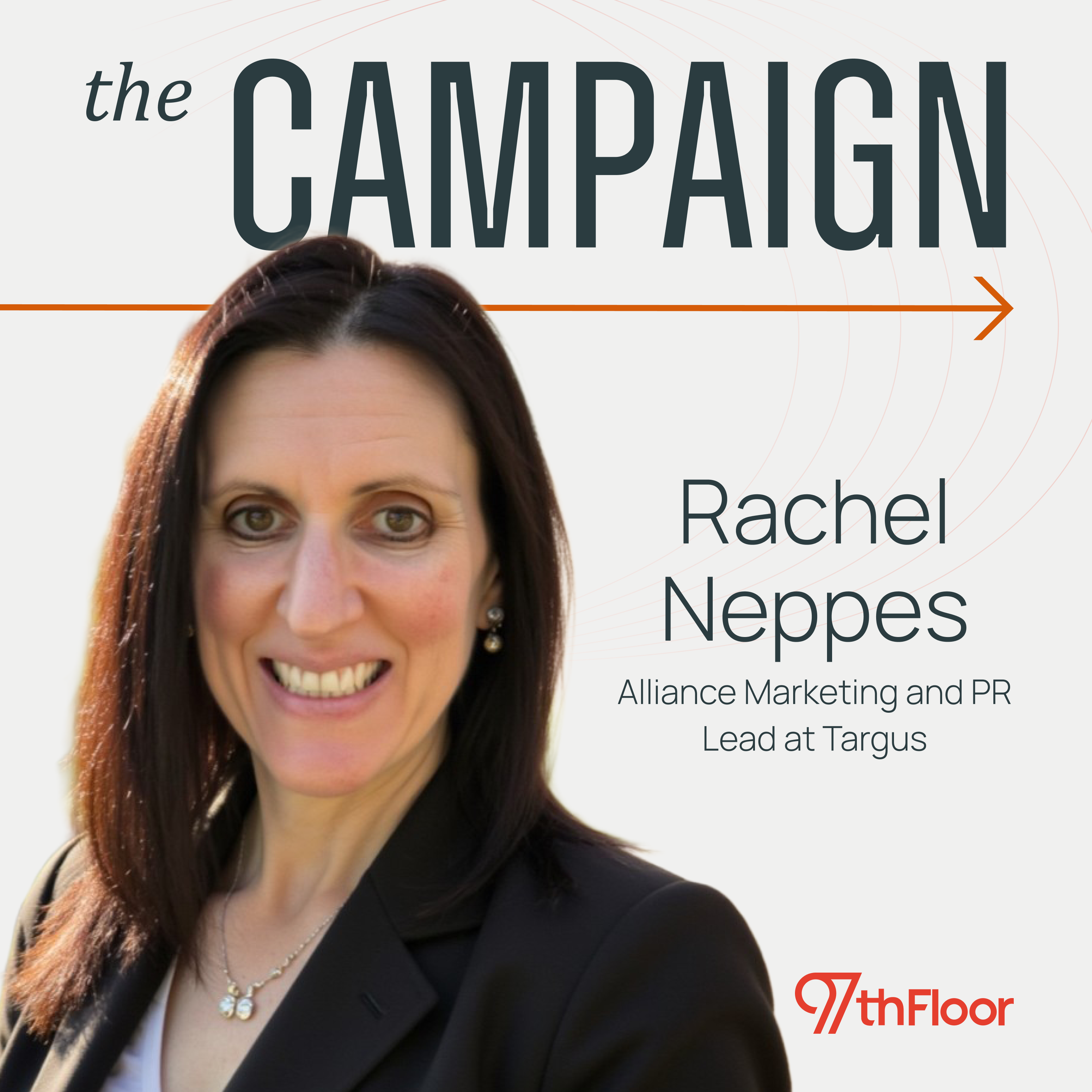
You can find past episodes of the campaign on YouTube, iTunes, Spotify and at 97th Floor.com. today's guest is Rachel Nepes. Rachel is a marketing leader focused on building brand credibility and relevance that drives demand and growth at Target. Rachel leads alliance marketing and global communications across partnerships. Go to market strategy and positioning, all to grow market presence and business impact. In this episode, Rachel will explain why flooding the Internet with AI content can backfire and how trust actually spreads across owned, earned and paid channels. Let's get into it.
[00:01:01] Speaker B: Rachel, thank you so much for joining us. I'd love to get started. You've got a really great pov. You're running alliance marketing and PR for a brand that's literally co branded on products sitting inside laptops and backpacks from some of the biggest names in tech. So before we even get started on strategy, I think the audience would be really interested to understand a little bit more about what your day to day looks like.
[00:01:24] Speaker C: My day to day is very diverse, but essentially my focus is shaping the target brand and making sure that we show up in the market in a credible and impactful way and making sure that we are closely aligned with the messaging and brand of our alliance partners.
[00:01:46] Speaker B: Great. So let's talk about AI. AI has come along and now brands can publish and push out just more content than ever. What are some of the flaws of the idea of just cranking out as much content as possible and you know, how does that impact trust and credibility?
[00:02:03] Speaker C: Yes, AI is obviously a huge game changer, both in terms of ability to be more efficient, you know, keep your voice heard and your messages flowing through channels proactively. But the risk there is, it becomes noise. Right? There's a lot of content, but the brands that really differentiate themselves are those that earn credibility.
And so I think, you know, it's really important to be authentic in your content and AI has a tendency to remove some of that authenticity.
[00:02:36] Speaker B: So credibility, you know, it's a common word. But how do you define credibility within marketing? Like how, how does a brand build credibility or turn credibility into a way to grow market share?
[00:02:48] Speaker C: So credibility is defined by trust, by how your audience trusts you and that's identified through how they're listening, how they're responding, how they're engaging with your content, not just scrolling past your content and really creating conversations with your brand to drive your messages forward and help reinforce the credibility of your brand. And that trust is essential to making them more audiences believe your brand is credible and relevant and trusted.
[00:03:24] Speaker B: Have you seen AI change the way that brands can either earn or potentially destroy their credibility? Do you feel like it's kind of the same game and equation that it's always been? AI is just now another tool?
[00:03:40] Speaker C: I think AI is absolutely making it more challenging to be credible. Right. Because people are skeptical of what they're reading and what they're listening to and what they're watching because of AI. And many people don't know how to tell the difference.
[00:03:56] Speaker B: Can you say more about that? Like, how does a brand, like, do they need to go out of their way to prove that this is not AI generated? And like, we need to think about that more often. And do you think there's ways that a brand could use AI generated material and not lose credibility, or do you think they just kind of need to steer away from that?
[00:04:16] Speaker C: No, I absolutely think AI should be used as a tool to strengthen your message and your brand credibility. But it needs to be done in a correct way. Think marketers or brands think that if you just crank out AI generated content quickly, you're going to, you know, build audiences and then they're going to convert into customers or sales. But the truth of the matter is people are more skeptical than ever because of AI. Okay, so how do you overcome those challenges? You have to be able to really scrutinize the content that the AI is generating on your behalf. And using it really is more of a foundation to strengthen your message rather than a replacement for your efforts.
[00:05:01] Speaker B: Something that I've heard people talk more and more about is ethics when it comes to AI and AI generated content.
And I'm wondering, as you work to build credibility and maintain credibility using AI content and using AI as a tool, are there certain guidelines that you found useful when it comes to, I guess, ethical boundaries or lines? There's a lot of new lines that I think no one is really drawn yet that we're all figuring out where those lines are. Is there anything that's been helpful for you?
[00:05:30] Speaker C: Well, I think that first, every business should have an AI policy. Okay. A policy of how companies are or how teams are using AI to create content and publish their content. AI generated content ethically should have a disclosure that AI was used to support the project or the content development effort.
And companies need to be very transparent about that. And I think that is really key in making sure that your audiences trust your brand and your messages.
Got it.
[00:06:04] Speaker B: Okay. So I want to build on this concept of credibility and talking about thinking of it as an ecosystem. So you've talked about all these different areas.
Work to build credibility. What does that look like when a brand's credibility channels are actually working together versus siloed. What are some of the ways they can work together and some of the benefits that you've seen?
[00:06:26] Speaker C: Yeah, absolutely. I mean credibility is built not just through one channel or tactic, it's built through the entire ecosystem of your marketing approach. So that spans your own content, your earned content, paid content. Okay. Everything that you're disseminating into the marketplace needs to be built on credible messaging. And you build that through partnerships, partnerships with your customers, how your customers speak about your products or services through testimonials, case studies, through media. Right. Through. But authentic stories. Not just an article that you paid for. Right. But an article, you know, based on real assessment of your product or your brand. A real review. I think partnerships, you know, that's, that's defined through your partners. Right. Your, your business partners. Similar to what I do in my day to day, working closely with our alliance partners. That's a huge credibility driver because we're building our brand equity alongside our partners. And that makes it much more believable when they hear stories from those partners about the strength of your brand or your products. Right. Because people believe what other people say about a brand, not what you say about yourself.
[00:07:44] Speaker B: Right. So I think when people hear partnerships, they think about like co branded emails or logo swaps. What's the difference between a partnership that builds credibility and one that's more just like, yeah, we checked the box, we built the partnership. You know, standard stuff.
[00:08:01] Speaker C: Well, I think that it's through real authentic storytelling. How your brand solved a problem. Right. How your product, you know, apply to a real use case scenario. Finding ways to tie your brand story into real world problems or solutions and you know, the topics that are really keep your customers or your audiences up at night.
[00:08:24] Speaker B: Yeah. So let's talk about PR and the role that you see PR playing in AI. I'd love to just hear like your initial high level take, then we can get deeper from there.
[00:08:34] Speaker C: Yeah. Again, you know, AI has completely transformed journalism. Right. I mean think about when you read something or you scroll through a news headline, what is your immediate thought? Is this A real reporter or is this an AI generated piece of content? You need to be able to tell the difference and that's becoming more and more difficult in this age. So you have to really scrutinize everything you read, check your facts, go to multiple sources, make sure that what you're reading or hearing is truly legitimate and trusted.
[00:09:08] Speaker B: Yeah. Where do you feel like, you know, some people listening to this are going to say, that's great. My resources are very limited. I can either build some great content and invest in the site and try to drive traffic there, or I can invest in doing some outreach and some PR and building the brand. Do you think that's the right way to think about it as like a. If, if you are resource constrained, is it an either or, or is there a way to do both that you would recommend to somebody who's maybe tapped on some of their resources?
[00:09:39] Speaker C: Yeah, I mean there's definitely a balance there. Right. Like I said, AI is a tool that we should be leveraging to our fullest advantage. But think I. But not something that I believe can replace the human voice or human creativity. And so it's really about finding that balance. But effort and time does need to go into quality marketing, communications. It can't be just press a button and generate this. People are going to start noticing the difference.
[00:10:08] Speaker B: Where do you think they are most likely to underinvest if they're just getting started in something like this?
[00:10:13] Speaker C: Yeah, I mean, I think that they're probably under investing in their PR campaigns. A lot of companies think, you know, maybe if we have to cut something out, we'll, you know, we'll cut back our PR budget because we can't directly prove how it's impacting our sales funnel. Right. But it's a, it's a huge influencer in, you know, building that credible brand message that you need to, you know, create real conversations with your customers and get them to continue through the sales journey with you.
So that's, that's, I think a big mistake that a lot of companies make in budget cutting environments.
[00:10:53] Speaker B: So I have to ask, I don't know if I've ever run into the concept of alliance marketing. Is that is like, is that a way of saying partnership marketing or is that different? Is that unique to Targus? I'd love to learn more about like that role.
[00:11:06] Speaker C: Sure. In our business, a lot of tech accessories providers, they, they work with, you know, OEMs like, like you mentioned and we make products, you know, to complement their devices. So when I say alliances, you know, can mean a lot of different things. Partners also mean our channel partners. Right. We sell a lot of our products through the channels.
[00:11:27] Speaker A: Yeah.
[00:11:28] Speaker B: Do you feel like your background in PR influences the way that you approach alliance marketing? That maybe some of your counterparts at other companies, do you see some things that they don't see because of your background?
[00:11:40] Speaker C: I think it definitely helps add value to my role and also to the outcome of the alliance business because it has an emphasis on creating trust in our messages and building, I think, real strategic partners that are going to partnerships that are going to advance our brand versus just thinking of it, you know, in a silo as, you know, partnering on a piece of content or a brochure and giving it to our alliance partner and then them putting it out there. Right. So it's a much bigger thing when you think about partnerships because PR is the essence of relationship building.
[00:12:20] Speaker B: Okay. Yeah, great. I'd love to talk about impact and measurement. I feel like that is the thing that everybody is talking about. It's getting feels like more and more difficult despite advances in technology. You think it go the other way and you know, things that are very important but difficult to measure, I think sometimes get sidelined as things get more difficult to measure. So brand trust, notoriously hard to put a number on. When your CEO is asking like, is this thing working? What do you say? How do you prove that it is?
[00:12:52] Speaker C: Well, I think you prove it by, you know, how your engagement rates are improving or how long, you know, you can actually measure it in tangible ways. Maybe not necessarily from I sent out a press release and then we sold, you know, XYZ product. Right. But there's a whole in between of measurement that is very, you know, engaging with your audiences. You know, the page, page bounce rate. Right. In your Google Analytics, being able to see how long someone's stuck on the content or did they actually take action? Did they download something as a result, what did they do? Are they having conversations with you on social media? Is it positive sentiment? Right. And I think all of that is very powerful. For instance, if your product is featured in a key publication in a top review, that review becomes equity to then leverage in your sales pitches and to convince your customers that you're, you know, a trusted and worthwhile brand or company to do business with. So all of that is absolutely measurable.
[00:14:05] Speaker B: That's interesting. So I think some marketers may say, hey, we got this placement and that's a win. That's the win is we got this placement. And what you're saying is that is A win, but you can then leverage that into more wins. And so maybe would that be like what you would recommend to some marketers? If you're like, don't stop at whatever this, this initial kind of metric is, but like, can you then leverage that into more and more value for the brand? Is that like a good way to think about it?
[00:14:34] Speaker C: Yeah, absolutely. If you see a big write up in a publication about your brand, right. If you, if you're not amplifying that story, you know it's losing its value, right? So making sure that your teams internally are also participants in spreading the word about this piece of content or making sure it gets shared out with their customers or their, you know, their audiences. So I think it's really essential that everyone's on board with that amplification.
[00:15:05] Speaker B: Has a partner ever helped you tell a credibility story in a way that really moved the numbers in a way that you didn't expect? Or are there maybe any examples where third party validation showed up in your data in a surprising way?
[00:15:17] Speaker C: I can certainly talk about some really important partnership efforts, such as a partner webinar. Let's use that. An example. We do that quite often with our partners and it creates a really credible piece of content and sales education.
Right. To be alongside our partner and talking about how our products are solving problems for them or for their customers, versus just saying we have this great new product and just talking about the product. So I think it's, you know, how you spin it too, right? That you're providing something of value.
[00:15:56] Speaker B: Yeah, yeah, I like that. Maybe to, to wrap up here a little bit. If a marketing leader is listening today and they want to start building credibility, you know, they haven't really invested in this. They haven't looked at it with this lens, but they want to be more systematic about it. What's maybe the one thing you tell them to go do first?
[00:16:14] Speaker C: I would do some research, right? Find out what people are saying and what they're responding to as it relates to your topic or your product or your industry, and figure out how you can tie in with that. Right? How can you make your message relevant to them? So that's the first step. You're building your pillars, okay. You're, you're deciding what to talk about that will be meaningful, that will actually move the needle, and then figuring out then how to put your own unique voice on that topic and make it distinct for you or your brand, rather than just repeating what maybe your competitors are saying, but come up with something new or different to talk about.
[00:16:58] Speaker B: Either it's a small business and they're like, I don't know what to say and it's just maybe a little bit of blank page syndrome, or it's a larger business and they're kind of afraid. Like, if you look at most B2B advertising, especially in the, the tech space or the HR space, they all, all the ads look the same. They're all blue and they're all some sort of illustration and shapes. You know, it's like, I think it's just a lot of people who don't want to go outside of the norm. So if you're either struggling because you don't want to take big swings because you work at a big org and you don't want to take those risks, or maybe you're on the early side and you're like, I just don't know what to say, I don't know what to bring. Do you have any advice for somebody who's sitting in that seat?
[00:17:39] Speaker C: Well, I think you have to really step back and try to understand what value your brand offers, what is your distinct position in the market, and then build your narrative around that. If you haven't fully defined your value proposition, then how can you talk about it in a way that other people will believe? And I think a lot of companies, they skip that part. Right. They're just in a rush to make sales or to, you know, get going, especially in maybe a smaller startup environment.
Right. But you, there's no shortcut for doing the hard work upfront. Yeah, yeah, yeah.
[00:18:15] Speaker B: That's the true. It's, it's like there's product market fit and then there's kind of marketing market fit or message market fit, and it's, it's equally as important.
Yeah, I like that. So, last question to wrap up. Something we ask everybody is who has had a big impact on the way you view marketing?
[00:18:34] Speaker C: Yeah. So I'd like to kind of step outside the boundaries a little bit and reference my journalism professor.
His name was Robert Greene. Some of you listeners might have heard of him, but he was a Pulitzer Prize winning editor at Newsday, and he broke some really important investigative reports like the Arizona Project. And he really taught me about how to be an authentic communicator and how to tell a story based on fact and truth and honesty. And I think that applies to marketing more, more than ever. Making sure that when you are creating a story that it's believable and it's grounded in truth.
[00:19:20] Speaker B: Yeah, I love that. I think there's a lot of Marketers today that find themselves carrying this burden of it's about generating the best results. And I think sometimes that ends up being more complex versus telling the truth. Being straightforward about what you have to offer and then changing what you have to offer when it's not a good fit. Where have you seen that play out in your career, that concept of just being straightforward and honest? And what has been the benefit of that as you've practiced it?
[00:19:48] Speaker C: Well, I don't want to cite any specific examples.
I've encountered scenarios where I had to defend a brand based on a recall or a faulty product.
And unfortunate situations happen like that. Companies tend to think about how can they spin it in the, you know, in the best way. But there's no, there's no escaping the truth. I find that when there's a negative experience about your brand or product, you have to talk about it and you have to communicate how you're solving that problem.
So I think that brands that do that authentically are the winners.
[00:20:26] Speaker B: Yeah, I agree with that. And I think there's, it's an opportunity to come off not as weak, but actually is more powerful by just being straightforward, honest and upfront about the situation.
I think that's a fantastic lesson to end on. That was a really great call out your professor.
So thank you for sharing that.
[00:20:44] Speaker C: Thanks for the great questions. I enjoyed it.
[00:20:46] Speaker B: Yeah, thank you for being on the show. How can what's the best way for someone, if they want to learn more about what you're doing or they want to contact you, what's the best way for them to reach out?
[00:20:54] Speaker C: Find me on LinkedIn. Rachel Nepes.
[00:20:56] Speaker A: Okay, great.
[00:20:57] Speaker B: Sounds good. Well, thank you so much for being
[00:20:58] Speaker A: on the show today.
[00:20:59] Speaker C: Thank you.
[00:20:59] Speaker A: It's been a pleasure.
That's it for today, everybody. If you enjoyed this episode, please consider leaving us a five star rating and subscribe so you don't miss future episodes. Huge thank you to Rachel Nepes for joining us today. And find her on LinkedIn if you want to talk with her more about brand credibility and partnership strategy. You can also find past episodes of the campaign and examples of our
[email protected]. There you can learn more about the agency and get in touch with a marketing specialist to get support for your own marketing campaigns.
That's it for now. Thank you for listening. As always, keep innovating, keep converting.