[00:00:00] Speaker A: Hello everyone, I'm paxton gray, CEO of 97th floor and this is the campaign.
Thank you for joining us today for another episode of the Campaign where we talk with marketing leaders about better knowing your audience, innovating beyond best practice and converting visitors into customers.
The campaign is produced by 97th Floor, a world class digital marketing agency designed to build organic and paid channel strategies for mid level and enterprise organizations. You can find past episodes of the campaign on YouTube, iTunes, Spotify
[email protected].
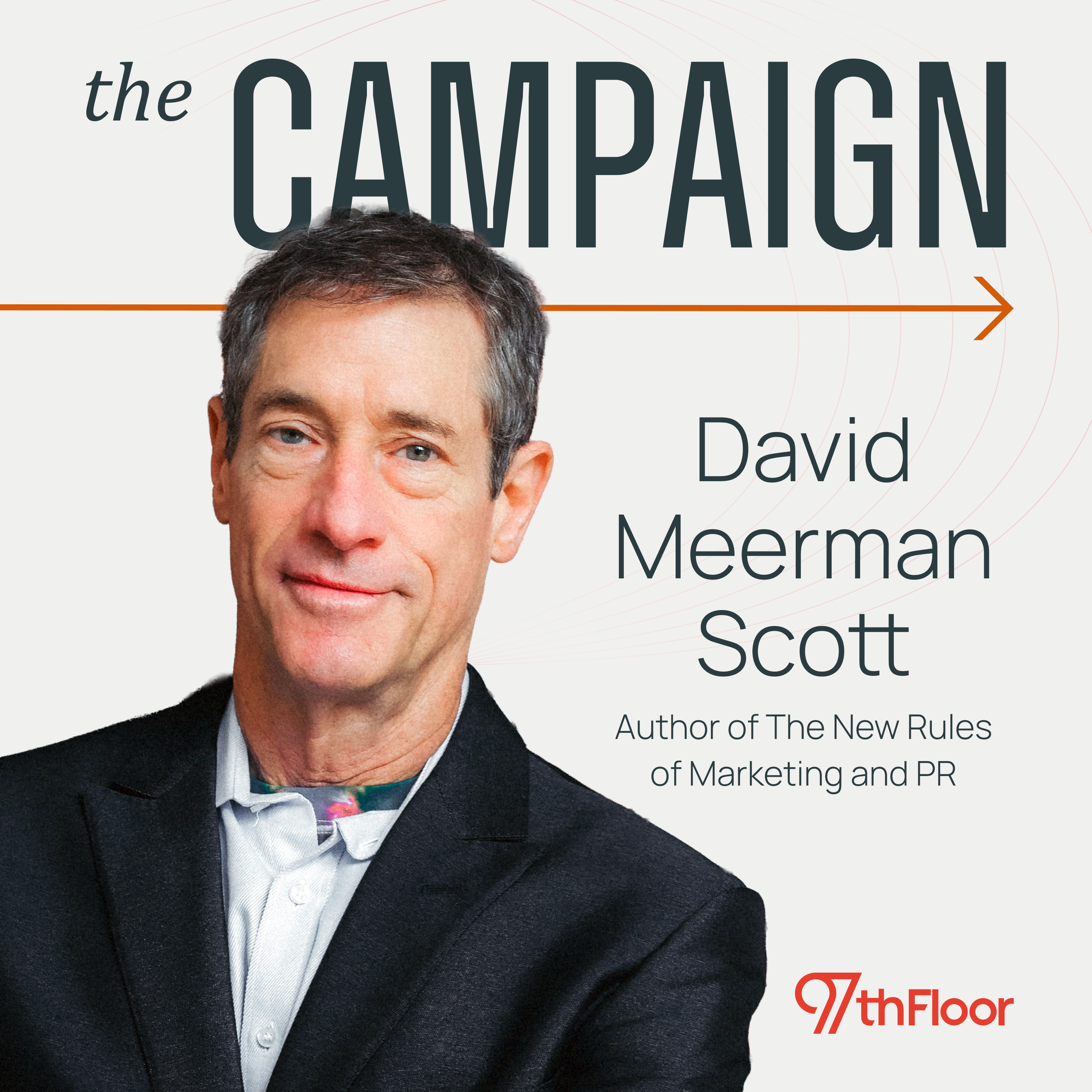
Today's guest is David Meerman Scott. David spotted the online marketing revolution early and wrote several books about it, including the New Rules of Marketing and pr.
Now he says the pendulum has swung too far to shallow online noise.
He shows how organizations win by building fans, which is the subject of his Wall Street Journal bestseller Fanocracy and his new book the Fandom Playbook coming out later this year.
In this episode, David makes the case that content still wins, but AI has changed where people find it. And he walks through real examples of how to get your content in front of the right people. Let's get into it. All right, David, so excited to talk with you.
I want to dive straight into it because I think you have so much to share with with our audience.
So my first question is getting straight into it. You've watched the rules of marketing get rewritten multiple times. Yeah, you know, social media, just when
[00:01:28] Speaker B: I thought it had, I had it figured out. They changed again.
[00:01:31] Speaker A: That's so that's my question is like where does AI rank in the history of disruption as, as you throughout your career, as you've kind of rewritten things?
[00:01:39] Speaker B: I haven't decided if it's number one or number two yet because as marketers the idea that you can create your own content and put it out there was absolutely freaking transform informational starting in the late 1990s because before that you had to pay to go to a trade show to meet people, or you had to pay to be in the trade publication or you had to have an army of people cold calling.
It was hard to reach people as a B2B marketer, which I was back in the day. I was the head of marketing for several different public companies, B2B technology companies. So I've been there, I've done that. But then the revolution of content creation comes along and all of a sudden your website and your later on social media and things like newsjacking, creating instant contact to generate attention, these are all radical transformations about how we B2B marketers work. And yeah, of course AI is huge and significant, but I haven't yet decided which one is bigger. The AI revolution or the ability for us to create content revolution?
At the moment, I'm going to call it a toss up.
[00:02:53] Speaker A: Interesting. So I'm curious what you saw change immediately and then what took maybe like a decade or more to change from that initial revolution? Because we're, we're in the stage of AI right now where some of the impact won't happen for another decade. So what did you see play out from the beginning versus the later stage?
[00:03:14] Speaker B: It took a really, really long time and in some cases people still aren't doing some of the things that I've been talking about now for, since the last century. I mean, it's hard to say it that way, but yes, since the 1990s I've been talking about this stuff.
And you know, people know that they need to have a great website. Not everyone has a great website. People know that you can reach your potential and existing customers by creating interesting and valuable content, but not that many people are doing it. So how long has that taken to play out? 30 years.
I think the AI revolution is going to take a shorter period of time. I can't imagine 30 years from now we're going to have people saying, well, I don't really do that much AI myself, but who knows, I mean, we're in the early stages right now. It did take a very long time for organizations to become a part of the revolution. I think part of that as I saw it at the time, was a holdover around who were the bosses.
So, you know, starting late 1990s, early 2000s, when you could create a great website, you could start doing blogging. It was pre social media, but you could do social media like things to get content out there. But, but the bosses, the VPs, the C level people came from a world outside of that. And I had so many people tell me who had read a copy of the New Rules of Marketing and PR or even before that, who had, who had been exposed to my ideas that they'd say something like, David, we know this is the right way to go. We know we should be investing in creating content and having a fabulous website and some of these ways of reaching people. But our boss, the head of sales or the head of marketing came up when the only way to reach people was to cold call them. Or the only way to reach people was to spend a million dollars at the trade show. And that's what they continue to want to do.
Those people are now kind of out of the picture. So we don't have that kind of resistance anymore. But I think that same sort of resistance is often showing up today around artificial intelligence implementation, at least for some of the smaller organizations that I see out there.
[00:05:41] Speaker A: I just recently read the newest version of your book and content plays a massive role in the kind of centerpiece of strategy within marketing.
And the sort of exchange has been. And really I've built my whole career on this very concept of you put content out, you attract attention, you build brand authority, affinity with that and you convert.
[00:06:07] Speaker B: Right.
[00:06:08] Speaker A: AI is coming along and now people are doing research inside of LLMs based off of content written by brands.
And for some brands it's changing the equation of the content formula. Do you see a fracturing of the consumer market or kind of a coming together in a monopoly in a sense of like attention? I'm just curious how you see equation changing and what the strategy is moving forward.
[00:06:39] Speaker B: So my sense is that the basic idea is still totally valid. You create content, people find it somehow and then that brands you as an organization worthy of attention, that maybe they'll check you out, maybe they'll become a client at some point down the line. That is still true. And I don't think that's changed in any way. However, as you rightly say, AI has changed the way that people are discovering that content, the way that that content is showing up for people or not showing up for people. I mean, in the old days it used to be the search engines, you know, even, even prior to Google, you had to figure out how to get found in places like altavista or Ask Jeeves or Yahoo, remember of those fun names?
And, and then of course Google. But now it's how do you get found in ChatGPT or Cloud or these other places that people are going? And it still is the content that drives that. And there's a number of different ways that that that can manifest itself. So.
But there's also people who are looking for the four kinds of content that maybe aren't being found through those AI engines. And I'll just give you a couple of examples of the things that float through my mind is many organizations, B2B technology companies included, have a vast store of interesting proprietary data that could, if aggregated and anonymized in some way be surfaced as valuable tools for potential or existing customers to be given away for free. Let me give you a couple of examples.
So some number of years ago I worked with a company called Intralinks. They have a technology product that allowed for deal Teams like M and A teams to have a secure place to store documents that they could share back and forth. And it became the largest provider of this type of service. Typically the investment bank would be the customer, they would buy the product, and then the companies going through the merger or acquisition or potential IPO would share between local lawyers and investment bankers and whatnot, and the company on the secure platform. What they realized is that they had a head start in understanding what deal flow looks like going forward because those data rooms were set up prior to an announcement of a deal happening. Now, they obviously are highly secure with highly confidential information, so they can't talk about individual deals. But what they could talk about is how many deals this month, how many deals this quarter, and is it larger or smaller than last month or this month last year? And so they put that out as the intralink steel flow calculator. And so it's a great way of aggregating the data they already had, anonymizing it and making it valuable. And that becomes a way that people can find them, that the AI engines later on can find that data and surface it. And then they can be seen as, oh, okay, well, these are people who know about this because they provide this tool. This tool is something I can use. I should check them out. Another example, actually, one of my favorite examples, when I'm on a stage and I ask people if they love car insurance, the answer is almost always no. Do you love car insurance?
[00:10:12] Speaker A: I don't know.
[00:10:13] Speaker B: You don't? Okay, he says humbly, I don't.
Once in a while someone's hands goes up and I call them out in their. In the insurance business. But.
So people hate car insurance. They hate buying it costs money. They hate using it because it means they crash their car. But Hagerty Insurance, the largest, they're the largest insurance company for classic cars. They sell both B2B and B2C. The B2B aspects, as they sell through insurance agents, they realized of that they have 3 million, over 3 million cars, classic cars that they insure, you know, might be a 1973 Land Rover like I own, or a 1963 Ferrari or whatever. It might be a 1972 Volkswagen Beetle. And they had so much data on how much these classic cars are worth, real data, because that's how much they were insured for. And they did the same thing, created a database, anonymized. They're not talking about individual vehicles, they're not surfacing the names of the owners, but they're saying that if you own Like I do a 1973 Land Rover Series 3 hardtop.
Here's what it's worth based on the amount of money that we insure these cars for.
And they put that out for free. Anybody can tap that data and find out what their classic car is worth. And they're like, who is this Hagerty company providing this fabulous data? Oh, they insure classic cars. I'm interested. So the first thing to be thinking about here is can you look into the bowels of your organization and, and find data that you have that's proprietary in such a way that you put it out anonymized so that it's valuable for the people you're trying to reach. The second thing is, and there's many more, but these are just a couple ideas that immediately come to mind are instant content. So for 20 years now, I've been talking about creating instant content right now. When something happens, you have an opportunity to put out content Today, right now, a blog post, a YouTube video, you could do instantly. Do an online event, a virtual event, you know, hey, we're going to do it right now, Come show up in two hours. And I invented this concept I called newsjacking, which is the art and science of injecting your ideas into a breaking news story.
And newsjacking gets content into the marketplace of ideas. When a story is breaking, when somebody who has expertise around that issue that's breaking puts that content out there, they can sometimes get quoted in the media, they can sometimes have people who are searching find that content. Now the reason that's really interesting is that many business to business companies are able to comment on what's going on in the marketplace of ideas in the news cycle. You know, okay, we're talking about AI, you're an AI company, bang. You should be talking about what's going on social media, you know, whatever it is that you do, whatever technology you provide, there's been a data breach. Do you provide data security software? Now is the time for you to talk. Not tomorrow, not two hours from now. Right now is the time to talk. So create real time content, put it out there where it can be found in a blog post, whatever.
Alert your media contacts, see if you can get quoted in a story. Because that type of content is what gets surfaced by the AI chatbots when people are searching on that breaking news story.
And, and so it's a great kind of way to get into, into those large language models. Now I'll give you one more idea that I've been thinking about a lot for getting into those large language models, which is Grok, which is the X version of artificial intelligence. Not as many people use it as ChatGPT and Claude and whatnot, but they've got a Grokopedia. It's a competitor to Wikipedia.
And Grokopedia is all AI generated content. But interestingly they have a suggest an article button.
And if you have an area of expertise around a particular issue, you can suggest an article, cite yourself as the source, and often the AI engine will then create something. So I've done that myself with all of my books. I was already in Grokopedia for my name, but now I'm in there for the books I've written. So it's, you know, notoriously difficult to get into Wikipedia because they have human editors. It's a lot easier to get into Grokopedia because it's an AI generated encyclopedia, online encyclopedia. And when someone asks Grok questions, it's often surfacing answers through Grokopedia. So an interesting backdoor content way to get in there.
I know that was a way longer answer than you were looking for, but I kept.
[00:15:12] Speaker A: That was great and I want to build on it.
I started my career in 2007 and back then the Internet was a very different place than it is today. One of the things that was common across virtually every blog, company or personal were comments.
There was a comment section at the bottom of every article, like on any company blog, you know, and it was a place where discourse would happen, questions would be asked and answered, and over time people started to manipulate it. It got to be filled with spam. I think it got to be difficult to monitor those comments. But now we find ourselves in a place where that it never happens. Like the only discourse that are happening are within the walls of Meta or Reddit or Microsoft with LinkedIn.
[00:15:57] Speaker B: Yeah, yeah.
[00:15:58] Speaker A: And I'm curious if that's something marketers should look at bringing back as a way to keep content fresh because comments make new content on an existing page and, you know, you just own more. But I'm just curious if you notice that same transformation and if there's anything there from like a human centered point of view on the content. A little less cold auto AI generated.
[00:16:22] Speaker B: I've absolutely seen it in my own blog, you know, back in the day. I started my blog in 2005, four, 22 years ago, and early on I was getting 10, 20, 30 comments on each blog post. This is great. You know, people are having a party in my house. This is fabulous. And, but since social Media came around. So call it, you know, 08, 09, 10, something like that. When social media started to take off, I noticed very much as social media was taking off with all of its commenting features, my blog comments went down proportionally.
People spending time on Twitter meant they're not spending time on my blog, which is totally fine.
I'm not sure the nature of your question was, should we bring that back? I'm not sure how that could be brought back.
I know that in my case, I publish to my blog about once a week or so, and then I copy and paste and change a little bit of it and put it into my LinkedIn newsletter. And the LinkedIn newsletter will get 10, 20, 30 comments sometimes, whereas the blog might get 0 or 1 or 2. But I'm not sure how I could possibly encourage my audience to comment over on my blog instead of commenting on the LinkedIn newsletter. Because the way I look at it is I want people to consume my content in whatever way they find best. I mean, maybe they can listen to this podcast that we're recording right now in their car when they're driving somewhere. That's awesome. What a great way to consume the content that you and I are creating right now. Or maybe they prefer to consume that on LinkedIn, or maybe they like coming to my blog. I don't, but I don't want to force them into one or the other of those things. I don't want to take my content down from LinkedIn and force people to go to my own website.
So I do think it, it continues to be really important to have content on your own real estate. In this case, my blog, which is part of my site, davidmearmanscott.com that's super important because that content you own, you own all that content. You don't own the stuff that you put out when you put it out on YouTube or LinkedIn or somewhere else. It's owned by those social media, those giant social media companies who can do whatever they want with the algorithm to show your stuff or not show your stuff.
Do you have any ideas on how you can get more people to comment on your own blog? I haven't even thought about that as a possibility.
[00:18:54] Speaker A: I don't know. Personally, I feel like the user experience, not in the traditional sense of like mathematical user experience, but just general feel, was a lot better at that time. And I think we all converged into these platforms owned by very few people with incentives to expand reach and increase consumptions. And I think in doing so, decreased the general experience.
The quality of the general experience. And so a little bit of that is like I want to go back to the Internet that was a little bit more fractured, a little bit more.
I hang out on these four sites, I check these five sites every day.
And less algorithm based and a little less feed based. So as a user I would like to have something more like that.
[00:19:40] Speaker B: But I don't know how you, I don't know how you can take the algorithm genie out of the bottle. You know, it's like, I think as the, as the rise of algorithmic driven content has exploded, that translates pretty one to one to the, to the decrease of comments on my blog posts.
And you know, I, I've written and spoken many times about how I believe that the algorithms, especially from Meta and Google, are among the most dangerous technologies ever invented by humans. I believe they're as dangerous as the atomic bomb. I truly believe that because those algorithms drive people into polarization and hate and all kinds of dangerous things that get people to believe things that they're perhaps predisposed to believe, but they never would have been too exposed to without those algorithms pushing this content on them. So I think they're incredibly dangerous. But I think that's the world we live in. When you decide you're going to use a product from Meta or you decide you're going to use a product From Google, like YouTube, you're at the mercy of that algorithm and that sucks you in and sucks consumers in in some ways.
And many of those are dangerous. I don't know how outside of legislation you can fix that problem though. And I see it getting only worse. And I'm fearful for the 2026 and even more so the 2028 election cycle in this country as algorithmic driven content, real and fake, starts to proliferate prior to those elections.
[00:21:36] Speaker A: Yeah, speaking of monumental shifts in technology, you Contributed to the 2026 Marketing Talent AI Impact Report and you said that AI is no longer an emerging skill, it's becoming the baseline of the entire profession. What does that mean practically for marketing leaders listening to this?
[00:21:58] Speaker B: You know, there's tons of people talking about AI and I'm not suggesting I'm any kind of expert in this. However, I do think that, that marketers who understand and can use AI are going to be way more powerful, influential and effective than marketers who don't. So the challenge becomes how much and how do you automate how much and how do you use agents? How much and how do you bring AI into the marketing stack, into the marketing strategies that you're doing. And the way I like to think about it is that for a long time we had a layer of people in the marketing department and the public relations department whose job was to translate the strategies from on high down to the doers who did the work. So the doers who did the work, the people who wrote the press releases, the people who produced the customer event, the people who designed the PDF document, the people who created the website, all of that, all of those sorts of marketing tasks. And then you had the strategy up top of this is the direction we're going, this is the product offering we have, these are the customers that we're trying to reach.
Our strategy needs to be how are we going to generate more sales leads of among this demographic? But there's a vast middle of people whose job it was to essentially translate that, that strategy down to the people who are executing on the details of doing that strategy. That middle layer is going away.
So either you're a strategy person or you're a doer person, called a player coach if you want. But there's not going to be much room for people whose job it is to sort of sit there in the middle and specifically people who sit in the middle between outside agencies and the company and people who actually work at agencies whose job it is to sit between the client and the agency. So those jobs, those functions, those people in many cases are going to gradually decrease and potentially even go away.
So think about how your marketing department can run using artificial intelligence to transform to an organization.
That strategy translates directly through technology to the people who need to execute on that strategy.
[00:24:29] Speaker A: Help me understand that practically, does that look like AI empowers the strategy? So whoever's in charge of strategy says, hey, we need to accomplish A, B and C.
And then the AI does the work of translating that into steps X, Y and Z. And then those steps go on to execution. Or is it that like, that can practically.
[00:24:52] Speaker B: That can be a part of it, but another very big part of it is literally just translating the reporting back and forth. Okay, so how many sales leads do we have this week and how many new clients do we sign this month? And how can we, how can we reach more people through the search engines? Or how many, how can we get more people to come to our, our annual conference? Much of that stuff doesn't need to be people generated anymore. It can be technology generated. So there's many different manifestations of that. And I think a lot of us who are thinking these ideas through are trying to figure that out, right now, there is no perfect example of a way that you can eliminate, you know, 20 people in the middle and, and have the CMO, the CEO and the chief Revenue Officer get together, set strategy, and then immediately have technology that drives it down to the point of the people who are actually doing the work. But that's where we're going.
That's where we're going. I believe, I strongly believe that's where we're going. And also with agencies, having that middle layer in an agency is likely likely to also go away. And the layer of people who talk from agencies to, to clients, that will begin to, to shrink. I don't think that'll completely go away because somebody has to maintain the relationship with the client. But a lot of the reporting stuff is definitely going to go away.
[00:26:22] Speaker A: Yeah, I want to make sure we touch on this because I think it's fascinating and hopefully we can talk again more about this later. Writing a new book, Fandom Playbook.
[00:26:33] Speaker B: The Fandom Playbook. Yeah. Yep.
[00:26:35] Speaker A: And you have talked about using AI in the production of that and it, it has a, an AI chatbot or assistant that goes along with it. Tell me about that process and what you've learned throughout the. The production of that.
[00:26:51] Speaker B: Oh, yes, sure. So I've written about fandom now for 20 years. It's most fascinating topic that I write about is how and why do people become fandom fans of something?
Why do you. Why do. Why does someone devote their life to Korean pop music like my daughter, who's a huge K pop fan? Or why did I become a nerd who loves the Apollo lunar program? And who. How did I become re in my recent life in the last couple of years, like digging deep into this nearly extinct dance called the Lindy Hop, which is the original swing dance out of Harlem in the 1930s, it makes. It's weird to like become a fan of something interesting and obscure. And so I've been studying this idea because it is entirely possible for organizations to build fans of their customers. And I've got tons of examples of those. So I wrote a book called Marketing the Moon about the marketing aspects of the Apollo lunar program program. And one of the important aspects of what the Apollo program did was made made the astronauts into heroes, the people who walked on the moon as heroes. And then people became huge fans of those astronauts and they became huge fans of NASA. And therefore the American people supported NASA spending billions and billions of 1960s dollars to send 12 humans to the moon. And now with the Artemis Project, which was a stunning triumph last month.
We are now going back to the moon. And people, the American people are behind it because.
And I actually spent a full day with the head of NASA and their PR department talking about how they can make more fans around what NASA's doing. And they took some of my ideas, which is get as many photos and videos out there as possible because that's what people become. Help. Help them to become fans of something. I wrote this book called Marketing Lessons from the Grateful Dead with my buddy Brian Halligan, the co founder of HubSpot, former CEO of HubSpot. Marketing lessons from the Grateful Dead. This crazy band that. Here's the book here. This crazy band that generated legions of followers. I've seen 111 Grateful Dead concerts. What's that all about? And I wrote a book called Fanocracy about sort of the big picture, the neuroscience aspects of fandom. And many people said to me, but, but David, I love these ideas of fandom. I'm absolutely down with the idea of making my customers fans of what we do and who we are and our people. But how do I do it? What are the specific steps? So the Fandom Playbook, which is coming out 10-20-26, is is a step by step guide to building fans of any business. B2B, B2C, nonprofit government agency, sports team, doesn't matter how to build fans.
And I did partly use AI to make the book because I'm not an expert in adult learning.
I am an expert in fandom. So I took my book, Fanocracy, a couple of other my books, 20 years of blog posts, transcripts of speeches, transcripts of some podcast episodes that I participated in, like the one we're doing now, dropped it all into a big database with an AI engine over the top of it, and then had an expert in adult learning. Her name is Jill. She's awesome. Help me to create a, a playbook, a series of plays that people can implement step by step. I didn't know how to do that. I'm not an expert in adult learning. I'm not an expert in translating text based content to learning based content. But that's partly what the AI did and partly what Jill, my learning design expert, was able to do for me. And that book is coming in October.
[00:30:27] Speaker A: Okay. I'm so excited to read it when it comes out and hopefully we get a chance to talk about more.
[00:30:33] Speaker B: Yeah, I'd love to come back on. We'll talk about that book. Yeah.
[00:30:37] Speaker A: To, to wrap up, I want to say, like, you've had a tremendous impact on the world and the industry.
Newsjacking was put into the dictionary. A term you coined.
Fly. You've had movies based off of your book. Fly Me to Moon is based off of your book. Just like a tremendous impact. And I, I. So my question is, I know that with how much you've put out there and the impact you've had, there must be some elements or principles that people have taken and run with incorrectly that just, you know, maybe get under your skin. You're like, if you could just help everybody understand one thing that they're getting wrong today, what would that thing be?
[00:31:19] Speaker B: For me, the thing that every time I see it I just want to cringe is, is anything that outwardly feels fake.
Examples stock photos of people on company websites or marketing materials. Please don't do that.
Don't use a stock photo to represent your clients. Don't use a stock photo to represent your employees.
Or the B2B language that is so overused to have become meaningless. The flexible scalable solution for improving business process using cutting edge technology and mission critical software to enable like, I mean, just makes my brain hurt when I, when I, when I talk about that, I call it gobbledygook language that, that primarily B2B technology companies seem to use like eliminate that crap. Don't talk in that babble. Speak, talk like a human being. You don't build fans by talking about your mission critical best of breed applications. You make fans by talking like a human.
Those are the two main things. Don't be fake, be real.
[00:32:30] Speaker A: I love that. Well, thank you so much for taking the time. I think we've got some really great takeaways for this.
Where can people go to learn more about what you're working on and get notified about the book when it comes out?
[00:32:44] Speaker B: Great. Davidmearmanscott.com I use my middle name professionally because a whole lot of David Scott's out there. So I was competing on the search engine. So 25 years ago I became using my middle name, David Meerman. M E E R M A N Scott. So google me, you will only find me.
[00:33:04] Speaker A: Great. Sounds great. Well, thank you so much for taking the time to meet with us today. It's been very insightful.
[00:33:11] Speaker B: My pleasure. I enjoyed the conversation very much.
[00:33:13] Speaker A: That's it for today everyone. If you enjoyed this episode, please consider leaving us a five star rating and subscribe so you don't miss future episodes.
Big thank you to David Meerman Scott for joining us today. You can find him on LinkedIn
[email protected] youm can also find past episodes of the campaign and examples of our
[email protected] there you can learn more about the agency and get in touch with the marketing specialist to get support for your own marketing campaigns. That's all for now. Thank you for listening. As always, keep innovating.