[00:00:00] Speaker A: Hello everyone, I'm paxton gray, CEO of 97th floor and this is the campaign.
Thank you for joining us today for another episode of the campaign where we talk with marketing leaders about better knowing your audience, innovating beyond best practice in converting visitors into customers. The campaign is produced by 97th Floor, a digital marketing agency designed to build world class organic and paid channel strategies for mid level and enterprise organizations.
You can find past episodes of the campaign on YouTube, iTunes, Spotify
[email protected].
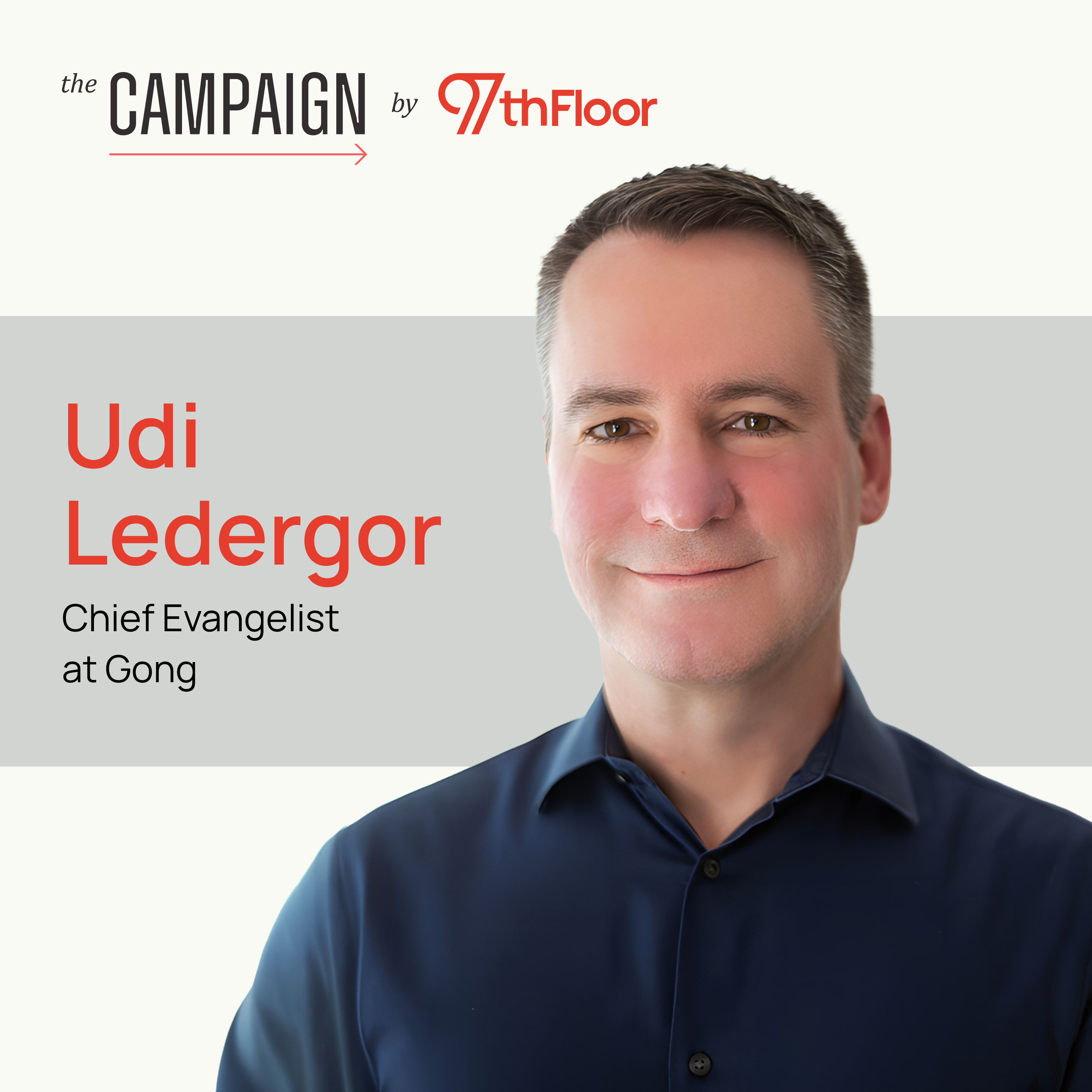
Today's guest is Udi Ledergore, Chief Evangelist at Gong where he helped to define and dominate the revenue intelligence category and helped to achieve a multi billion dollar valuation.
Udi is also a best selling author, speaker, mentor, angel investor and board member. Today we're digging into his new book courageous marketing the B2B marketer's playbook for Career Success.
We'll be talking about courageous marketing, how to have more crazy ideas that actually work and how to get buy off on those big ideas.
Let's get into it. Udi, thank you so much for joining us today. It's a pleasure to talk with you.
[00:01:06] Speaker B: Thanks for having me. Pax. Happy to be here.
[00:01:09] Speaker A: I'd like to start UDI talking about really the premise of your book which is courageous marketing. If you had to say in a nutshell what courageous marketing is as a concept, I'd love to hear your take on that.
[00:01:21] Speaker B: Courageous marketing is about leaving behind the so called best practices which in reality are boring practices because by the time anything becomes a best practice, everyone's doing it. So all you're going to get are mediocre average results and instead adopting a sharp new unique point of view and applying that point of view to everything you do from content marketing to brand awareness, from event experiences to anything else you do in demand gen. That's what courageous marketing is about is making courageous choices. Whenever you need to launch a new campaign or a new piece of content, how can you do it differently bolder than anything that's been done before?
[00:02:04] Speaker A: Great.
Yeah, I absolutely agree. The our entire industry kind of is bogged down by best practice and that I think really slows us down and creates like mediocrity at best.
You have a chapter in your book about punching above your weight.
I'd love to explore that a little bit. So you know that can mean a lot of things. But when it comes to marketing, what what is punching above your weight?
[00:02:31] Speaker B: Punching above the weight originates from the need of many companies, especially in early stage, to appeal to large enterprise buyers.
Geoffrey Moore in His landmark book Crossing the Chasm talked about where most companies go to die is the chasm between the early adopters and the early majority.
Because the early adopters, these are the ones who have to try every new tech and gizmo in the B2B world, especially where we're talking here. So you're always going to find a few of those. But getting to the early majority, these are people who are more conservative and they want to see that other people are using it. They want to make sure that they're buying from a respected, established vendor. And as a young startup, which is most of where I built my career and many of my friends have, you just don't have the luxury of that status. So how will you go about selling to these large enterprises when they don't want to buy from large enterprises because they don't know if you're going to be around in two years, they don't think the product is built out and stable enough, and you don't even have enough reference customers. So that's where the need arises to punch above your weight and look much bigger than you are to appeal to those enterprise buyers. Even at later stages, there are undeniable benefits of appearing to be bigger and standing out. And so if we agree that that's a challenge and a goal that we want to achieve, the question is, how can marketing make the company appear to be two years ahead of where it really is? And so I broke down many of the campaigns that I've ran and I've seen other companies run really successfully and I figured out the formula and I give examples in the book of how, how I did this with Times Square billboards, even with a Super bowl commercial with cars wrapped in branding around the biggest conference in the world, you can do all these things on a much, much, much smaller budget than you think and create visibility that makes it appear much bigger than it really is. And if you want me to run through the formula very quickly, it's a six stage formula, so I'll go quickly. And of course, the full details are in the book Courageous Marketing, which anyone can go get after listening to this podcast.
Step number one is picking a medium typically associated with a large advertiser. So think about Times Square, it's an iconic location. Think about the Wall Street Journal. Getting a full page ad still impresses the heck out of a lot of people. So that's step number one. Step number two is figuring out how to get an affordable way into that medium. So I explain it in detail in the book, but for example, you can pay just $500 to get a Times Square billboard. If you buy it for one day on a digital billboard, you can get it on demand online.
And now you've just bought a Times Square Builder for $500. You want to do Wall Street Journal? Well, instead of doing the national edition, consider the west coast edition, which is much cheaper.
As I'll explain later in the formula. You can still create the full effect that you want with that, but it's going to cost you 20% of what the national edition costs. I even did this on the super bowl, paying about 5% of what people assumed I paid for the national spot by picking three strategic regions where I knew my buyers were concentrated. So that's the second step. Find an affordable way to get there. Step three is make creative use of the medium. So don't be lame, don't be obvious, actually put some work into getting creative with it. For my super bowl commercial, I showed a VP of sales in an empty office during COVID and that really resonated with every sales team out there that was experiencing really, really rough year. We've used our Times Square billboards, amongst other things, to celebrate our outstanding employees and, and make them feel proud, make their team members crave wanting to be on that billboard next year and everyone else looking and going, oh, I want to work for a company who recognizes their employees that way. So get creative with the use of the media.
Step four is getting a photographer or a videographer to take great photos and videos of that installation. So put someone in Times Square if you know that your billboard is going to be up for one hour, make sure they're sitting there 15 minutes before. Take great photos. With all the hustle and bustle of Times Square. And now you've memorialized this iconic moment of your billboards up in Times Square.
Step five is sharing those photos and videos with your actual captive audience, usually on social media. So Gong, as an example, has over 300,000 followers on LinkedIn alone. So when we paid $500 for that little billboard in Times Square, but then share that to our 300,000 followers, now the right people are seeing it, because I don't care about the random tourists on their way to see Phantom of the Opera, and I care about the people following Gong on LinkedIn. And now they saw a large portion of them, saw this billboard, and knew that we did this iconic campaign. And finally, step six is all about mobilizing your employees and sometimes even your customers to increase your reach for practically free, Gong has 1600 employees. Imagine if just half of them, let's assume they have 500 followers each, some of them have over 100,000, but let's just assume 500 followers. And if half the employees share this post about the Times Square billboard, imagine the hundreds of thousands or even millions of people who are exposed to this campaign. So that is the six step formula. I know I rushed through that, but all the details are in the book.
[00:07:59] Speaker A: Yeah, I love that. And it really highlights the really classic principle of marketing that we forget a lot, which is the medium is the message and it's taking advantage of credibility is associated with Times Square placement. And so you're kind of earned like borrowing that credibility through a campaign like this.
[00:08:20] Speaker B: 100%. That's where Apple promotes their new iPhone, that's where Netflix promote their new series. Just like you said, the medium is the message. And I think that's so underrated these days because so many of the younger generation of marketers are just used to doing everything that shows up on a neat digital dashboard. You can get pretty far with LinkedIn ads, Google Ads, but sometimes you have to break out of that mold and do something that just makes you punch above your weight and look so much bigger because you're utilizing these mediums that are typically associated with much bigger advertisers.
[00:08:56] Speaker A: Yeah, so I've seen this happen a lot where you will have somebody, you know, typically in marketing, sometimes younger in their career and say like, let's do something great, great. And there's these mental blockers for a lot of people that it's like, ah, that's too hard or that's going to be too expensive or you know, whatever roadblocks that they put up in their own minds.
How do you help people and teams overcome those mental blocks or roadblocks and get creative with, you know, maybe we can't run a month long campaign in Times Square, but we can run it for 30 minutes and get some photo. Like how do you get them thinking about that and kind of tearing down these roadblocks and experimenting?
[00:09:43] Speaker B: Yeah, that's a great question, Pax, because it's probably the number one question I get when I teach classes in like Pavilion CMO school and I, I do classes for a bunch of VCs, accelerators and other programs. That's the first question I usually get after I've spent like an hour showing all these incredibly creative ideas. I see these frustrated marketers saying, I would love to do a tenth of that, but how do I get buying for this? How do I convince my CEO or CFO or CRO, whoever is blocking them to do this. And so let me give you four tips that I give around this. One of them is preemptive budgeting. The second one is going to be doing a pilot correctly. Number three is going to be avoiding death by committee. And number four is going to be moving on when the first three didn't work. So let me go back to number one, preemptive budgeting. Just like any doctor will tell you that the best medicine is preventive medicine, you want to eat your vegetable and fibers before you get sick, not after.
Same goes for budgeting for marketing experiments.
So this started when I was budgeting for all these crazy ideas. I literally had a budget line item that said oodie's crazy ideas.
One of my team members, Russell, stopped me a moment before I hit send to send that to the cfo and he said, udi, maybe we should soften that. Let's just call it marketing experiments, which I thank Russell to this day for. But ever since, every annual budget that I've sent submitted for approval has about 10% of my program's budget under marketing experiments. And in one way or another, it always gets approved. And here's how I would recommend marketers rationalize this if they're called into the CFO to explain what is that. So there's two ways to easily rationalize this. Number one, everything we're currently doing in demand gen is going to stop working at some point. Google might change their algorithm. Agentix search might rise quicker than we expected. LinkedIn might make their ads more expensive. There's so many things that we don't even know that are going to change, but the one constant is that we know they're going to change. I just don't know if this is going to stop working next week or next year or in two years. But every channel that's currently producing our funnel and our pipeline is going to stop working at some point.
And so marketing experiments is something we have to do now to make sure that we understand what else we could be doing and quickly stand up a new channel when some of the old ones inevitably stop working. So that's one, the fear is real and it always happens. Number two is there are going to be marketing opportunities next year that we'll all agree are a good idea to take advantage of, but we don't know about them specifically today during budgeting season. Here's an example. Let's say next October there's going to be a great marketing event and our competitors and our Customers are all going to be there. We all want to go there. But the problem is it was only announced in April, a few months before it happens. Now we're recording this in November, December, the year before budgeting season. I don't know about that event, but I know that I don't know about the events are going to happen October next year, not all of them. So I need to budget for that and leave some room for marketing experiments. So that's. Those are the two ways to rationalize marketing experiments. We know that some demands and channels are going to die. We just don't know when and which ones. And two, we know we're going to have opportunities that we don't know about today. We need to budget for both of those things. That's how you get preemptive budget approved.
Next tip how to run a pilot. So my simple recommendation is, when I want to run something crazy like this, I look for, for a way to do it small enough that I can go under the radar. And if I spend a few thousand bucks and it didn't work out, there's probably a good learning in that. I just figured out what else doesn't work so I can move on and narrow the possibilities of what will actually work next. And it was small enough that nobody gets fired, but it was big enough that it's indicative of whether or not we should be investing more in that channel. So once you do something that actually works, then go do internal marketing around and say, hey, we, we quietly spent $5,000 on this pilot. Look at these amazing results. I want to spend $20,000 next year. Can we please get approval for that? So that's how I would run the pilot. Number three is avoiding death by committee. And in the early days when I could afford to, I just kept everyone out of the room if I didn't absolutely need them in the room to make big decisions. Because there's a famous sentence by the British writer Gilbert Chesterton. He said, I searched all the parks in all the cities and I found no monuments of committees.
And if you think about it, all the monuments we see in the park are of one woman, one man, sometimes on a horse, never of a committee.
Why? Because committees suck the creativity and the courage out of every decision. They always gravitate to a mediocre, happy middle where they're happy about the decision, everyone gets a little bit of their way. But guess what? It's a sloppy mess that's not going to excite anyone. And anyone who's tried to approve a new website or a new campaign or a new ad with a committee knows what I'm talking about. It's the most hair pulling experience that you can have. So if you can avoid that and agree with say your CEO, hey, I want you, me and my creative director to be the task force around this team. I don't want finance and legal and sales and product and all these people, I love their opinions, I just don't want them in the room because they're going to suck the creativity out of this.
I don't get to tell them how to write their code. They shouldn't get to tell me how to run my advertising campaigns. So that that's what works in early stages, in later stages, when inevitably you do have to sit in front of committees. And you know, when I did my super bowl commercials, I did have a much larger team I needed to appease than when I ran my, my first campaigns years before that. In that case, what I do is I make it clear that everyone in the rooms understand their role in this decision making. So there's plenty of decision making models and frameworks you can choose from. There's Raski, there's Rapid. I like Rapid because it's just simpler. So for those who don't know it, here's a 10 second primer. Like the R stands for recommender, the A for approver, P, P is the performer, I is informer, and D is the decision maker. So the first slide when I present my new campaign is first, here's the rapid.
I'm the recommender, my CEO is the decision maker, all of you are informers. Which means I would love to hear your opinion. Don't expect it to necessarily show up in the final product because I am going to recommend what we do and my CEO is going to decide on it because he needs to approve it.
All of you get to put input, none of you get to veto this or stop it or change it in any way because that is not your role in this program. So I think by setting those expectations, it might not solve all of your problems, but it makes things a lot clearer and it avoids all these roadblocks later down when people say, no, wait, I didn't approve this. But you weren't asked to approve it, you were asked to provide input.
So that's the third tip. And then the fourth one is sometimes you're a great marketer, not in a great environment.
And if you've tried everything I just told you and you're still coming up blocks after blocks and not getting the experiments, budget approved and you don't have authority to run a pilot and you actually need 20 people to approve everything you do, you might be in the wrong environment. If creativity and courage are your thing, move on. Life is too short to work with jerks or people who don't give freedom to your courage and to your creative freedoms. Just move on. You'll be much happier somewhere else And I talk in the book about how to vet new workplaces that you're considering how to look at the company's product market fit, which I think is the most important and underrated thing for marketing success because I've joined companies with very weak product market fit and nothing I could do would work there.
Almost every marketer I know, except the very lucky ones, have fallen into that trap of joining a company without fully vetting their product market fit. So I talk about how to vet that and I also talk about how to vet your CEO and sales partner and how to build the relationships with them to make sure that they're on your side.
[00:18:02] Speaker A: Okay, so definitely good reasons to check out the book.
One of my favorite quotes from this book, going back to your first point is an experiments budget also helps to exploit opportunities that present themselves during the fiscal year but were unknown during the budget approval. And it really highlights the fact that the budget approval process and timeline is arbitrary and is is built for the finance team and is not built necessarily for the marketing team. And there's probably lots of other things within organizations that are not built and like conducive to really great marketing.
And I think that really highlights your point about getting buy off and making because like what you're doing here is you're adap the argument to make it make sense for finance in order to get really what marketing needs, which is more flexibility when it comes to buy off. The big elephant in the room is always attribution.
And I've seen companies go off the deep end in this pursuit of the ultimate attribution dream.
And really it is a dream in my experience, but I'd love to hear your take on it.
Is there a certain level of attribution? You also talk in the book about some really creative attribution using GONG specifically.
I'd love to hear like where do you feel that line is? Because there is some sort of like line where you cross it and you start to get diminishing returns in your experience. Where. Where has that been on attribution?
[00:19:34] Speaker B: So, so at the high level, my thoughts on attribution is that I've never been obsessed with attribution And I've been fortunate to work for a CEO who is not obsessed about attribution.
Here's a direct quote from Amit Bendov Gong CEO and co founder. He said, look, if you're running a marketing campaign that works extremely well, you don't need any dashboard to tell you it's working extremely well, right? Like imagine you ran a full page ads in the Wall Street Journal and the phone is ringing off the hook with new customers. You know it worked. You don't need a dashboard to show you that if you're getting crickets and nothing happened as a result of the campaign. You also know that the problem is that a lot of times the truth falls somewhere in the middle and you just don't know that. Was it a complete flop? Did it work? Just a little bit. And that's where things get sticky.
So first I would say attribution can definitely keep you from doing the right thing for the business. If you're holding back on doing something you strongly believe has the potential of increasing awareness or launching a new product or creating demand, whatever you're trying to do, because you know you're going to have some difficulty measuring it, I would urge you to find a way to run that experiment while setting expectations that we might not be able to measure all the near term or even long term effects of this campaign. And I've typically found that you're in a far better position to ask for that freedom. And when you're hitting your targets, right, when you have a pipeline target, you're hitting that target, maybe even exceeding that target, you still have some budget and ideas and you want to say, hey, everything's going great on the numbers I signed up for. I want to spend $20,000 on something crazy. I think it's going to do us a lot of good. I don't know for sure. It might be a complete waste of time and money, but we're doing great on the numbers. I want to try doing this.
That's a much better state to come ask for that than say, hey, I'm 50% behind on my target, I'm out of ideas. I've got this Hail Mary idea. It might be a complete flunk. I won't be able to prove it. You're less likely to get that approved. So. So that's kind of initial thoughts on attribution.
2. I, having said all that, I would try and get creative and wherever I can measure things because A, it's important to me and B, if I can show it to my CFO or my CEO or my CRO. This is how this actually influenced business. I'm more likely to get an increase in that commitment for the next time I want to do that. So one example, as you mentioned, that I talked about in the book, is whenever we did, like, a podcast sponsorship or a Super bowl commercial, things that are notoriously difficult to measure, I went into gong. For those unfamiliar with gong, it's a operating system, an AI operating system for revenue teams, but also has some fantastic marketing use cases. And when I went into Gong, I could see that 452 sales conversations talked about my super bowl commercial. I could see 40 buyers who came in quoting the episode of the podcast that I sponsored and saying, hey, I heard you on the Michael Lewis podcast. So I came and took this demo call. I actually had a count of those calls because I used GONG as my secret weapon to get that. So if you're not already using that intelligence from your customer conversations, you're missing out on a really important way to attribute some of the impact that your brand awareness campaigns are having.
So, so those are kind of my, my thoughts.
And again, sometimes, you know, like in the last two years, the economy is going to be hit so hard and teams are in crunch mode and tightening the belt. It's going to be harder to approve these types of campaigns. And you can see in the last two years, there's been a lot less billboards and super bowl commercials and all this stuff from B2B brands compared to the, the height of the previous bubble in 2020 and 2021, when everyone was doing it and it was a lot of fun. But I, I think we're coming out of this period and we're seeing with all the new AI companies, they're, they're back in the super bowl, and they're definitely here in San Francisco in the Bay Area on all the highway billboards. And it's, it's getting fun again.
[00:23:40] Speaker A: I mean, it's the classic Warren Buffett situation, too, where it's, you know, you want to buy when everyone's fearful and you want to sell when everyone's greedy.
Yes, maybe not the sell side, but definitely the buy side. You know, when everyone else is, like, playing it safe, they're not investing. That's the perfect time to not play it safe and to invest. But it does take a lot of courage to do that.
[00:24:03] Speaker B: Need the right environment for that. Yeah.
[00:24:06] Speaker A: One thing that I talk about a lot is the importance of taking big swings, which I think is very much in line with, you know, the thesis of the book.
But it's important to not just take big random swings, but to make them as informed as possible, especially in your market and how they think. You know, GONG has a massive sales force, and I'd love to know the impact of sales on marketing ideation. And do they get involved? You know, they're talking to your customers day in and day out. You also have GONG that is basically market research day in and day out. I'd love to learn about, like, the ideation, where creative ideas can come from as it relates to the boots on the ground, talking to your market. And is there any collaboration that you've had particular success with?
[00:24:58] Speaker B: Oh, a lot. A lot. And I think GONG is really a great example of how great sales and marketing alignment can truly produce magic. So first, like you said, we use gong, we drink our own champagne. So you'll regularly see marketing folks listen to sales calls and now use the AI tools we have to, even before we listen to sales calls to surface new trends, new pains in the market, what customers are saying about us, what they're saying about the competition, all of this is in there. And when, when you're at the scale that we are at gong, there's just so much data coming in. Like, as I'm speaking to you now, there's probably 100 sales calls happening that I'm missing. But I could get an email report in an hour telling me what I missed and what are the top three trends and the top three pains and the top three competitors and everything I want to know. And that should inform marketing strategy. Marketing messaging, marketing campaigns. Imagine knowing exactly how your customers describe their pain so you can mirror that on your website and in your ads when you're trying to grab their attention.
Imagine understanding how the market sees your competitive differentiation against other competitors. If you could word that so clearly as your best customers do. And if you're not, if you're in marketing, you're not using GONG for that, you're definitely missing out. So that's one way that we do that regularly.
The other way is because salespeople are typically much closer to customers than most marketers are, including myself.
We should absolutely listen to them because they know what's happening and they've got their feet on the ground.
One of our SDRs, her name was Nicolette. A few years ago, she heard we were organizing our first customer conference, and she suggested we should call it Celebrate, because it has a bit of a ring with sell, as in selling. And it's a celebration of salespeople and we thought that was a brilliant idea. And to this day, six years after our first Celebrate, it's still called Celebrate. And we took that idea from Random str. It didn't come up in marketing.
I remember another SDR we had, her name was Sarah. And Sarah was, was moving from an SDR role to an AE role. And she wanted to use that journey to inspire other SDRs about their next role. And we saw her post a couple of things about it on LinkedIn and we really liked what she was doing. So we came to her and said, sarah, can we as a marketing team support you? We'll bring a professional videographer, we'll shoot you once a week for these videos and we'll, we'll post them on Gong's official channels. You'll get a much bigger audience. And she was excited to collaborate with us. And that became a really, really popular mini series that we did on, On Social with Sarah being the star. She eventually got that promotion to an AE and moved on. And she's very successful.
So those, those are just one of many ideas of how we collaborated with sales. The last one, I'll tell you, which I think has an important lesson in it, is that people ask me, how did we get Gong's content so right for many years? And here's the secret. The, the first two people who had the biggest impact on Gong's content marketing, they never had a marketing role before they joined my team. What both of them did have in common is that they were salespeople and Gong sales to sales leaders and salespeople. And having someone who truly spoke their language write the content for that Persona made all the difference. I've seen so many marketers struggle to speak authentically to an audience they don't really know because they've never walked in their shoes.
And I think that's a fool's errand. And if you can get someone who knows the domain, I can teach anyone how to be a decent enough writer and, and turn that writing into, or videos or whatever they're creating into a demand gen funnel. But I can't teach anyone an experience that I haven't been through. So when you know, Chris Orlop or Devin Reed or the other great content writers I've worked with came on and they, they could write a blog post that started like this with the cliffhanger like this. It was the last day of the quarter. I was 150k short on my quota. I didn't know if I was going to make it. Then I had the slide Bulb go off. If you're a salesperson, you want to keep reading like, what did he do? I'm in the same position. Help me. I can't write like that because I was never a salesperson. I never walked in those shoes. But Chris did and Devin did, and that's why their content resonated so well with our audience.
[00:29:39] Speaker A: I think you hit the nail on the head.
[00:29:42] Speaker B: Yeah.
[00:29:43] Speaker A: There's so often painted this conflict between sales and marketing across so many organizations.
And one thing that marketing is guilty of, that I think they rarely acknowledge, is these sales reps are talking to your market every single day. And they can't help but eventually start to paint a picture of who the market is in their head. And as soon as marketing produces something and publishes it, that is out of line with their mental model of who the market is, that totally erodes so much trust between them. So it's like marketing started it. They don't even know that they started it. And then it kind of can devolve from there. So I love that you're, you know, the idea of tapping into what they know about the market that you don't know and collaborating on that is a really great way to build that bridge and make everything more effective.
[00:30:36] Speaker B: You're absolutely right. And such an important topic. I dedicated the entire last chapter of the book to sales and market marketing alignment. And I, I practically co wrote that with Ryan Longfield, who was my longtime CRO at Gong, because I think a well aligned go to market team is an absolute must for the company to succeed. I've never seen a company succeed when sales and marketing operated in silos. I just don't think it can be done. But understanding that that's important and actually breaking down, how do you do that? How do you get your sales leader to talk to you and give you the time of day and not cancel your recurring meetings because they don't see any value in what you're producing. How to actually break down that collaboration? I think Ryan and I did a decent job of that in the last chapter of the book. And I've been getting a lot of great responses to teams that are like, oh, now you're giving me an actual framework. I can go try and maybe make this relationship work.
[00:31:30] Speaker A: Udi, I want to, I want to end on the one subject that it seems like everyone can't stop talking about and no one wants to hear about anymore, and that is AI.
[00:31:40] Speaker B: I've heard about AI.
[00:31:41] Speaker A: Yeah, Yeah.
I want to know your opinion on AI as it relates to Creativity. Some view it as the death of creativity and it's just full of AI slop others are using in creative ways. I'm interested in how you approach AI and what you think marketers should be thinking about or working on or looking at as AI continues to develop and, and change the landscape of marketing.
[00:32:09] Speaker B: So what I'm seeing, like any new tool, I'm seeing some really good uses of it, and I'm seeing even more abuses of it.
I think marketers are still figuring out where it can truly be helpful and where it just makes you look lame and lazy.
I'll give a couple of examples. So I think things that we used to spend a lot of time working on, like taking one piece of content and then spending weeks repurposing into slicing and dicing shorter social posts and creating a long form for SEO and maybe a different version for every social media, AI can do that beautifully and faster than we could ever dream of doing before. And that's an absolutely acceptable use of AI where I think it's being abused right now.
Let me take you back 15 years.
I was head of marketing at another startup 15 years ago, and I remember some fellow CMOs boasting when they told me, you know, we found this marketplace like Fiverr, and we can hire a blog writer in some developing country and for $50 they'll do my blog post, which my local writer wanted hundreds of dollars to do. So now I'm outsourcing all my blog writing and I kind of scratched my head because after the initial, like, wow, we were really saving a lot of money. I started wondering, but who's going to read that?
Who wants to read a blog post that was written by someone who doesn't understand the culture of this country and the industry that you're writing for? They don't know anything about your product and your market. It's going to be complete fluff that they probably googled a few things about your industry and kind of loosely tie them together. And that's, of course, what happened. And back to present day, I'm seeing marketers abuse AI to create content because they feel they have a quota to fill. Oh, I need a blog post every week. AI can do that. Can do 10 of them a day if you want. But who's going to read that? I mean, anything you're asking AI to write for you is a regurgitation of everything that people have already written. You're not creating anything original. You're taking the most obvious things that people have written about and just repackaging them. Like, do you expect people to get excited or say, whoa, that's a really bold point of view. Let's have a discussion, let's comment, let's argue with the no, they won't because it's completely trivial. And so that's where I see AI being abused. And I'll end maybe on a, on a fun example from another CMO friend of mine, Kyle Lacy, currently at Toshibo.
He has a great use case for AI says if we're getting together in a room and trying to come up with a new campaign idea, many teams will start with give me 10 ideas. I have this billboard to fill. This is what I want to say. Give me 10 creative ideas. And then the mediocre marketers will take those 10 ideas and actually go narrow them down and develop one or more of them into a billboard. The creative marketers will say, now that we have these 10 ideas, let's go table them and never look at them again. But now we have our creative juices flowing, we can actually create something interesting and original. Because these 10 ideas that ChatGPT gave us are the most worn out, overdone ideas in the world. Because that's how ChatGPT was designed. It read all the state of the art and then you just asked it to regurgitate them. So that's what it did. It gave you the 10 most obviously overdone ideas. Please don't use them. Go create your own.
[00:35:39] Speaker A: I love that. What a great use of AI in ideation.
Udi, thank you so much for joining. I have to say I'm a big, big fan of Gong. We've been customers for six years, I think since maybe 2018, 2019. And the reason we're customers is because I would go on walks at night and listen to podcasts and I would hear GONG sponsors on almost every other podcast in the business and leadership space. And I probably listened to it maybe nine to 10 commercials before or finally I thought, you know, I'm going to check it out. And then we became customers. So your, your work worked.
So anyway, thank you. I, I, I. Please, for our listeners, check out the book courageous marketing the B2B marketer's playbook for Career Success. We're gonna leave a link to that in our show notes. Udi, anything else that you would wanna direct our listeners attention to?
[00:36:34] Speaker B: No, just get out there, be bold, put the best practices behind you, do something creative, get the juices flowing. You won't regret it. You either end up with a great story and a great learning or you actually drive the business outcomes that you're after. So go out there. Be bold. Be courageous. Get more of that courageous marketing anywhere books are sold.
[00:36:55] Speaker A: Udi, thank you so much for joining us today. It's been a pleasure talking with you.
[00:36:59] Speaker B: Thank you pax.
[00:37:01] Speaker A: That's all for today everybody. If you enjoyed this episode please consider leaving us a five star rating and subscribe so you don't miss future episodes.
Huge thank you to Udi Ledergore for joining us today. Check out Udi's book for the rest of his story and tips. We'll link to it in the show notes. You can find past episodes of the campaign and examples of our work at 97th Floor.com. learn more about the agency and get in touch with the marketing specialist if you want support for your own marketing campaigns. That's all for now. Thanks for listening and we'll see you back here. Until then, keep innovating, keep moving.