[00:00:00] Speaker A: Hello everyone, I'm paxton gray, CEO of 97th floor and this is the campaign.
Thank you for joining us today for another episode of the campaign where we talk with marketing leaders about better knowing your audience, innovating beyond best practice and converting visitors into customers. The campaign is produced by 97th Floor, a digital marketing agency designed to build world class organic and paid channel strategies for mid level and enterprise organizations. You can find past episodes of the campaign on YouTube, iTunes, Spotify
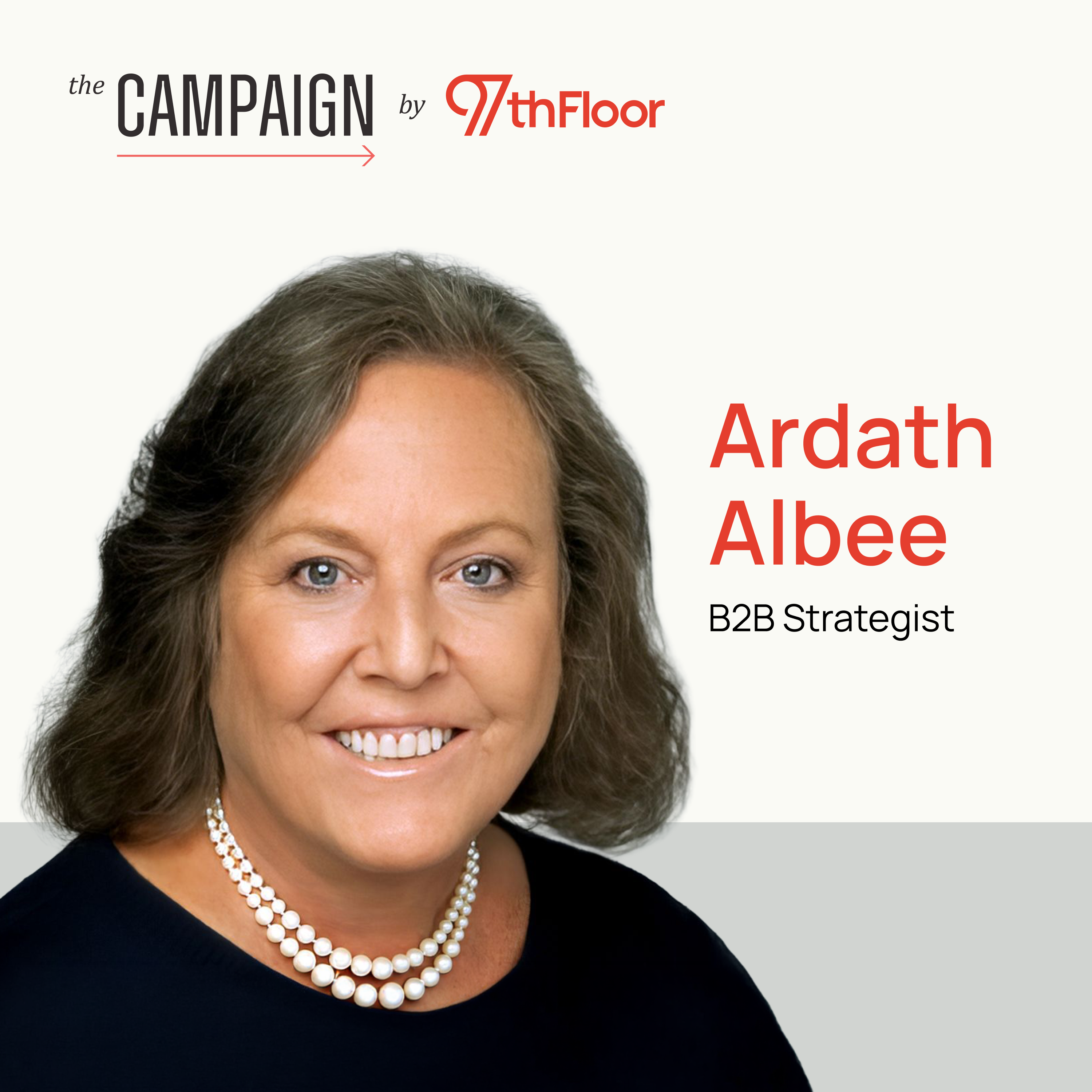
[email protected] Today's guest is Ardith Albee. Ardith helps B2B companies with complex sales cycles using digital marketing strategies that employ content to turn prospects into buyers. Ardith has written two books about her approach, Digital Relevance and E Marketing Strategies for the Complex Sale.
In this episode, Ardath explains why most buyer Personas fail and what actually makes them work.
We're also going to dive into how to better understand your buyer to effectively drive content strategy, engagement and revenue. Let's get into it.
All right, Ardath, thank you so much for joining us today. It's a pleasure to have you.
[00:01:09] Speaker B: It's a pleasure to be here Pax. Thanks for having me.
[00:01:13] Speaker A: So I'd love to hear about some of your big formative experiences in your career as they relate to Personas. When did you first start getting diving into that, making that connection between lining up Personas and marketing activities?
[00:01:30] Speaker B: Okay, so let's go back to the year 2000.
So I was helping my sister build a tech company, think first iteration of marketing website platform for marketers to operate themselves and in working with our customers they would take back in the year 2000, remember it was like, okay, let's put our corporate brochures online and you know, first iteration of that. And then they'd say, well, nothing changed, nobody's engaging with us. And I started looking at their content thinking, well geez, why would anybody want to. And so my background before that was in B2C so I ran hotels and country clubs and I have a degree in English literature and I do a lot of fiction writing for fun. And I've attended all of these writing workshops and whatever and learned how to build characters and you know, how do you sustain them over a hundred thousand word novel, right. And all that kind of stuff. And so I started thinking about it and asking them questions about their buyers and figured out that I could transition that methodology into helping them understand their buyers.
And so I started helping them rewrite their websites and they started getting engagement and it started growing and pretty soon I had all these requests from our customers to do this work. And so I jumped in 2007 to become a consultant, wrote a book, et cetera, and there you go.
So I've been doing it for a long time.
[00:03:00] Speaker A: I feel like Personas, they've gotten a bad rap over the years because there was a time when I think everybody was very into them, but then we spent a lot of money on them. They sat on a hard drive and they were never opened or used. And now they've started to collect some dust.
Can you share some of your thoughts on maybe why they've run that bad rap? Or maybe the way we're thinking about them incorrectly, that caused them to not be used as much?
[00:03:29] Speaker B: I've only had one time where a potential client came to me and said, well, we already have our Personas. Can you just help us with content strategy?
And so all the other times I've opened these Personas and looked at them, and one of them even had some of the Latin filler text in the templates that hadn't been replaced, you know, and they just don't contain anything you can use.
And so it's like this demographic thing. And they. They tended to have consumer information in them, like, you know, married with two kids and a dog, drives a Volvo. And I'm like, who the heck cares?
You know? And so they're not oriented around the roles for B2B buyers. And they don't.
They don't do the research to get those insights. You know, the phrases that people use, the problems they face and which concerns are most important to them out of the range of possibilities.
In fact, I'm. I'm working with a client right now, and I'm having this push me, pull me thing about them letting me talk to their customers. They're like, well, we can just get in a room and hash this out with the marketing team. And I'm like, really? Based on what you know? So it's still alive and well today. And the problem is assumptions aren't going to cut it. And even more, the thing that I find really interesting right now is I'm fascinated with the way AI works and how it categorizes things and how you get on its knowledge graph so that your content can be included in answers.
And since all our buyers are going to chatgpt and typing in a prompt, you know, and so for me, it meant, okay, marketers are finally going to go back to the foundations and they're going to talk to their customers, they're going to get to know Them, they're going to be able to answer these questions and get the right context to engage people.
And yet people are still dragging their feet. And now they think even more ridiculously that all they have to do is ask the AI and the AI will tell them about their buyers. Really from what, based on what. And like those buyers are your buyers.
And you know, I just am kind of like amazed at the need we have for that easy button instead of doing the work. And so for me it's, it's kind of fascinating because now when I'm talking to buyers and I'm thinking about, okay, instead of a forward Google search term going to type in a 23 word prompt, what might that look like? You know, and so as you think about it, when you're talking to them, the things that they say, the words that they use, the context that they put in that prompt, if you don't know what that is, what are the chances that your content, your company, your brand is going to surface as one of the answers or part of the answer, right? And so it just becomes more and more important, important for us to really gain that true understanding of our buyers. And we've got to know the different things about it. I was, I don't know if you're familiar with it, but I follow Carrie Cunningham's work with Six Sense and they just released the B2B Buyer Experience Report and 10 month journey on average. And that's after the trigger hits, right? So I'm sure you've heard about this. 95% out of market, 5% in market.
You don't know when that's going to happen. But as I watch all this change as buyers take over control of their buying processes, it's really become incumbent on marketing. In fact, our purview has expanded, right? It's no longer generate a lead, toss it to sales. You don't even know who they are. They're doing 70% of their buying process outside of talking to vendors. And so that means marketing has to really step up. We've got to engage them, we've got to tell that story over time, which gets to a thing I call the continuum. And you know, help them progress and build momentum toward making a decision and finding the problem we're solving and a vendor who they can defend, right, that they made this choice that's going to make them look good and better and help them actually produce the result they want. And how do you do that if you don't know who your buyers really are?
And so I think the interesting Thing for me is I saw a period of time where not only was I building Personas with clients, but I was helping them institutionalize them, right? Teaching salespeople how to use them, teaching marketers how to use them, you know, updating them, showing them how they could drive a content strategy from problem to solution all the way through instead of these silly campaigns that are three touches in a sales call. When a buying experience lasts what, a year? I have clients that have had a four year buying process because it's such a big, you know, solution to buy. And, you know, we've got to look beyond that. We have to look beyond this thing where a click is a lead, you know, or an MQL or whatever you want to call it, which is ridiculous. But we also have to look at buying groups. Who else is involved? It's not just reaching that one person. They've got to talk to a bunch of other people about it or how are we facilitating that? And I'll stop now because I'm like, I could go forever on.
[00:08:44] Speaker A: I love it. One thing I want, you said that I want to hone in on is building out these Personas you've mentioned elsewhere too.
It's not about titles, it's about roles. A lot of people view those as synonymous.
Tell us about what you mean when you say that.
[00:09:03] Speaker B: Well, it depends on what vertical you're going after. You know, who your market is. But there are a lot of titles that have similar roles. And so, for example, one client I'm working with right now has identified 12 different Personas. And I'm looking at them thinking, guys, you don't have a big enough marketing team to handle 12 Personas, right? So which are the ones on the buying committee? And it's.
And they just kind of looked at me and I said, well, it's obvious that these over here are end users, right? And so you're going to interact with them once a deal is done and you're into the customer life cycle, right? And they're the ones using your platform or whatever, but what you need to focus on are the ones that you can reach and influence, right? And then think about how do you get your con them to pass your content on or, or pick up your ideas and those internal conversations where you're not in the room and those kinds of things.
And so it's a process of narrowing it down. So when you think about roles versus titles, you want to look at, okay, maybe these three different titles are not three different Personas, because what are they responsible for? They're responsible for the same stuff. And we all know titles can vary based on company or company size or whatever. And so if you dig into the roles these people play, are they similar? Would the same ideation and content engage them? Are they responsible for the same kinds of outcomes and that kind of thing where you see a big difference is when you move between size of company because the hierarchies are different, right? Smaller companies, one role covers more stuff.
As you get into bigger companies, it's more specialized. And so then you have to kind of weigh, weigh those choices. But a lot of times I've looked at people, one person called me said, I have 52 Personas I've identified. But when we sat down and looked at them, it was like 10 or 12 could go into one Persona because they were so similar. And they got caught up in this idea of a VP of this is different than a VP of that when it's actually saying the same thing but using different words. So it depends on the culture of the company, how they do their titles. And you know, there's been some crazy titles lately. Then you really have to look beyond that to what are they responsible for. And that's how you should group them.
[00:11:29] Speaker A: So you also said at the beginning, getting into a bunch of consumer data, this is their kind of dog, this is their kind of car.
These things don't matter, especially in the B2B world. What belongs in a B2B Persona? So I've got the role.
What else do I need to make sure is in there in order for it to be effective?
[00:11:49] Speaker B: Well, one of. There's of course the role and then there's a. I always write A Day in the Life.
So it's. Which is pulled from all the interviews I do with customers and that kind of thing. And it's kind of the a first person version of your Persona talking to you like, I'm the VP of such and such at this kind of company and what I most care about is achieving X, Y and Z.
And what I'm really looking for is a way to solve whatever. And you know, and it goes on and on like that. So if you, like me, work on a bunch of different Personas or whatever, you don't do it every day. So you can pick it back up and read that first person account and kind of step into their shoes and start thinking, okay, so in this context, what matters to them? But the thing that I find most valuable, in addition to like general priorities and objectives and challenges they're facing, are what questions do they need to have answered?
So it's.
It's really interesting when you look at all the transcripts from the interviews and that kind of thing you can pull out, okay, here's what they had to learn in order to move forward. This is all the stuff they had to figure out, right? The jobs to be done, if you will, or. Or whatever, and structure those as questions. And here's what happens with that. There are questions that you can figure out that they're never going to ask this before they ask that, because if you don't know the answer to this one, you would never think to ask that one. And so when you figure out all the questions, you can shuffle them around and figure out, okay, what does this look like from a progressive perspective? How do I build a narrative or a storyline? Right, so this gets to the continuum thing I talk about.
So the questions are really one of the most important things. And the thing that's interesting about questions is you can answer them in a variety of different ways. And so, for example, some people, because a Persona isn't going to answer it for everybody who's in that Persona. So, for example, some people do better with carrot content, like, here's all the great stuff that's going to happen. And some people do better with stick content, like, you know, the world's going to blow up if you don't do this. And so you can answer these questions in different ways, designed to engage different types of people, but talking about the contextual things that are relevant to them. Do you know what I'm saying? And so the questions really provide a lot of insight in how you put your Personas to work and how. And so if you think about it, a conversation is really Q and A, just like you and I are doing right here. You're asking me questions and I'm answering you. And then you say, yeah, but what about.
And, yeah, okay, that's great. What about. And it just kind of goes on like that. So if you start thinking about the narrative you need to build for your buyers as an ongoing Q and A, so whatever the answer is that you provided is going to open up or prompt them to ask the next question.
And you can kind of build that progression and momentum by sharing new insights, helping them think differently, which is what you really want to do is become that trusted resource, right? So they turn to you and think, I wonder what so and so has to say about this kind of thing, you know, and that's. That's really what Personas should be built for.
[00:15:18] Speaker A: So let's let's maybe take one step back and talk about your continuum framework.
Could you.
Yeah. Let us know from, from the beginning, like what, what is that framework? When why do we, why do we use that approach?
Could you lay outline that?
[00:15:37] Speaker B: Sure. I wrote about the continuum in my second book, Digital Relevance and what, what occurred to me and what I was seeing in client engagements was that we need to engage our buyers across the entirety of the journey from first of all, we don't know where they are in that journey. Right. They may have already learned some things, done some preliminary research and stuff, but if we don't have all the different pieces, if we don't know all the jobs to be done and the questions that have to be answered, we can't build that. And so one of the complaints you hear from buyers is content is too shallow. It doesn't help me think differently. It doesn't identify new patterns or unknown challenges that we haven't recognized.
It doesn't actually give us insight into how do we make a decision about solving these problems, you know, what's the next step, that kind of thing. And you can build that. This is building that trust in the relationship across the process by connecting the dots for them from problem to solution. It's not about these short term campaigns that are, you know, several touches and then sales is going to reach out to you type of thing because you usually in B2B, at least in the, in the projects I work on, the problem that's being solved is pretty complex and it's expensive. It's not just oh yeah, we'll just buy this point solution and fix it. You know, it's not that kind of thing. It's helping them really make a, a big decision and there's a lot of people involved and you have to figure out how are you going to get everybody on the same page, which is some of the value Personas. Right. If you've looked at them across the buying committee, then you understand how the questions differ that they would ask and how are you going to relate those things and help people? You know, just to. As an aside here, a lot of times what we do is we get a Persona and we just make a track for that one Persona. And yet we've got all these other Personas over here that have to interact with that person, but we haven't thought about how do we help that person interact with them as well. So we've got to create these multi threaded things that intersect so that they can figure out how to talk to each other. About the problems, you know, but the other thing with the continuum is really helping your buyers be become smarter or at least look smart. And so if they share that content with their peers, you know, or pass it up the chain, it's going to make them look good. And a lot of content today doesn't do that because it's too shallow and God forbid, AI generated with no human intervention. But, you know, so we need to think about that Persona from a specificity point that really touches where they are, what they think about and they're concerned about so that it's relevant to them enough. Say, hey, this says it better than I could ever say it. You know, my stance on this here, now look. And you know, it's a different kind of relationship. And most vendors still talk about what they think, their point of view, their product, their features, whatever, instead of the buyer point of view. And even after all these years, it's of saying buyer centric. We're buyer centric. No, you're not. You haven't got to know them well enough to be buyer centric. So you're still talking from the inside out rather than understanding what it looks like from the outside looking in.
And that's really key. But the point of the continuum is to build that progression to help them move forward. If your content, it just falls flat and it doesn't help them gain an insight or learn something to move them forward, they're going to go look somewhere else because, you know, buying is a secondary job, right? They have their day job.
They don't have time for all of this. And so it's got to be helpful. It's got to be seen as valuable. It's got to help them think differently so they can move forward. Otherwise they just stall, right? They don't know, what difference does this make to me? Why do I care?
And so the idea of the continuum is you start with, okay, what are your category entry points? What would be a trigger that would have somebody come into market? Okay, what happens before that?
So how could you help create that trigger? So start before that. Then the trigger happens, and then it's like, why should I really care about this? What do I need to know? What am I missing? Why haven't we solved this in the past? You know, what makes it different? What's going to happen if I don't do anything at all about this? You know, and then why should I care about you?
You know, as the vendor? What are you going to do for me that I can't get somewhere else? And all of those things. And then as. As they get interested and they learn more, they start thinking about, okay, this is kind of risky. Is it going to work? Right? Is how do I know? Give me the proof, show me the evidence. You know, is it going to work? And what does that look like? What challenges could I face in the implementation process, which nobody ever wants to disclose? You know, if you read a case study, it's like they had this huge problem and they bought the vendor's product, and all of a sudden, magically, it's all solved. Well, nothing ever happens like that. Anybody who's ever implemented tech knows this, right? There's always something, gee, I wish you should have told me that before I bought. We could have been prepared. You know, I hear it all the time in customer interviews. And that also informs.
What do you need to tell them about, right? How do you need to expand your content to cover these different things?
And so, but anyways, the continuum is just creating this progression. And once they've learned this, then they can ask that. And it's, you know, and on and on you go until you get to the solution. And then ideally, you would continue this across, you know, the customer life cycle once they buy your product. And then everything kind of shifts a little bit because it's like, okay, they solved that original problem.
So who is involved now solving the next problem? What is it? And then you keep going.
As more marketers become responsible for retention, then it's imperative that they know the difference between content that's needed for new buying net, new logos, versus content that's needed to help expand the use of your products and, you know, gain a bigger foothold in the company.
[00:22:04] Speaker A: One question I have when it comes to Personas, well, there's actually a lot that I have, but one is the concept of this journey that you're talking about. And, you know, you have one Persona, they have this one journey, but you're neglecting all these other Personas and their journeys.
I think it's easy for people tune into it, what that journey might be. It could be, you know, an ad, series of ads, landing page, series of landing pages.
But one area that I've never seen an elegant solution for is the homepage.
So, you know, let's say a brand is dealing with four or five different Personas.
The homepage is always the homepage.
And unless you get into personalization technologies, it needs to be one page that's for everybody.
So how do you elegantly deal with the fact that you may at any point be talking to the Decision maker, the person, you know, the funding decider or the champion, or all these different parties that have sometimes conflicting and, but always different needs.
How do you deal with that from a homepage level?
[00:23:17] Speaker B: Well, that's a really tricky question.
I would take it up a level to icp. So your ideal customer profile. So what do they have in common?
What do they care about? You know, and you can kind of roll it up that way and then include, you know, in modules down the page, things that your various Personas might be interested in, but at the top of the page in order to show them they've landed in the right spot, that this is for them. Focus on the icp, because otherwise you can't include, you know, you try to talk to everybody at the same time and it doesn't work. It's, it's just, you know, your message becomes so high level and so generic that it just doesn't make a difference. Right. And so you can't be everything to everyone. But if you focus on ICP instead of individual Personas, I think you hit the mark as long as your ICP is the right icp. Right. And so I'm helping a company do that now. And we actually had just rebranded and relaunched their website and as we, which we had to do before ICPs. Don't ask. But anyway, as we got the ICPS done, we went back and shifted the messaging so that we had a better lead in because it became clearer as we got the ICP work done. And so I, I think that's one way to solve it. You know, it's, it was a little bit easier when those rotating carousels were in style because you could have, you know, one for different Personas, your top Personas.
The thing that I find interesting is a lot of websites now on the navigation have, you know, for specific buyers, there's a drop down and a list marketing sale, you know, whatever whoever the buyer group is.
And yet if you look at those pages, there's no relationship from one role to the next. It's like just a siloed pathway for that one person doesn't talk to them about how, you know, marketing needs to relate this to sales or to finance or to whoever. They've just created these siloed paths for people. And that doesn't really solve the problem.
So I, you know, we expect buyers that, well, it's there. They could click on it if they want to. But why are we making them do all the work? Why are we not doing it for them? But the other thing that I Found really interesting in as I work more with AI and trying to figure out how do we get our content found by AI and make it valuable to both AI and humans is creating that the semantic connections between our content and the quality of the anchor links that help the AI connect the dots and add us to their knowledge graph. And so there's a way to do all of these things, but once again, it's not the easy button, it's doing the work. And so it's really interesting to look at it all.
[00:26:19] Speaker A: So how do, how would your response be to that problem of yeah, great, we've got these Personas there, some PDF or in my Google Drive and I can guarantee you in six months no one's going to be looking at these. How do you actually put them into practice so they become useful?
[00:26:43] Speaker B: Well, depends on the company and the company culture. But a lot of what I do, like a lot of times my projects are I build the Personas for them and then we move that into a content strategy process. And I do workshops with the different departments that need this information. But the other thing I knew too is when we plan strategy out, we refer specifically to the Personas and which part of the Persona to look at to address this. And so trying to weave them in. When I write content briefs for writers, I'll include a link to the Persona and tell them, you know, why it's important and which part to focus on.
And like I said, those day in the life stories, first person stories are really helpful. The other thing too is to keep from forgetting about your Personas. You gotta update them. So it's like, and with buying changing so much and new tech evolving at the rate it's evolving, people's perspectives change more rapidly.
So if you're updating your Personas and doing consistent customer interviews and that kind of thing over time, instead of a full blown Persona project, right? So do a couple of interviews every month or whatever. Then you can, you know, update your Personas. You can share the insights and the findings. Hey guys, this is changing. You know, pay attention. Are you hearing this in your sales calls? You know, what are we seeing from a user perspective in the product, etc? And you just have to keep it front and center. And so it's just the same with buyers. Repetition, you, you know, gets them, keeps them going and moving forward. You got to do the same thing internally. And so if you raise the visibility of Personas and it's not the Persona you want to raise the visibility for, it's the insights that you're Getting right buyer insights, customer insights, whatever you want to call it, hey, we're learning this and seeing this happening now we need to make some adjustments and get people involved in that conversation because otherwise, if it's just a marketing tool, then you've got disjointed stuff going on all over the company because everybody's looking at your customers differently. In fact, I've worked in companies where product has user Personas, marketing has buyer Personas. You know, somebody sales has their version of what they think a buyer is and none of them meet in the middle. And so it just creates this confusing fragmented experience for your buyers.
[00:29:21] Speaker A: Yeah, I like that. So I mean, in a nutshell, it's kind of like you have to have discipline to use refresh, keep those going and developing that discipline is key for them to function well. Is that accurate?
[00:29:35] Speaker B: Yeah, I would say that's accurate. And I would also say that if you push it a little further, Buyer applying buyer Personas to your programs also helps you prove impact for marketing, which, you know, everybody's always worried about roi and the problem is when you have a year long buying process or something, what are you going to tell every quarter? You know, but if you can show, hey, we did this work and learned, you know, about these buyer insights and we've applied, you know, them to our content and what we're seeing is when we apply these insights, we get higher engagement, etc, we, we're seeing more pipeline velocity because of this program which is based on, you know, a continuum approach, etc. It validates all of the work. One of the things I hear the most is, well, we, we don't have money for that. We've got to spend it on getting programs live. Let's push content out the door, whatever. And I'm like, okay, but if engages nobody, is it any good for you? You know, and so there's ways to tie this all together to prove that doing that foundational work actually has impact on the results that marketing's getting. And from, you know, when you have a long buying cycle, you've got to be able to prove income incremental movement across the pipe, right? Because you're not going to, you know, I mean, once you get the wheel turning and you've been in motion for more than a year, you should see, you know, deals closing, right?
But until you get to that point, it's, you got to figure out how do you keep everybody invested in this instead of saying, well it's been three months, we haven't closed a deal, so can this, let's do something else. And we've got to have revenue right now. And so you need to find a way to sustain that and get to the point where you've made it through a cycle so then you can start seeing results every month, quarter. However,
[00:31:32] Speaker A: we had talked for a little bit about AI and we were talking specifically about it within the realm of content production. I'm wondering if you are using AI in any ways that is particularly helpful or that you think people should start looking to AI for or are you generally kind of against the use of it in marketing?
[00:31:55] Speaker B: Well, I use it every day, but I use it for specific things. So I use it for research and you know, I spend a lot of time creating thought leadership content, different things like that. So I use it to narrow down that hours of research that it would take me to find all the stats to back up something I want to write about, for example. So I have a go out and find reports for me.
And then the other thing that I found to be really effective is once I've written a piece of content to put it into the AI along with style guide and some other things, and also ask it to show me where I'm missing semantic connections or entity connections or things like that so that I make sure that I'm not only engaging humans, but I'm engaging AI, hopefully.
The other thing that I'm using is a tool that's just coming out in beta now, but it's called Vizx VIX AI and it's a semantic connections tool. So what is doing Usually companies library of expertise is in their blog, right? Or a lot of things. That's where we publish. And what it does is it analyzes your blog and it tells you which post to connect to create semantic connections, how to strengthen all of that from an AI perspective, what to use as your anchor text, those kinds of things, how to build bridges between the different categories that you have on your blog so that AI can see what AI is looking for is your depth of authority. Right. So is this something you just kind of talk about at surface level or do you actually have, you know, the depth that says you're an expert in this? Right. And the way that you link things together is how it determines that in a lot of ways. And so it's been a really interesting process.
I was an advisor to the or I'm an advisor to the company and so I've been testing it and working it on my own blog and it is a lot of work to go back and institute this Stuff because, you know, when you think about it, especially for me, I'm so busy doing projects, it's like, okay, I got to get a blog post out.
And so I write it, I publish it, and I don't think about it now. It's like, okay, what three things can I link to that are relevant, that are going to show the depth and create the, you know, the authority level and those kinds of things. And so this tool helps you do that.
And so it's still early days, but I think it's, you know, everybody talks about using a tool to see, okay, are you showing up in AI citations and that kind of thing. It's the first tool I've seen that actually helps you create the connections and the semantic links and entity links and all that kind of stuff that would put you in a position to be found, not just monitor. Okay, are you showing up in response to prompts? Right? Is an answer.
So he got to do the work. Once again,
[00:35:06] Speaker A: what would be some. Some pieces of advice as it pertains to, like these Personas, continuum and in depth, thought leadership that is sustainable, will last and is effective?
[00:35:18] Speaker B: Well, depending on your background and whether you can write the thought leadership or you need your SMEs at the company to contribute, that makes a difference. But I think the upside from Personas is, and I'm doing this a lot with a client right now saying, okay, here's what I'm hearing about from our buyers.
What do you think they need to know in relation to whatever topic? Right. And how would you help them decide about this type of thing? You know, and so coming Personas can help you go into those conversations prepared. And so what I'm able to get back from a conversation with an SME in 30 minutes is really useful and helps me generate the entire piece for them.
And, you know, it's, it's. And using AI to parse through the transcript, right, because we'll talk about other things in 20 minutes. But to parse through the transcript, pull out the stuff, put it in a flow, you know, and then I can sit down and write the piece without having to spend all that time digging through the transcript, because you know how conversations go. You're not going to talk about it in the exact order that it's going to flow into an article, right? So you have to, you know, pull it apart and put it back together again, that kind of thing, and then add in research you've done and other things. And then, so I find it extremely useful to have the AI parse that transcript for me and, you know, put together a structure that helps me think it through. Then I can sit down and refer to the transcript and write it all. And you can even have the AI pull out good quotes from. Just check them because it makes stuff up. But, you know, so you get a lot of help from the AI. But I think we need to figure out ways to include our subject matter experts. How do you get the expertise out of the organization and into the buyer's hands?
And Personas can help you figure out, okay, how do you want to position this? Because if you know how you're going to position something and what the buyer really cares about, it helps you have a directed interview with that SME that gets to the point you don't have to go back and say, well, I forgot to ask you this. And you know, really what I need is, you know, how about if we look at it from this other perspective? And that's when SMEs start going, you know, you're wasting my time, I'm busy. I don't have time for this.
And so Personas help a lot with that kind of thinking and organization. It goes really back to the critical thinking that a lot of us give up when we just rely on AI to do stuff. You have to direct the AI. It doesn't have an opinion. Right. It doesn't understand context. It doesn't have emotion. You know, marketers need to be the arbiters of taste in this whole thing and help ensure that our thought leadership delivers something that is original, you know, and unexpected, and something that is contextually relevant to the buyer that is aimed at.
[00:38:18] Speaker A: I love that. Thank you, Arda. Thank you for being on the show. I want to end with. This is my, my last question is in. As technology is developing, there's this emerging tactic of one to one experience within marketing, which has historically been one to many.
And, you know, where every person is saying something completely individualized to them, enabled by, you know, their history, their preferences, what we know about them.
Curious on your take on that tactic where you see Personas fit in with that or.
Or not?
[00:39:04] Speaker B: Well, I kind of have this love hate relationship with the way marketers talk about personalization.
And for me, I think about it instead of. Because mostly what you see still these days, even with all the tech is high first name, you know, and that kind of thing. And marketers aren't really good at personalization. So for me, what Personas do is help you be personal.
And what I mean by that is addressing things that that Persona cares about and the context, right. Having content that speaks to the different stages of their buying process because you know what they are, right. So. And providing something that's helpful to them, to me, that's a lot more personal than high first name. And we saw you, you know, checked out our ebook, so would you like to talk to sales? I mean, you know, right, Go away. And so, you know, I think we need to think about personalization as personal.
And there's a lot of hype right now about AI is going to help you, you know, do that one to one personalization.
And first of all, ooh, creep me out.
Second of all, it's like, I really don't care if you know my name. What I really care is, do you know what I care about, where I'm at, what I'm trying to do, how are you going to help me? You know, that's what I care about. Are you giving me information that's helping me move forward to make a decision?
Is it relevant to my context? You know, do you show that you understand me as a buyer, my company, my industry, you know, the problems we're facing, the objectives we have to achieve? That to me is personalization, right? Because it's, it's relevant to me. You know, this, this other stuff where they pretend to know you is, you know, just a throwaway. And so it's like, it's like in your LinkedIn direct messages, right? When people reach out to you and you can tell they haven't even bothered to read your profile. Right. And so it's, it's just kind of like really, what are you doing? You know, does this really work for you?
Right. Just kind of wonder about it. But I think we're better off because I, you know, I think personalization on a one to one basis is a sales thing because they get to know that person, that buyer, where marketers probably won't ever do that. But if we understand what they're going through, their situation, their needs, their context, et cetera, we can make it personal enough that it's relevant enough that people start to rely on what we share with them. And then sales can pick it up to the, hey, Dan, how are the kids? You know, and whatever that other personalization is. And so I just think we might be overreaching with this idea of this one to one personalization where it's like, we know what you had for breakfast and we're going to talk to you about that. I don't want anybody to talk to me about that. You know, I Want them talking to me about stuff that I care about and I need to solve in my role. And that's why these Personas that are focused on, you know, married with two kids, a dog and a Volvo, why, what are you going to use that for? And this is one of the reasons, you know, going back to your question about why don't people use Personas because they have all that garbage in them that they can't do anything with, you know, and it's not going to be true across the board. You know, I doubt seriously that the 50 people that are VP of whatever in your database all are married with two kids, live in the suburbs and drive a Volvo and have a dog of the same breed, for example. You know, some of them probably cat people. So, you know, I mean, we have to think about this from what's. What are we capable of as, as marketers given our remit to drive revenue. Right. And drive opportunities that then sales can close and you know, there's a limit. And so we need to decide, okay, we're going to be really good at being relevant, we're going to be really good at resonating because we understand context and the problems and the perspectives of our buyers in, in this one Persona group. And that to me, I think will help us achieve a lot more than trying to get to that one to one.
Now it's different, for example, if you have an ABM program that's one to one and you're working with sales and sales can share insights with you and you can, you know, do onetoone reasonably well in within the context of that buyer.
But you know, for most of us, we have to reach one to fewer, one to many and we've got to impact as many of those people in that group as we can. And so I think if we give up on this personalization quest and look at it is let's be as personal as possible, meaning address their context and, you know, what they care about and understanding their perspectives, being able to show that empathy. Right. And so it goes back to being an arbiter of taste. Right. What are they going to appreciate?
So that's how I would address that.
[00:44:13] Speaker A: Ardith, where, where should people go if they want to learn more and connect with you?
[00:44:17] Speaker B: Sure.
I'm on LinkedIn so at Ardith albeit and my website is marketinginteractions.com so you can reach me through either place.
[00:44:28] Speaker A: Okay, we'll make sure both are in the show. Notes Ardif thank you so much for joining today, sharing your experience and wisdom.
We really appreciate it. It's been a pleasure talking with you.
[00:44:38] Speaker B: Thanks so much for having me. It's been fun.
[00:44:44] Speaker A: That's all for today everybody. If you enjoyed this episode, please consider leaving us a five star rating and subscribe so you don't miss future episodes. Subscribe thank you to Ardith Albee for joining us today. You can find her on LinkedIn or at her website, which is marketinginteractions.com you can find past episodes of the campaign and examples of our work at 97th Floor.com.
learn more about the agency and get in touch with a marketing specialist if you want support for your own marketing campaigns. That's it for now. Thank you for listening and we'll see you back here. Till then, keep innovating, keep converting.