[00:00:00] Speaker A: Hello everyone, I'm paxton gray, CEO of 974 and this is the campaign.
Thank you for joining us today for another episode of the campaign where we talk with marketing leaders about better knowing your audience, innovating beyond best practice and converting visitors into customers. The campaign is produced by 97th Floor, a digital marketing agency designed to build world class organic and paid channel strategies for mid level and enterprise organizations.
You can find past episodes of the campaign on YouTube, iTunes, Spotify and at 97th Floor.com.
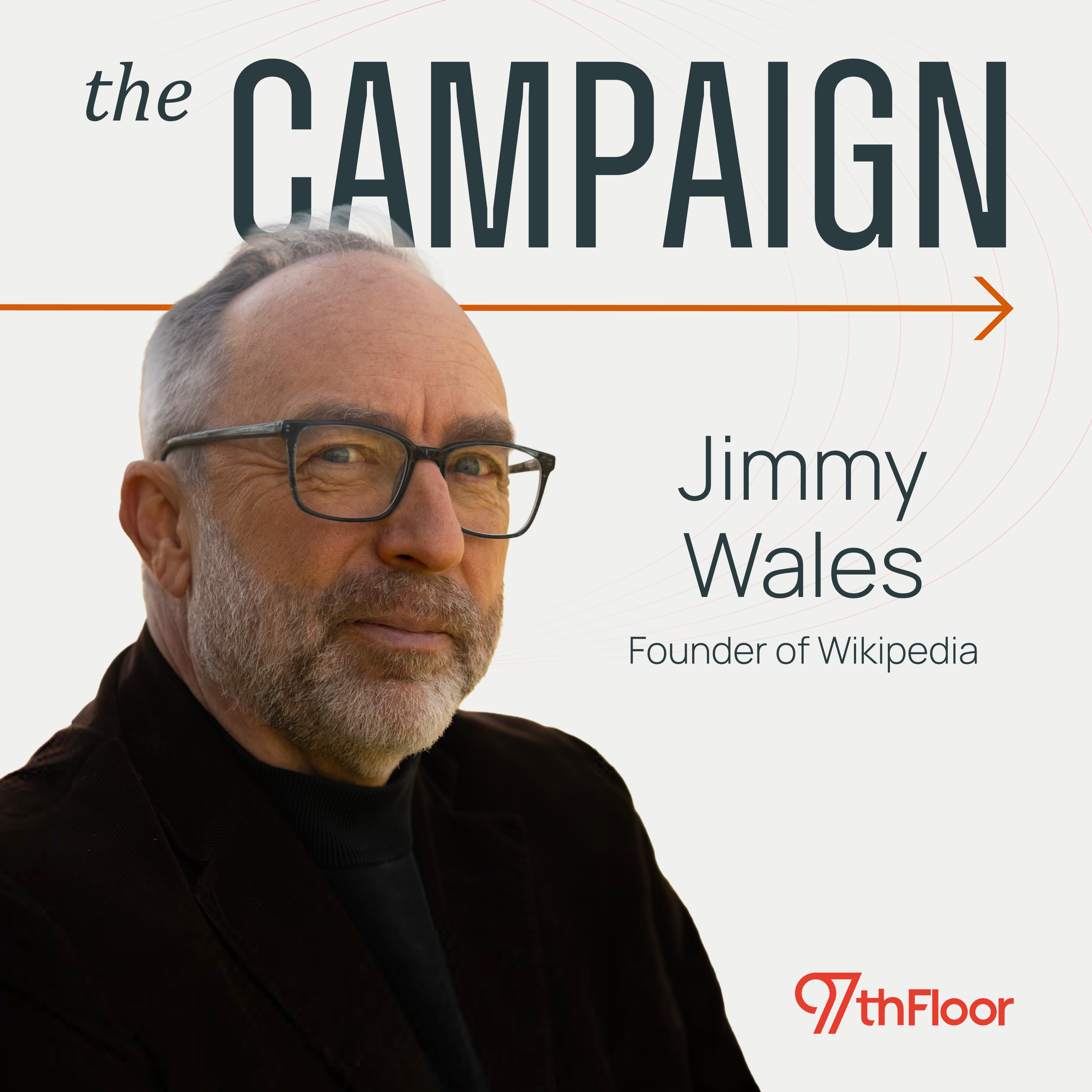
today's guest is Jimmy Wales. Jimmy founded Wikipedia in 2001 which has now become one of the top five most visited sites on the web. He's also the founder of both fandom and the Wikimedia Foundation.
He recently published his debut book the Seven Rules of Trust, which is out now. He's also been recognized as a Time 100 honoree and and World Economic Forum's Young Global Leader.
In this episode, Jimmy unpacks why trust is Wikipedia's greatest asset, why they are built to survive in the AI world, and what it will take to save local journalism before it disappears for good. Let's get into it.
[00:01:10] Speaker B: Jimmy, thank you so much for taking the time to sit down with us today. I've been looking forward to talking with you.
[00:01:15] Speaker C: Great. Good to be here. Thanks.
[00:01:18] Speaker B: So I'd love to dive in to, to we're going to talk about your book and some of the lessons from that. But to start I wanted to ask kind of a bigger question which is Wikipedia has a large amount of, you know what I would call and I probably others, power in culture, in the Internet. Just there's a lot of companies whose base is kind of built on some of the information within Wikipedia. And where do you feel like that power comes from?
[00:01:55] Speaker C: Well, I mean I think one of the things that I think is really important around that, I mean power is a bit of a funny word to me, but sure is the trust that people have in Wikipedia. So that doesn't mean necessarily trust that Wikipedia is perfect or that everything In Wikipedia is 100% correct, but trust that it's honest, that transparency, you know, that we're trying to get it right, trying to do the right thing.
I think that means a lot of people turn to Wikipedia when they just want some basic information and they listen, you know, they read it and they accept it as being, you know, valid information simply because, well, all the sources are there and the people who wrote it are there and you can talk to them, them and so on and so forth. So I think that's probably the most important thing,
[00:02:47] Speaker B: I'm curious, if not power, how, how might you describe that word and the impact, I guess, that Wikipedia has?
[00:02:56] Speaker C: I mean, probably impact.
You know, I mean, I think that the reason I'm a little uncomfortable about the word power is that normally power is towards some end and that's not really how I think about it at all. You know, like we're just a bunch of nerds writing an encyclopedia.
So, you know, the, the end is people to learn about the world, you know, so it's sort of odd to talk about that as power.
[00:03:22] Speaker B: Yeah. And perhaps that's why Wikipedia has the impact is because there's not that end of power and influence. It's, it's more of the impact.
[00:03:33] Speaker C: Yeah.
[00:03:33] Speaker B: I noticed in your book you describe a lot of the early success of Wikipedia around numbers and specifically around articles on the platform.
How do you measure success of Wikipedia today? Like what are some of the main KPIs and how does that differ from how you measured success in the early days?
[00:03:58] Speaker C: Well, I mean, it's a very good question. I mean most of the kind of KPIs, so to speak, that we look at, we, we look at, you know, the, the growth of Wikipedia in the languages of the developing world. That's a very important metric for us.
You know, we are very interested in the quality and neutrality of Wikipedia. And so we try to evaluate that and try to keep on top of that to make sure, you know, everything's going well.
You know, we don't, we're not, we're a charity, we're a non profit organization. So you know, we, we do keep an eye on readership, for example, and reach. But that isn't necessarily something we obsess over. Right. It's important because, you know, it's like if people are not reading Wikipedia, then what's the point of being here?
But people are reading Wikipedia and so we do look at that. But it's not really the be all and end all.
It's, I mean, we're funny because we are first and foremost we're a community of nerds who like writing an encyclopedia as a hobby. And so that's what we're here for. So it's great.
[00:05:10] Speaker B: Do you keep an eye on and try to influence or increase the number of the nerds or the editors that work to build out and continue to sustain Wikipedia, or is that just been an organic thing that, that continues to perpetuate itself?
[00:05:28] Speaker C: It's a bit of both. We do keep an eye on, you know, the number of Editors and we are interested in bringing in newcomers and new editors.
We think that's really important.
Certainly, you know, we have people who've been with the project for a very, very long time and that's great. So we, you know, when we think about retention, I think we do a very, very good job in the community of retaining people for the long run. But we also want to have, you know, new people, young people, people who. Well, Now Wikipedia is 25 years old, so there's a lot of people who are editing Wikipedia and it's already been there for their whole lives, you know, so that's kind of an amazing thing.
But we also think about community health. So, you know, if we wanted to increase the number of people who edit Wikipedia, there's some really easy ways to do that that we don't do because it would be kind of pointless because it's not a metric in and of itself. So, for example, just make the edit link bigger, you know, put it in people's face, you know, put a little pop up saying, why don't you edit this page now? And that sort of thing. We don't do that because, you know, what we really want are people who have a commitment to neutrality, a commitment to kindness to others and all those kinds of things. So we're really looking for the right kind of people.
[00:06:48] Speaker B: How have you found people enter the fold? Do they. They find you or do you have ways?
Maybe not you individually, but I know that these editors have communities within communities.
[00:07:02] Speaker C: Yeah, so we do, we do outreach, we have edit a thons and then we do, you know, with the, the local chapters. We have a lot of local chapters all around the world and they do events, they work with g, libraries, archives, museums, things like that. But I would say the vast majority of the people who are editing Wikipedia just came to Wikipedia originally as a reader. They came, you know, through search engine or whatever. They came to Wikipedia. Maybe they heard somewhere that you could edit Wikipedia and maybe they read an article about the editors and they're like, oh, that sounds interesting. That sounds like something I might enjoy. A lot of times people come in for the first time and they just make a small edit. You know, they see a typo and they fix it or they add a source or something like that. And then, you know, there are different kinds of editors. Some people are really sort of passionate hobbyists about some part of history or some musical thing or whatever it might be. And so they'll tend to edit in that area, their specialty subject. Other people are just interested in Wikipedia in itself. So they, they end up becoming admins or they're, you know, they're working on editorial questions and things like that. So it's a, it's a lot of different paths into Wikipedia, but it is largely people come to us.
[00:08:22] Speaker B: Yeah, you, you brought up search engines and that makes me curious about Wikipedia. Wikipedia's impact on the world is tremendous. And one of those that we can see is search engines rely on Wikipedia to understand the world.
And from what I can tell, Wikipedia relies on search engines to be found and to bring visitors to the site. And so there's this kind of mutually beneficial relationship.
[00:08:55] Speaker C: Definitely.
[00:08:57] Speaker B: I'd love to know your take on some of the upheaval around search engines and AI and discoverability and.
[00:09:05] Speaker C: Sure.
[00:09:06] Speaker B: It's, yeah, it's like where you see things going.
[00:09:09] Speaker C: Yeah. So, you know, obviously, so if we just sort of go back a few years, so the first sort of big change to search that we had some, I would say, concerns about at first is, you know, and Google is by far dominant in search. So we'll talk about Google mainly. So Google started putting what they call a knowledge graph, you know, the little panel on the right hand side, you know, when you search on a topic, then you'll often get that panel and that has quick facts. And so people might just see the thing they were curious about there and they don't need to click through to the Wikipedia entry.
Then they got better at answering, you know, very simple questions like if you typed Tom Cruise birthday, if you did that 20 years ago, Google had absolutely no idea when Tom Cruise's birthday is. And so they just linked to Wikipedia. Right. That was the first link. And you would click on Wikipedia and find out when Tom Cruise birthday.
Then they started being able to answer very simple questions like that. And so it would say right at the top, Tom Cruise birthday and source Wikipedia. Well, now, certainly in the last year, last two years, you increasingly see the AI summary at the top of the Google search results.
And so that has had a couple of impacts. So one, my understanding, I don't have any access to internal Google data or anything, obviously. But my understanding is people, people are adjusting how they use search engines and they're more likely to type more words and ask a question simply because in the past, typing more words and asking a question didn't actually do you any good. Google had no idea what we were talking about. It was just more keywords. In fact, it might have muddled the results because it might have not known which of the keywords was actually the thing you were looking for. Now it fully understands all that. And so people are asking more questions. So there's that, there's that impact. But that also means that if you ask, you know, a lot of questions that you would have come to Wikipedia to get the answer. You may just get that quick answer right there.
And although Google is pretty good about attribution, you know, they'll, they'll link to Wikipedia there and so forth, people do click through a bit less.
Now what we have seen as a result of that, we've seen about an 8% drop. That's the most recent numbers that I have.
Those numbers are now, I don't know, six months old or something. So who knows what the next six months was like? I need to find out soon. But that we've seen about an 8% drop in human traffic.
But we believe that most of that is that quick answer type of traffic, which, you know, is, yeah, it's important, it's relevant. It's not a disaster for us. You know, if you ask how old is Tom Cruise? And Google can just tell you that's fine, but hopefully you still click through when you're like, oh, wow, he's, he's a lot older than I thought.
When was that movie? He was in that first movie. And then you click and you say, oh, I'm gonna read all about Tom Cruise. Right? You still do that and that. And then you, you're reading that and you're like, oh, Risky Business. Oh, I remember that movie. I'm going to click there. And you end up in that rabbit hole of Wikipedia learning whatever you're interested in. So we haven't seen a complete collapse in traffic.
There are sites like Stack Overflow. So Stack Overflow is a programmers discussion forum type of website where traditionally if you're programming, you get an error message, you'll probably Google the error message and you go to Stack Overflow and hopefully somebody, they had the same problem and then there's a little discussion and they explain how to fix it and great, and you're back to work. Now obviously all of the AIs, whether you're asking that question in Google or you're using ChatGPT or Gemini or whatever, Claude, they're really, really good at coding. They're really, really good at helping you with an error message.
So that is just a better product for that use case.
And so Stack Overflow, I saw a headline, their traffic is down by like 90%.
Or as Donald Trump apparently uses a funny way of calculating percentages, it's down 1,000%? No, it's down 90%. And that's, that's a, you know, that's a devastate for that. That's a for profit business. That's pretty devastating for them, right? I mean, they're pretty, pretty doomed, you know, so for us, an 8% drop is meaningful, but, you know, it is what it is. And also because we're not advertising supported, the relationship between revenue and traffic is very far from one to one.
If we had ads on every page, then a 10% drop in traffic is a 10% drop in revenue. In our case, it's when we ask you for money and you say, oh, I love Wikipedia, I'm gonna chip in this year.
It doesn't really matter if you came to the website or not, you know, as long as you understand where you got the information from, as long as you still know that, you know, we're the source of all that and we're a charity and we do need your support to keep the Internet not terrible, then, then we're okay on a revenue side. So. Yeah. So there's a lot of nuance to the question, really.
[00:14:23] Speaker B: Yeah. In that with the idea of trust and, and the nonprofit status and asking for donations.
I'm curious. I think the, you know, the initial knee jerk reaction to a donation is going to be for a lot of people, like annoyance or whatever. However, in my experience, I feel like when I get asked when I'm visiting Wikipedia, it actually increases my trust in the platform to be asked to donate. And I'm curious if you see if you have any research that shows the psychological impact of the donations on perceived trust.
[00:15:07] Speaker C: So I don't think we have any formal research, but certainly what you say rings true anecdotally. I mean, certainly there's a couple of, couple of levels I would look at that. So one, you know, when people see and understand, oh, they don't have ads and they're supported by the readers, then that does help with trust. It's like, oh, they're here to give me information. They're not here to promote whatever advertisers think and so on. Like that that's important, that makes a difference. But then also I believe it's always quite common. Like if you are actively supporting some cause, it raises your level of affinity and appreciation for it. You know, you want to go out and tell people like, hey, I support Wikipedia. You know, and so you may become a supporter financially, but you may become a supporter in lots of other ways. And obviously once we have that relationship I mean, a lot of our donations are from the email campaign with previous donors. Our donors tend to be quite loyal. They give year after year. We send an email on your one year anniversary saying, hey, it's been a year, you know, I want you to chip in again.
And that brings in a huge chunk of money, which again goes back to that. It's not all about page views. It's about that relationship over time. And it's about people knowing about Wikipedia and caring about Wikipedia.
And so, you know, I do think, you know, that there is something to that, that sort of reciprocity of trust that comes from the business model. Really
[00:16:44] Speaker B: going to ask you to maybe imagine here for a second. We have a lot of, most of our listeners are marketing leaders and for profit businesses.
If you found yourself at the helm of one of these for profit companies and you can pick whatever business model you want, how might you take the learnings of this?
Ask to donate or ask to contribute, ask to be a part of it trust and transparency and apply that to a for profit model?
[00:17:18] Speaker C: Yeah, I mean, I think some of the broader lessons are very widely applicable. You know, in, in my book the seven Rules of Trust, we interviewed a lot of people from for profit businesses. You know, we tell stories about Airbnb and Uber and so forth because building trust is really crucial for any kind of a business, business. And, and so that takes a lot of forms.
And so, you know, it's certainly, you know, like the first rule, be personal. You know, it's, it's that thinking about, you know, when you're designing something, thinking about that, that moment of the one to one relationship, like what are you doing that gives assurance to the other person that you're going to do the thing you say you're going to do. What are the things that you might be doing that undermine that kind of trust that people think, oh, I'm not so sure, you know, and you know that that applies to for profits, applies to nonprofit, applies in life, you know, in your work relationships and everything that, you know, if people can count on you. Right. It makes everything in, in the world easier. Right. Because suddenly negotiations become a lot cheaper. You can sort of do things on a handshake because everybody's feeling trustworthy and so forth and you're not having to second guess and over inspect the work of everybody and so on like that, which is what you get in low trust environments.
So yeah, I mean, I think the lessons are pretty universal.
[00:18:54] Speaker B: Tell me about that decision to be nonprofit. Was that there from the very beginning or was that part of the furthering of the, the mission?
[00:19:05] Speaker C: No. So it, you know, in the very early days, Wikipedia was a project. It was a thing, it was a thing I needed to do.
I was very excited about the Internet. I was seeing, you know, there were amazing opportunities going on at that time. And by the way, if I were the age I was today, I would be exactly the same way about AI and all of the things that are really exploding there. There's so much interesting opportunities of things we can do with this new tool. Back then just the Internet and so just started it and I didn't really have a clear business plan or you know, I was very inspired by open source software. But you know, in the open source software world there are nonprofits for profits. You know, like there's the Apache foundation which is a nonprofit, but there's also Red Hat and other companies that are for profit. And you know, didn't really have an idea. I was just like, let's just do it. Like this is just seems like a really cool idea. And obviously a lot of people agreed with me because they came and immediately we started building it and so forth. And so it emerged later on. And in many ways Wikipedia as it is today is a child of the dot com crash.
And so there's a couple of things I can say about that. So first, you know, if we hadn't had the crash and if you know, the website was growing very quickly, but I'm going to need some money to buy more servers and so on and so forth, had we not been in the depths of the dot com crash, the most natural path would have been to go see venture capitalists and raise money and that would have put us down a certain path and it twofold like, and it could have been healthy, could have been unhealthy. You know, like there's a lot of, a lot of questions there. But the biggest thing is if at that time, if I had had access to, you know, let's say I raised $10 million, which would have been a lot back then.
You know, the natural thing that you see is like, oh, we've got some problem on the website.
We need to hire some community managers, right? We need to hire some administrators, we need to hire some editor in chiefs and things like that, we would have probably pursued a much more top down model, much like all social media.
And instead there was no money, there was no way to hire anybody, right? We just had to figure it out. And so that means that there was no choice but to innovate. Around how does the community work? How do you put trust into the community? How do you build institutions and rules and traditions and culture in the community that leads to healthy outcomes?
We wouldn't have done all that, like, we would have accidentally shortcut all that learning because we would have just been like, I don't know, I hired 10 moderators and we solved that problem. Right? But then the next sort of year, you have to buy, hire 100 moderators, and next thing you know, you're YouTube. And then today we'd be like, oh, can we replace all those moderators with AI? And you know, like, it's completely a different world.
And so that, you know, I don't, I don't recommend, you know, broadly intentional deprivation as a means of innovation, but it does kind of work. You know, like, it was the fact that we had no choice. We're like, okay, well, we got to figure this out somehow. Let's, let's let the community become admins and start blocking people. Oh, but how do we do that and make sure that somebody doesn't go wrong? Well, maybe we need to do this. And, oh, we could have that and we could have an appeals process.
And, you know, it worked out pretty well.
[00:22:40] Speaker B: I love how principle driven the Wikipedia is, and your story is going through this book, and it makes me wonder what your opinion is, you know, from the, the outside of OpenAI, beginning with this very elevated idea of nonprofit, we're going to further humanity, we're going to use AI, it's going to be open to everybody. And then switching to for profit, it seems like a violation of a lot of the principles that, that you believe so deeply in. But I'm curious what your, your opinion is there.
[00:23:17] Speaker C: Well, I mean, I think I have a little bit more nuance than that. I mean, certainly my understanding, although their legal structure is quite complicated these days, I don't really fully understand it, is that it's still a nonprofit at the top and they've got this capped return for profit underneath. So that's still true, as far as I know. And I don't know what to make of that and so on.
And then the other thing to say is, I mean, one of the great things about Wikipedia is that it's always been possible to really, to bootstrap.
We never needed really to raise money from outside investors. We never needed to sort of raise $3 million in advance in the hopes that we would be able to get it back in donations later. That's just not how we ever had to do it. We sort of raise money as we go along and then we spend the money as we go along. And we've been successful at doing that.
The difference with AI, and this is also the difference with a lot of different kinds of projects is like a single training run to train a frontier model costs unknown amounts of money. But I think if somebody told me it's a billion dollars to train the latest big model, I'm going to not blink. I think it's enormously expensive.
Therefore, how would you build the model in the first place in order to get the customers later?
That gets to be quite hard. And that's actually, you know, when they first sort of started to toy with the idea of capped return models and things like that, it was really like, we need 10 billion from Microsoft. I think that was the first really big deal because we see this incredible opportunity. You know, our research budget, which they had, they've raised a lot of money from sort of wealthy Silicon Valley people for the nonprofit concept. But you know, to say, oh, actually this is really promising, we really should do something.
And it's going to take more capital than we can go out and sort of pass the hat in Silicon Valley for. We need, we need something bigger. So I get that. Like, I think it would be really hard to bootstrap. And certainly, you know, one of the areas that I'm very, very personally interested in as a geek, and I do a lot with it myself, if this were a tech podcast, we'd definitely be talking about it in detail, but is local large language models, open source models. So I bought sort of last year, just a little more than a year ago, I bought the most expensive laptop I could ever conceive of buying, you know, sort of an M4 Max with 128 gig of RAM because it can run local models, pretty decent ones.
Now I'm holding off on buying the M5, although I'm twitching, you know, I really want the latest.
And you know, for me, I'm the, I'm the type of person who I only, for years I only had, I would buy like a two generation old computer because I'm like, well, I don't, I don't. I'm not editing video, I'm not processing images. I get on the Internet, I check my email, I get on the web, like, I don't actually need a very powerful computer.
And then suddenly I'm like, yeah, I need a really powerful computer. And so now I've got a few. I mean, just personally for hobby projects and things like that.
And I think that I forget even how did I go down this?
[00:26:41] Speaker B: I don't know, but I'm curious to learn.
[00:26:45] Speaker C: Go ahead. Yeah.
Oh, I know it's sort of going back to that. So in that open source world where people are really running local models, they, you know, like hardware is quite expensive, it's quite hard. You know, even as a hobbyist you've got to spend quite a lot of money to do it.
And if you want to do training as opposed to just inference, so inference just means you download a model that's already been trained and then you just use it for making stuff. And training means. No, let's actually train the model to do more. Well that you, it's not really feasible other than some minor fine tuning like as, as a hobbyist, you know, it's like maybe if you spent $100,000 on a, on a small cluster you could do some decent training but for much less than that, you're pretty well constrained. And so you know, that means it's really interesting because some of the companies actually Google just released an open source model, Gemma 4, which is incredible, like it's really great. And then a lot of the Chinese companies are releasing really fantastic models, many of which are so big you can't even run them without quite expensive computers. I think that's a really interesting area because what that means is in order to be a leader in the AI, in order to train like a top, top model. Yeah you might need that billion dollar training run, but to do other interesting things, it is accessible to people doing open source and things like that. And I think that's super important and super interesting.
[00:28:15] Speaker B: I'm curious the what you do with a local model versus something cloud based.
Is it mainly you just want to play around with it and kind of see how it works and tinker with it or is there some advantage that you're finding with something that runs locally?
[00:28:33] Speaker C: Yeah, so it's mostly to learn and it's mostly just as a hobbyist to play around. But there are other elements. I mean I think privacy is quite important and so if you are, you know, for a lot of people, so not me in this context, but you can imagine if you are a small to medium enterprise and you're wanting to use AI to process a bunch of records that you have, maybe you're a law firm, maybe you're in the medical field. Right. Health care. Well those have really, really strict and really, really like crucial privacy requirements. Like you can't just start willy nilly uploading patient records to any random cloud provider. And so that's one of the areas where it's really, really important.
And then, you know, I'm actually, I was just playing around today with OpenClaw and this and that and I was like, oh, actually the model I'm using in the cloud, which isn't that expensive, but so it's fine. But it's like, oh, Gemma 4. I just looked at some benchmarks. It's actually just as good.
So I could be calling my local machine and doing it for free, of course, for free after I spent quite a lot of money on the computer. But so, you know, I think there's a lot of that. But I'd say for me personally it's mostly staying up to date with technology and, and being able to understand it because I'm, I'm asked questions about AI and things like that all the time and I wouldn't want to be uninformed. And also, you know, we're making decisions that at Wikimedia, also at Fandom, my for profit company, really thinking about, you know, what does the future look like. And I think we better really understand AI in order to be able to predict the future. Because people, you know, I know people who are either all in enthusiastic or super skeptical and that's fine. You might reasonably take either of those positions. But I'm like, I think you shouldn't take either of those positions unless you've actually gotten your hands dirty. Do you really understand what is the current state of play? What is the most likely way forward? Because otherwise you're going to say, oh, this like it hallucinates. It's really not a threat. Okay, but hallucinations are getting a little better all the time and maybe there are ways we could use it and, or it's amazing, we can just write articles with it. No, we can't. So neither of those is actually true.
And so like I'm just fascinated by that. Also I'm just, I'm a geek, so I love it. Yeah.
[00:31:01] Speaker B: Last year Pew Research did study release some data and I don't, I should have looked deeper because I'm not sure how they got this. So I'm not sure how accurate it is. But they said that AI bots and other non human agents produced more than 88 billion views for Wikipedia alone in 2025 alone.
And my question is, does that.
I can see a world. I can see two sides. One, I can see a world where that almost stings a little bit. Where it's like, hey, they're coming and they're Taking this content that our community put together and they're just passing it on, whether they cite or not, but it's not coming from us. And then I could see another side where this is a, it's just an extension of our mission and now there's additional vehicles through which that mission is being carried out. Curious where, like, how does that feel? And yeah, like, are you concerned about that?
[00:31:54] Speaker C: So, so it's both, you know, on one level, you know, I think it's great that, you know, all of the large language models are trained on Wikipedia data.
That's a good thing for the world that, you know, they're reading this resource, which isn't perfect, but is basically calm, tries to be neutral. All of those good things about Wikipedia, you know, fact based, lots of sources, all of that good stuff.
And it is an extension of our mission, you know, which is free knowledge for everyone. And you know, if, if AI is better for it, then we're all better for it. I mean, I, I like to joke, you wouldn't really want to use an AI that was only trained on Twitter, right? It would be very stupid and very angry AI.
So that's a good thing. At the same time, you know, we do, we do focus quite a lot on the costs, the actual cost. Also, everything in Wikipedia is open source, freely licensed, so there's no copyright questions. I mean, attributions are requirement and they're not that good at that. So we want to see improvement there. But broadly it's fine, take Wikipedia, that's what it's for, you know, but the, you know, a lot of the AI bots are just hammering our servers and you know, we are, we now have an enterprise product which we go out and sort of sell to them to say, look, use the API, first of all, it's tuned for that use case. And so it's better for you to not be hammering our servers. But also you should pay, you should pay your fair share and you're imposing actual dollar costs on us. So that's not really very nice to do.
And indeed, that sort of quid pro quo of the search traffic and the crawling the site, which has been true for everybody forever. It's like nobody. Well, I shouldn't say nobody. But broadly, no sort of website operator ever was like angry because like Google visited my site a thousand times last month. No, thank you. Google come more often, right? We've got content, we want you to tell people about it, right? Well, if it's AI learning from you, maybe not. And then the other element so that argument's working. We've got most of the big players signed up and the ones who aren't signed up yet, we're starting to block to say, like, really, it's not fair. You know, the average donation to wikipedia is about $10. It's like those people chipping in their $10 aren't here to subsidize your multi billion dollar funded company. They're here to support our work. And while we think you should use Wikipedia, you should probably pay your fair share. And that, that has a pretty compelling, you know, the other element that I, I don't know and I'm, I'm very interested in because I've been playing around a lot with agentic AI, so using Open Claw, which is all the rage these days, and I'm sure a lot of people in the, in the marketing world are looking at it and very interested in it. It's a little rough around the edges to use right now. It's pretty, pretty technical. So, you know, not everybody's going to be able to just download it and start using these agents, but it's coming. It's pretty, it's pretty impressive.
And you know, and by the way, for people who aren't very technical, please don't just download it and give it access to your whole computer. That's a security disaster. So just, I'm going to put that out there as advice from somebody who knows a little bit about tech. So, but at the same time, like, I just think about, oh, if I've got this AI bot and I ask it to do some research for me, it's going to go out and it's going to crawl, it's going to do some searches, it's going to download some pages, it's going to summarize something. If I say, oh, you know, tell me about the campaign podcast with Paxton Gray. It's going to go out and look for that and it's going to look on all kinds of places, might look in Wikipedia and so on and so forth. I don't know if it's in Wikipedia, but we're a little thin on podcast coverage sometimes. But point is, maybe I never even know that that bot went to Wikipedia, right? And I'm not a commercial reuser, so I'm not hammering the website with millions of requests, but easily I might sort of have more page views coming from my bots than from me personally. And that's interesting. Like, I don't know, I don't know where to put that. I don't know what that's going to mean for our costs and so on and so forth. So, yeah,
[00:36:20] Speaker B: in your book, you talk about trust, and I can tell you one of the things as a marketing agency, we, you know, we get asked lots of questions to do lots of different things. One of the top, I'll probably say top five, maybe top 10 things we get asked to do is, can you guys edit Wikipedia?
Can you guys edit Wikipedia entries?
[00:36:42] Speaker C: It is.
[00:36:43] Speaker B: And we always say, no, we don't have. I mean, we're not editors.
You know, if we tried, it would just get reversed. It is a hot item in the business
[00:36:55] Speaker C: to edit.
[00:36:57] Speaker B: I'm so, I'm curious. You know, as the influence of Wikipedia grows, you kind of create this pot of gold that people want access to.
[00:37:08] Speaker C: How.
[00:37:09] Speaker B: How do you simultaneously have great community involvement and it comes from the people, while also keeping the desire to monetize and extract that kind of value from it at bay?
[00:37:23] Speaker C: I mean, that's been with us for a very long time now. You know, Wikipedia has been one of the top five websites for, I don't know how long. A decade, you know, more than a decade, 25 years old now. So for a long time.
And so we just, we manage it, you know, I mean, it happens. The community is quite vigilant about this sort of thing. I think from our perspective, the most important thing is the sort of sourcing standards and the quality of Wikipedia. And there are ways for businesses like, if your Wikipedia page is just wrong, okay, well, justifiably, you probably want to do something about it. So there are places on site you can go and say, hey, this is wrong.
The most important is the talk page of that article to say, oh, and usually what I find, and I don't know, you probably have seen it sort of from the other side. A lot is, a lot of it isn't like toxic, bad, sort of motivated pr sort of can you make, you know, why doesn't it say we have the best, you know, it's the best hotel in Paris, you know, like, no, that, that's not actually what a lot of people, people get that. Like, that's not what Wikipedia is about.
But it's just like, oh, that's out of date. Like, that's, that's not up to date, or it doesn't include the most recent thing.
Certainly that's the sort of thing where, you know, leaving a message on the talk page with some links to say, like, oh, actually, you've overlooked this. And then on the negative side, right. Sometimes what you can see is like, oh, there was this sort of negative news article about the company, maybe a lawsuit and so on. Well, you might want to come and fluff that a bit, but you probably shouldn't, right? But what you can do is to say, like, oh, actually we won that lawsuit. Right, Actually, and the judge said, like, this is bogus, you know, and then leave a note on the talk page saying, oh, did you see this update? Like, actually, this is a little bit out of date. And yes, there was a lawsuit, but it was resolved favorably or whatever. You know, it's hard to say. And then there are always going to be people who actually don't respect the values of Wikipedia, and they're very problematic, and I'm sorry you have to deal with them. But, you know, at the end of the day, you just have to say, yeah, no, that's not really what it's about. You know, you can't. You can't really do it, because what happens is if they try, then the community gets very upset. And then you get a little message saying, someone with a conflict of interest has been editing this. And, you know, you actually make it harder to correct than a genuine error, because everybody's like, super skeptical of, like, oh, you've lost our trust. Right? Whereas if you come into us and you're like, oh, by the way, you know, this is wrong.
We were founded in 1964, not in 1974. And here's the link. Great. Like, that's good. You're behaving like a proper person. That's completely fine.
[00:40:16] Speaker B: It appears from the outside that the community has a very strong culture.
In your book, you talk about one of the pillars of Wikipedia being that, quote, Wikipedia has no firm rules.
But then you go on to explain, you say, quote, of course Wikipedia does have rules, and we don't literally mean that Wikipedia and should ignore them. What this pillar means is that Wikipedia has policies and guidelines, but are not carved in, but they're not carved in stone. Their content and interpretation can evolve over time. The principles and spirit matter more than literal wording. And sometimes improving Wikipedia requires making exceptions.
So I'm curious, that culture of the Wikipedia community, how have you seen it change over time? What do you feel like your. And Wikipedia in general, what kind of control do you feel like they exert or have over that community? Or is it just like, extremely organic and as long as they operate within these rules, they kind of do what they do?
[00:41:17] Speaker C: Yeah, I mean, it's. It's very organic. And, you know, the rules are set largely the detailed Rules are set by the community.
Certainly the broad principles are sort of like we talk about neutrality. Neutral point of view is non negotiable. Like that's not set by the community. That's set by, well, me originally. But you know, like that's, everybody has to sign up to that. That's, that's what we're here for.
And there's lots to argue about there and so forth.
But you know, broadly the, I'd say no, that the community hasn't really changed. I mean, there's a certain kind of culture that's been very, very consistent for a very long period of time. There are details, right, that, that do change over time. And certainly in the, in the very earliest days we, you know, like when you went to the page on Paris and it just said Paris is a city in France, you could probably add that it's the capital without putting in a footnote. Right, because it's like common knowledge.
But as Wikipedia grew, it became more important to say, like, actually almost everything needs to have a source.
And so, you know, you need to be thoughtful about that. Certainly we've already talked about, you know, the influx of people trying to use Wikipedia for spam. And so then you suddenly have to think about in a more serious way than you did in the year one, like, oh, well, like when should we have a Wikipedia article about a certain company, right? So if the company is a local restaurant, right, and that's they own one restaurant, they've got one restaurant in Des Moines, Iowa. Should we have an article about that restaurant or not? Okay, we better like, okay, maybe we should, maybe we shouldn't. Like, how do we think about that? Like, what do we need in order to be able to write a good encyclopedia article? So that kind of detailed guidance in the community is definitely something that evolved over time. But I would say the broad principle was always the same. Everybody kind of had the same intuition of like, yeah, sometimes like it's culturally important restaurant for some reason, other times it's just a random restaurant. So we're not a directory of restaurants. Right. We're an encyclopedia. So you probably don't need that. And also you probably can't responsibly write it and maintain it. There's no news on, there's nothing to write. That's third party.
And then there are other elements. Like I just was having a very interesting conversation about, you know, so one of the, one of the shifts going on in the outside world is really the decline of local journalism. So a lot of small town newspapers have Completely gone out of business.
That's a problem. But then a new sort of way of looking at that problem somebody was talking about. You know, most computer magazines, like serious technical computer magazines have also died. Like that isn't how you do it anymore. And certainly books about programming languages, they, they're still published, but they're pretty slow. And maybe a lot of stuff isn't in those books and so forth. And yet that stuff is really important or can be really important.
So this was, the conversation was around a programming language that I'd never heard of before, but apparently it has some users and so on. I don't know how important it is. The people who were yelling at me are like, I can't believe you think it's not important. I'm like, I don't have an opinion about that. But we do need sources, right? And so you can't just say whatever because there's a lot of people who make up a new programming language and it's their own little project, a hobby project, no real user. So is that even. No, we can't really have an encyclopedia article about it. On the other hand, if journalism isn't being published about it and books aren't being written because everybody just uses the web and first party sources, that's interesting. Like, that's a hard challenge. And like, maybe we need to think about, okay, what, what are we using as sources in that area? Are there things that we should think about updating?
Anyway, I just think it's interesting, but that's kind of the process is to go, oh, okay, hold on. Maybe our existing sort of rules are not working in this one area. Wikipedia would be better if we could accept more of this or that in this particular field or whatever it might be.
And this is not new. I mean, it's new this programming language thing. But you know, I remember many years ago there was something about dolls, you know, where there was a big sort of brouhaha about dolls. And I didn't look into it that closely, but that one of the, one of the issues was there weren't. There's just not a lot of mainstream sort of normal sources about that subculture and community. But there are sources, they're mainly blogs and things like that.
So how do you think about that? How do you sort of think about which of those would be considered good enough quality that you could write about, you know, et cetera. So it's fascinating. There's always lots to look at with Wikipedia.
[00:46:12] Speaker B: Speaking of local journalism, I think AI is changing the equation to Accelerate that problem even more. I mean, there are businesses whose whole model was based off of producing content. And now the, the exchange, the equation is thrown up in the air. Do you think there is some sort of.
[00:46:31] Speaker C: Go ahead. Well, I'm not, I'm not so sure. I mean, I, I hear what you're saying, but I think it's too early to say for sure because one of the things I'm really interested in is the extent to which some aspects, not all aspects, but some aspects of local journalism can be supported by using AI large language models in various ways. So I'll just give it the simplest possible example where it seems pretty obvious there's something useful is if you look at scouring databases of building permits, right, to sort of talk about what's being developed and things that are interesting in a local community.
And you used to sort of have to do that very, very manually. And basically you had to have a lot of different this and that and the other. Maybe an AI assistant for a journalist in a small town newspaper could surface once a week, sort of here, Here are the 10 largest projects that building permits have been put forward.
And here's the one that got a lot of objections from the community. And here's that debate. And then the journalist will say, oh, hold on, that's a story. I can go, I can go and take this material and do something with it. Whereas in the past they might not have been able to do it or it would have taken them a hell of a lot longer and so forth. And that's important. Local journalism is like, oh, what's, what's this new. Oh, there's a new shopping mall. Like, actually, I didn't know that was going to be there. How come I haven't read anything about it? Well, because there's no local journalism, you know, now there could be. And so I think those are the kinds of things. I think it's possible that we'll, we'll get a little bit more sort of support for that kind of local information. Not everything. And I do think that question of, you know, what is the.
How do you get traffic? And all of those kinds of things are really important. But that's been broken for local journalism for a very long time. But it's also been broken in part. I'll just give a sample. My hometown, Huntsville, Alabama, where I grew up, and I used to be a paper boy when I was a teenager. And at that time there were two local newspapers and the morning paper died many years ago. Now the afternoon paper, last I checked is published three times a week, and it's published out of Birmingham, a city 100 miles away. The number of local journalists is a fraction of what it used to be.
And the readership is way down. The local newspaper, because people are so this is a cause and effect, though. People are just going on the web and getting sort of national news and maybe they'll get a little al.com, you know, local ish news and so on.
And so I was chatting to my mother about this and saying, oh, I mean, I really hope, you know, now that we're seeing the rise of subscription models, maybe they won't be so reliant on just page views. And my mom said, yeah, but why would I subscribe? That newspaper is terrible. And so they've got a chicken and egg problem. It's like they killed the product and now there's absolutely no reason to be a subscriber to it because it's just junk, you know, and so, like, okay, but like, if we can reduce the cost of doing some kinds of journalism, maybe they can start to build products that actually people are like, oh, yeah, actually, I do want to support this. I do think this is worth doing. So I don't know, we'll see what happens because I think we need local journalism, so we're going to have to sort of find ways.
[00:49:49] Speaker B: Yeah. And that theme of change. The subtitle of your book is A Blueprint for Building Things that Last.
What do you feel like, what role will Wikipedia be playing a hundred years from now after we're all gone?
I assume, you know, like, what if you had to read the tea leaves a little bit?
[00:50:09] Speaker C: Yeah, I turned 60 this year, so I figure my life is half over. I'll probably live to 120. That's my knock on wood. That's my optimistic nature.
So, yeah, even I'm not going to make it another hundred.
I think it's almost impossible to say.
I think that we are at the cusp of a really amazing transformation of technology.
AI is is here.
It's broken. It's great. It's terrible. It's all of those things, but it's, you know, we can see a little bit of the path forward.
And so predicting what life will be like in 100 years, it becomes very, very hard. I think it's hard to predict. I mean, the one I've been trying harder on just because it's quite convenient and an anchor in My mind is 25 years from now because Wikipedia just turned 25 years old. So it's like okay, we're halfway to what? Like, where are we going to be in 25 years? And even that's quite tricky. Like, it's kind of hard to know. But. So one of the things I'll say about the next 25 years, probably, but certainly the next five to 10, is we, the Wikipedia community, we write Wikipedia because we enjoy doing it like it's a hobby and we like writing an encyclopedia, so we're not doing it, you know, the kinds of people.
So let me just give an example. Like Instagram.
So a lot of people use Instagram just for their family photos or whatever, but a lot of people are using Instagram who want to be influencers, right? And they want a large following and so forth. And if technology shifted in such a way that people weren't coming to Instagram anymore, all those people are going to stop doing it. You know, like you're on Instagram or TikTok or wherever because you want an audience, either because they're going to pay you or because you've got something else you want to promote or whatever it might be, or you just enjoy sort of having influence, whatever it might be, and that they'll go away, like, otherwise. But the Wikipedians aren't going to go away. Like, we. That's not why we're doing it. I mean, it's great. We look around like, oh, wow, people like Wikipedia, but that's not what we're doing. We're doing it because we're nerds and we really enjoy doing this and we like talking to other nerds like ourselves, and we're working on this.
So Wikipedia will still be here, but how will the world interact with it? How will you get access to the knowledge in Wikipedia? Will you still come to Wikipedia directly? I think you will.
But what. What does that actually look like? I think it's really hard to say.
So, yeah, you know, I think, yeah, I think we'll be here. I just don't know what it'll be like.
Do you think.
[00:52:44] Speaker B: This is my last question before wrapping up, but do you think common knowledge has grown or just changed as time goes on?
[00:52:55] Speaker C: It's hard to say. I mean, if by common. What do you mean by common knowledge? Would be my first question.
[00:53:01] Speaker B: So you said something like, you know, Paris is the capital of France. That's common knowledge.
[00:53:05] Speaker C: Okay.
[00:53:06] Speaker B: And I think we'd all agree that that's common knowledge.
[00:53:08] Speaker C: Yeah.
[00:53:08] Speaker B: There's going to be some borders to what common knowledge means. Do you think that the average human knows more, I guess, today than maybe we did 20 years ago. Will we know more in 100 years?
[00:53:19] Speaker C: I think, I think we do, but I think it's really hard to say because obviously the human brain hasn't changed in 25 years and our capacity for knowing things hasn't changed. And I assume people have always, throughout history, the last thousands of years, fill their brain up with whatever is important and interesting.
And so, you know, it's clearly changed. Common knowledge. So, for example, my dad was a car enthusiast. Shade tree mechanic you would call it. That's what. I don't know if that's an old expression, but.
And he could fix his cars, like, and I helped him and we rebuilt the carburetor of my car and you know, all that kind of stuff. And he loved tinkering and so forth. That's kind of impossible now. Like people that as a hobby has really declined. There's still people who are doing it, you know, but it's not common. Whereas back then it was quite common. Like lots of people could do all kinds of, you know, like, change your own oil, do it at home, you know, like now I don't know if people actually bother doing that. Right, but you used to.
And so if you look at that and oftentimes people are like, oh yeah, kids these days, they don't even know, you know, whatever. They don't even know. They don't even know each other's phone numbers. And we knew everybody's phone number. Well, that doesn't mean they've gotten stupid. It means you don't need to know people's phone number anymore. You just look it up on your phone. Like, that's just silly. Like, that one's easy. But there's a lot of sort of knowledge that would have been common knowledge years ago. Like specifically, like, when do you plant cotton? Like, I haven't got the least idea. In the spring, I guess, you know, whatever. But I don't know anything about that. But somebody does. And maybe that was much more common knowledge back when more people were actually farmers, you know, and that was part of the culture and part of life and so forth.
So that's changed.
And then broadly, you know, I think one of the things that I think is interesting in this area is like today you can very quickly get access to a tidbit of knowledge that you need in a real time way and you don't necessarily need to have it all memorized. Phone numbers is a good example.
When I was a kid, I don't know if kids in the US still do this, but we had to memorize all the states and capitals in fourth grade.
And there was a big test sort of at the end of fourth grade, and you had to sort of Write down all 50 states and capitals.
Even back then it was kind of like, is this really a useful thing to fill in my brain?
And even back then it felt like, no, actually this is just about practicing memorizing things, which is fine. It's a good skill to have, you know, now that's obviously silly. Like, why would you need to know that? At the same time, people who say, oh, you don't need to learn anything now, you just look it up, that's absolutely not true. Like you, lots of knowledge, lots of information.
You can't even understand it unless you've got a pretty broad base of knowledge in your brain as context that you can actually process it, you know, so if you think, you know, I'll give an example. There was some talk recently about Trump might bomb Iran's desalination plants.
Okay, I don't know anything about that. So that's not common knowledge, right? But I read, and I don't know if this is true or not, but I read, like, actually Iran only gets about 3% of their water from that because they actually have water and a lot of the other Gulf countries get most of their water from that. And so I was like, oh, that's interesting. So obviously bombing their desalination plants is a really dumb idea because it isn't going to hurt them, but it's going to tempt them to bomb everybody else's desalination plants. That doesn't sound like the right answer. You know, that's not common knowledge. But I also like to process that knowledge, right? To look up those facts, I need to know quite a lot about the Middle East. I need to call a lot about the political situation, everything I just talked about. Most adults would at least have a cursory knowledge of that sort of thing that makes it possible to actually interpret that. So we very much need sort of good education, good broad general knowledge in our own brains and even if you don't have to memorize every detail in the same way. So
[00:57:28] Speaker B: thank you. So my last question here is how we end every episode.
You know, you've done a lot of great things in marketing, built one of the most recognizable brands in the world, and you've got for profit companies as well. Who has had the biggest impact on the way you think about marketing?
[00:57:48] Speaker C: So this is fairly new and fairly recent for me. I've just discovered Rory Sutherland And I read a news article about him, but I'd never heard of him before. And I started seeing him on YouTube shorts and he's this British ad exec.
He's really very entertaining to watch and to listen to and has a lot of insights. I mean, some of them, I think he, he's so good at storytelling. You come away going, oh, I'm A, I'm completely convinced. But B, I also know I was just mesmerized by the story and maybe he's not right about that, but I'm finding him very, very interesting. So I've just bought his book and, you know, got that on my list when next time I'm on a plane I read on Kindle.
And he lives here in London, which is where I live. So I'm thinking, how can I meet this guy? He seems kind of cool, very fun. And so anyway, he, I think he's quite interesting. Yeah.
Okay.
[00:58:42] Speaker B: All right, we'll have to add him to the follow list.
For our listeners, please go buy a copy of the Seven Rules of Trust, A Blueprint for Building Things that Last.
Where else might we direct the listeners?
[00:58:57] Speaker C: Well, I mean, there's, there's Wikipedia. They're probably already there.
Fandom. I've got a pilot project called Trust Cafe which is a sort of a new type of social network where it's built on trust community members trusting each other rather than engagement. It is just a pilot project, but I'm on there all the time so people can come and say hi to me there.
And yeah, that's my main things that I'm working on these days.
[00:59:27] Speaker B: Great. Well, thank you. Thank you for all your work and for taking the time to sit down and talk with us.
[00:59:33] Speaker C: Good fun. Thanks.
[00:59:35] Speaker A: That's all for today, everybody. If you enjoyed this episode, please consider leaving us a five star rating and subscribe so you don't miss future episodes. Big thank you to Jimmy Wales for joining us today. Be sure to pick up a copy of his book, the Seven Rules of Trust, A Blueprint for Building Things that Last. You can find past episodes of the campaign and examples of our
[email protected].
There you can learn more about the agency and get in touch with a marketing specialist to get support for your own marketing campaigns.
That's it for now. Thank you for listening. As always, keep innovating.