[00:00:00] Speaker A: Hello everyone, I'm paxton gray, CEO of nice and floor and this is the campaign.
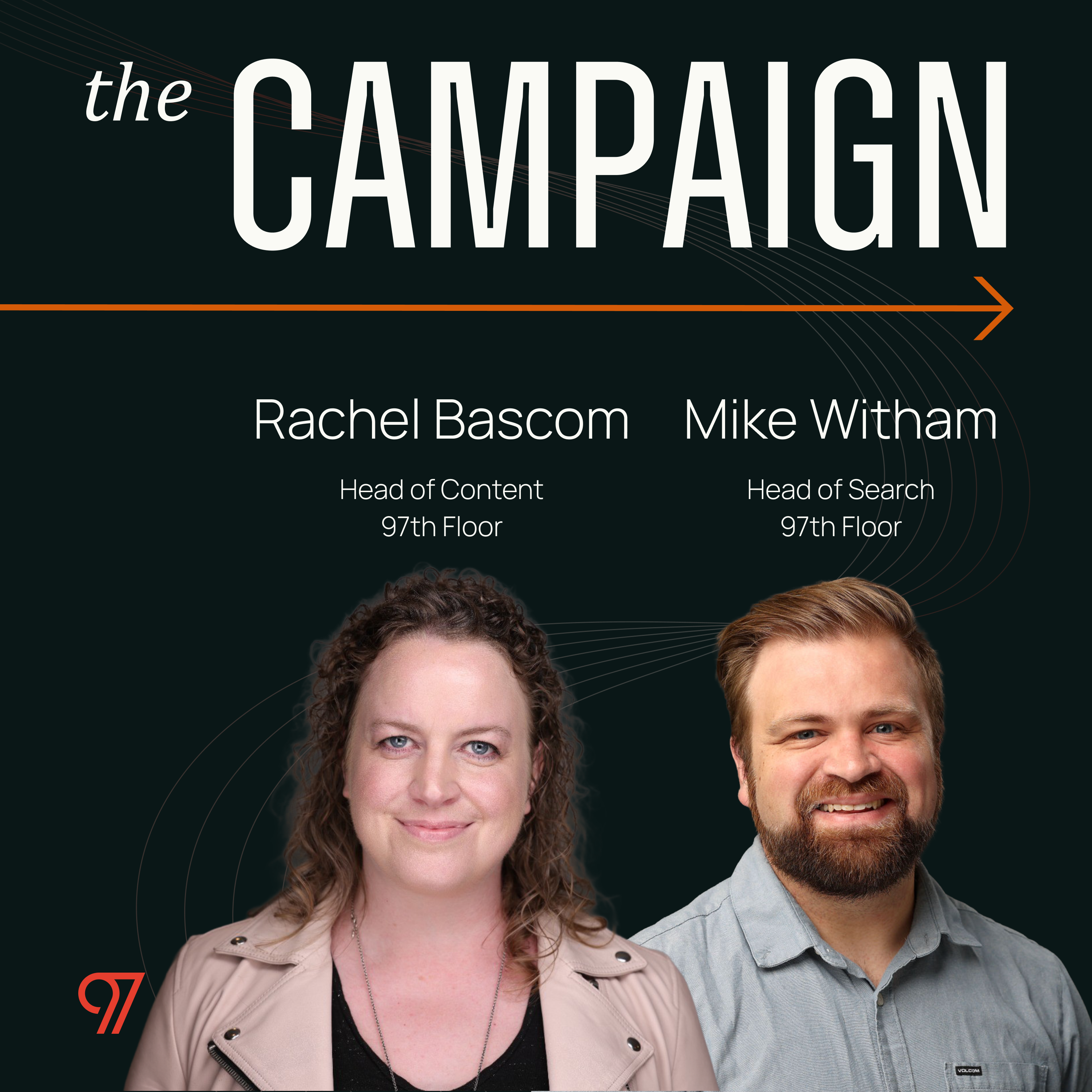
Thank you for joining us today for another episode of the campaign where we talk with marketing leaders about better knowing your audience, innovating beyond best practice and converting visitors into customers. The campaign is produced by 97th Floor, a world class digital marketing agency designed to build organic and paid channel strategies for mid level and enterprise organizations. You can find past episodes of the campaign on YouTube, iTunes, Spotify and at 97th Floor. Today's guests are 97th Floor's own head of content, Rachel Bascom and head of Search, Mike Witham. Today we're going to be talking about Google IO and the trends that we're seeing because of AI search, how marketers should respond and how we can measure the impact of AI search. Let's get into it. Hey guys, welcome. Super excited to talk with you. So let's talk Google I O. A lot of announcements came out of Google I O. We're going to talk today specifically about the search ones and we're going to talk a little bit about AI search in general. So Mike, why don't you lay on us some of the big announcements from Google I O that impact search specifically.
[00:01:07] Speaker B: Yeah, so there's two primary things that were announced that I think is direction Google is going and the first one is more personalized search results and the second one is turning search into a more AI chatbot experience than, than your traditional search engine. And that's those are like probably the two overarching changes I would say in the way that they've like announced these changes or the things that signal these changes are first of all they are turning search into more AI conversational type experience rather than just like a keyword search where there's follow up searches within your search. And then the other big thing that they're doing is they're keeping the conte of your previous search history. And so the search results are very tailored to you as a user and they're going to be very specific and basically custom UI every time you do a search for your based on your, your specific search history. And then the other big reason or other big thing that they're changing is it's, it's going to be a lot more based on agent activity. So they're going to be sending agents out to websites to do things for the user. So it's almost like a turning search into not just a information source but almost like a personal assistant. For example, they're sending search agents out into the web to do research on specific topics or for specific products that you're interested in, or that you've told Google to search and research and find information and new information about those products or those topics and deliver that back to you and summarize all of its findings back to you. So it's turning way more personalized and it's way more agentic. Those are the big, big shifts that I got from the AI or the IO Search summit.
[00:03:02] Speaker A: So Mike, as our VP of Search marketing, how does the strategy for SEO and AI search change with as personalization rolls out? Like what. What is different about the old way of doing SEO versus how we need to think about it today?
[00:03:19] Speaker B: Yeah, so really it's about knowing your customer and knowing the customer journey and having content and having information resources for the user for each stage of their customer journey that these systems can pull from and give to the users who are doing their research on products or services. And from a, from a content perspective, that's, that's really the big shift is tailoring not just about a specific subject, content about a specific subject, but a specific subject in the context of a user that's looking for that information, if that makes sense. And then the LLMs are, are looking for information across an entire topic. So it's not just answer a question or optimize a page for a keyword, but you have to have topical authority with multiple pages, multiple, multiple pieces of helpful content with unique perspectives and unique data, unique research that provide that topical authority and prove that you are a good source of information for each of those subjects. So we've always done E A T like expertise, authority, trustworthiness. That's always been part of our roadmap for content strategy. And we've been doing hub and spoke model for a long time too. But now we're tailoring it more to prompts and query fan outs and specific things that LLMs are looking for rather than just general keyword searches.
[00:04:49] Speaker A: So Rachel, if you don't know, Rachel's over our content here at 97th floor. Rachel, how do you see some of these announcements and develops and platforms and as like impacting our strategy? Like what are some of the things you're thinking about?
[00:05:03] Speaker C: Yeah. To build on what Mike is talking about.
The audience first aspect has never been more important and that applies to both the change that we talked about with more tailored responses and the change with more agentic booking and purchases, things like that. So you have to be thinking about your, however much you were thinking about your audience before you had to think about them twice. Or five times or infinity times more. Because there were things that maybe you could get away with before when it came to your content around, you know, we talk about authority and you could maybe create a bunch of content that you know your audience likes but doesn't really fit into your unique expertise or your unique point of view, your unique value propositions, even where it didn't necessarily matter like it does now. You know, if, if, if. So for an example, if someone's talking to AI and they're asking about product recommendations there, and then they say, okay, my main thing that I care about, or they've said this maybe previously is price. Like I want it to be affordable. That's something that's going to factor into the recommendations that the AI is giving it. Which means that all through your content you have to be consistent on playing into your UVP so that if one of your UVP is price, that's going to come up in the recommendations. And then the other flip side of it is that agentic side that I mentioned where thinking about your audience in terms of frictionless checkout, removing barriers, that's not only now things that could cause your audience to bounce. I think humans maybe are probably actually more resilient when it comes to that kind of thing than robots are. And now you have to consider the robots. And if, if checkout is not frictionless, you're going to run into issues.
[00:06:55] Speaker B: Yeah, and I think that's a, that's a good point to bring up, Rachel. Of, of we, we've talked up to this point, we've just talked about content. Right. And, and that's good. And that's exactly what we need to talk about because that's what Google's looking for, is looking to delight the user at the end of the search or the end of the prompt. Right. And, and they need us to provide content that, that will accomplish that, that end. But the web is a massive place. So Google can come out and say their guidelines are, write helpful content all they want, but at the end of the day, they have to go through billions and billions and trillion pages to find the right content to serve to users. And so technical is, is a huge part of this. Feeding the information to bots, to agents in an efficient way that allows them to find what they're looking for and deliver it to a user very quickly is so essential right now. And that's a really interesting point to bring up in the sense of content and bots coming to your site because your shared con, your shared traffic, now it's not just thinking about the user, but you're also thinking about how is a bot going to digest this. How can I be very clear and specific about elements of a page or different parts of an infographic? You know, like, how can we convey this information as simply as possible and as efficiently as possible to bots?
[00:08:17] Speaker A: So there are some ways to structure content. Some of the things that are being talked about in the industry are schema markup as being one of the methods of doing that. There's like markdown versions of pages. Another take is just providing very clean HTML. And then what's I've seen kind of on the rise right now are specific pages where it's. The entire page is meant as the single resource for all bots coming to the site written in markdown. And it's kind of like the BL end all page to reference for these bots. Ramp did a test a few weeks ago. They released where they had an offer that was hidden inside of schema markup. And then I believe they had a separate offer that was hidden inside markdown files that was mentioned nowhere else on the site, so that they could see whether or not the bots would extend that same offer to the human users in AI Search. What they found was the offer in schema markup was never surfaced. And then the offer that was in the markdown file was surfaced. And it was very quick, I believe.
So it was like batting a hundred, a thousand versus like zero on the schema markup. The conclusion I believe that they're drawing and others are drawing is that schema markup doesn't work. It doesn't really do anything. What really impacts it is the markdown file. I think there's a lot of variables and that's a big conclusion to draw from that. But it is interesting curious where you know, where you Mike, are sitting for the agency and the work that we're doing on like how to structure things so that bots can consume them.
[00:09:51] Speaker B: Yeah. So it's, it's interesting what has come out of, of resources bots use to understand context on a page or understand the information being conveyed or different elements of a page. It's interesting that you bring up schema markup. We, we've done tests where schema markup absolutely did help. And, and if you think about the concept behind schema markup, it's a way to parse out information and deliver information in a different way, in a more direct way than having a bot come and just read through the HTML and piece together the information. So it's calling out specific elements of and giving that information really cleanly. So maybe in that specific scenario or for that specific set of prompts that they were tracking, it wasn't working or didn't, didn't make a difference maybe. But I, but I do think I agree with you that Pax that there's lots of different factors and elements in play that, that that prove or disprove that would need to be considered to prove or disprove that schema markup works. But the idea behind schema markup working is that concept of delivering content in a more efficient way. And it really interesting because schema markup was invented and used by search engines to display content in search results in search result pages, on search result pages in a different way like in people also ask or featured snippet or different site links. You know, it was never created technically for that purpose of delivering content to bots to then be used in generative results. But it, but it works and it makes sense. Another one that's really interesting is the accessibility tree.
The accessibility tree is meant for individuals who end users who are auditorily or visually impaired and they need assistance to understand different pieces or elements of a page. And so that that function of a page that was built for specific users that needed that assistance is now being used for bots to understand and get information that they need about specific pages. So schema markup accessibility tree and then like you said, packs HTML, clean HTML or straight up markdown versions of a page. Those are really easy for bots to crawl, whereas JavaScript is a little bit more difficult. They have to execute JavaScript, they have to do a lot more processing.
It requires a lot more processing power to understand the elements of a page when it's in purely JavaScript or even in combination. So they definitely. It's proven, I've read many studies, I've done tests myself. It's proven that that bots prefer clean HTML over JavaScript. Not that they won't read JavaScript, but oftentimes they're going to favor HTML and clean HTML. So one of the tests that we're doing is using markdown text on some resource pages. We're doing this with a few handful of clients as well as on the 97 Floor blog. We're creating versions of our pages that are in markdown text that's just really easy and really clean for bot to come and scrape and use use that content. And we're going to, we're going to track logs to make sure that bots are actually using it and that it's in prominent places that bots will notice it. That version of the page. Yeah. So. So kind of like the example you, you described Pax, we've got some of that in the works and it's, it's kind of an exciting space to be in. And it's like I said before, the. The web is a massive, massive place and good content is always going to win, but good content that is delivered in an eff these bots is, is going to be the ultimate winner at the end of the day.
[00:13:31] Speaker A: So, Rachel, I, in my. Since the, the early days of Nice and Floor, I've always had this like pendulum in my mind about the agency and whether we are more on the creative side where it's a little, it's a little bit more, you know, outside the box, but not, not, not as much technical, but it's kind of tapped into, you know, pop culture or whatever. And then on the other side is like total nerdy technical stuff. And I noticed that over the years we kind of will sometimes creative end, sometimes we'll be on the more technical end and kind of oscillate back and forth just a little bit. I'm curious if you feel from your perspective like this update from Google and overall the rise of AI, do you feel like that is going to push us toward the more technical end of that pendulum or toward the more creative end?
[00:14:17] Speaker C: You want me and Mike to fight right now, huh?
No, I think this conversation, like from the content side is like kind of straightforward because for us true believers in quality content, like nothing is really changing. And so in that respect, like I would think, yeah, pendulum swings towards the quality content and creative creativity in content. Unique perspective because it's more, as I said before, it's more important than ever. We've been talking about how important it is to optimize now rather than just, you know, CRO for a landing page conversion, path optimization and optimizing full customer journeys. And that starts right at the beginning with the type of content that you decide to produce and optimizing that for what your audience really wants and needs to see. And so from my perspective, I think this is a big win actually for content marketers because whether it is someone seeing it via a robot or if they end up on your site, you still have to optimize for the user and what they need.
So I think it's a win.
[00:15:31] Speaker A: Mike, your response. I've tricked you both into a debate here.
[00:15:37] Speaker B: Thank you, moderator. No, the interesting thing is PAX and I We were, we were talking to someone who runs a fairly large editorial site just the other day and, and they kind of posed that question of like, why would a bot care and why would, why would an LLM care about content that was written by an LLM when that's literally something that it could spin up itself. What it really wants is unique perspective and it wants unique experiences. That's why UGC is so, so prevalent in every response. That's why Reddit owns so much of the citations across all industries almost because it's lived experience and it's people that are giving real opinion about certain topics and things. And that's how, it's, how it's learning too is through those, through that user generated content. So yeah, it has to be audience focused. But I've said it for so many years that you can have the best, the best content in the whole world. You can have the most beautifully optimized piece of content. And that's like so unique and so helpful. Nobody, nobody else in the world has the information that you have on that piece of content. And it's just the best. It's going to convert 100%. If bots and, and algorithms and agents come to that page and they don't know how to read it and they can't read it or they can't even find it or they can't access it, it doesn't matter. Nobody's ever going to. That piece of beautiful content that converts at a hundred percent, you know, like it has to have both. You have to have content that, that has information and data that the, that the bot is looking for. But it also has to be accessible first and foremost to the bot and findable by the bot. So technical matters just as much. One can't, one can't thrive without the other, in my opinion.
[00:17:27] Speaker A: Rachel, I'm curious. One, do you believe that that one can't thrive without the other? And two, how do us changing our approach given, you know, developments and what are some things that you don't think marketers should be doing anymore, marketing teams should be doing in order to situate themselves well for the next wave?
[00:17:47] Speaker C: The only, I won't, I think when Mike said one can't thrive without the other, I think that's the fairest way to put it.
My caveat, caveat would be that people not over correct for like optimizing for robots because I'm not, I'm not foolish enough to say that that's not the direction we're going. Where most users are probably going to be using AI. And, and that's how they're going to interact with content. But there's always going to be holdouts. Right now, you know, there's a whole thing about how millennials have to make big purchases on their computer. They won't even do it on their phone, you know, like, that's a thing. And so, like, do you think they're going to make a purchase through chat GPT? Like, if it' big that qualifies as that, you know, I, I don't think so. So that's a huge demographic that's gonna still be making sure they visit your site and need a good experience there.
And, and there's always going to be holdouts. There's always going to be ways that people end up, like, interacting with your content. I don't think that's ever going to go away completely. And so I'm not gonna say that what Mike has said is, is wrong, because I, I do think that's incredibly important.
But I do think that content, good content, is resilient and that there's always going to be a place for just content that, like, speaks for itself. You know, if you overcorrect and you're only thinking about optimizing for just robots, you're, you're gonna end up like the people who were keyword stuffing back in the early days of Google, because every, every update that they make is to try and get a better use.
So even if you do try and game the system and pander to the bots, it's not going to work out. Right. So your audience is your best bet.
[00:19:37] Speaker A: Yeah, I think I generally agree with that. You know, I think a lot of the industry, content was a means to an end, and I think I would limit that statement to written content was a means to an end of, you know, ranking higher and improving search. And that's what the end was for the content. And I think, I wonder, I mean, content, I think, should still be a means to an end, which is ultimately conversion, speaking to an audience, building brands, building fans. But it seems to me like the equation should be slightly shifted where instead of content being a means to an end for SEO and search success, it feels like SEO, technical and AI search optimization should be a means to an end to serve the content and help the content perform, which in turn is a means to an end to help the bottom line instead of going the other direction, you know, So I see this as a slight shift in. I don't know if power is the right word, but a slight Shift in strategic power at least in favor of the more like content and creative. I think if brains are smart, that's, that's they're not going to forego the AI search by any means. But I do think we should maybe start thinking about the creative a little bit more than a lot in the industry has, you know.
[00:20:49] Speaker C: Yeah. And I think it's been implicit to what we've been saying, but just to make it, it explicit, we're talking about content, not just written content, all forms of content.
Video is going to continue to be huge and graphics, I think, you know, infographics might not be coming back where they might be, but some form of, of that site type of content I think is, is pretty important moving forward.
[00:21:19] Speaker A: Yeah, yeah, I agree with that.
So what about these brands?
Let's shift a little bit to attribution, which I think is a strong word and implies a lot of different things. But the fact is for brands and specifically like CMOs and marketing leaders to get budget, they must attribute success. They must say, here is how I'm winning.
And the old formula, like old, old we could see, hey, you are ranking exactly here for this keyword. And that has brought in these specific visits. And 20 out of those 18 visits purchase or 20 out of 18, 200 out of 800 of those visits purchased. And I can see exactly where they went, what they purchased. And then in 2013, Google removed all of that.
So we don't see that data anymore. But we could still see generally organic traffic, what kind of conversions we're getting from that channel now. You know, with organ traffic going down, being eaten up by AI for a lot of brands, a lot of it is a lot more opaque. So first let me state, you know, this is a data from Google's IO I want to get your reaction to. Google says AI mode queries have been doubling every quarter since their launch. First off, first reaction to that, do you believe it or are they just masking the fact that they are just applying AI mode to more queries? Like, I don't know, I kind of seem skeptical of that, that it's doubling every quarter since launch.
[00:22:46] Speaker B: Google loves to, to release statistics like that without giving additional context. So mobile searches have been the majority form of searches for like over a decade now. Right. Since basically since release of the iPhone in 2008. Right. Like it's just mobile has taken over search and, and that's the, the biggest, biggest driver of searches and Google since AI mode was released. AI overviews and AI mode was released. If you click on the AI overview in your search results on your mobile phone, it automatically takes you to AI mode. So yeah, of course they're doubling and tripling and quadrupling, whatever. Like the primary source of your searches. It's an automatic default that goes to that mode. Yeah, more people are going to use it, not because they chose to, but because you, you defaulted for them to use it. That's my opinion on it.
However, I do, I do believe that search behavior is shifting to be more conversational in general. And Google is recognizing that and recognizing the need to change their platform in order to cater to that. There's one aspect of all this that pax, I think you and I will disagree on, but I think that Google and all AI chatbots are realizing that they can't not send traffic traffic to sites. I'm seeing referral traffic go up in almost every instance of every site and hyperlinks are more prominent and hyperlinks make more sense in generative responses now. And my reason for thinking that they, they're realizing they can't do that is that there, there has to be a symbiotic relationship between content marketers and, you know, search engines where we're feeding them information, giving it to them. That's the only reason Google is. Google is because for 25 years we've just been giving it information, giving it really good content, and they're realizing they can't cut the spigot off of traffic and expect the same level of content in return. And I'm not saying referral traffic is replacing what has been lost with organic traffic, but it is growing and it's in correlation with clear adjustments made to AI platforms that would promote driving traffic to sites.
[00:25:06] Speaker A: Yeah. First off, a few questions. One, I'm curious why you feel like I would disagree with that.
[00:25:10] Speaker B: Your comment just barely of, of Google taking away data from webmasters. And I, I feel like I prescribe to the more optimistic side of driving traffic to sites sometimes while you're, you're the more like realistic side of. Google doesn't care about you. Google cares about Google.
[00:25:30] Speaker A: Yeah, no, Google for sure doesn't care about you at all. Unless you're a shareholder, they don't care about you. And in fact, unless you're a major shareholder, they don't care about you. Yeah, but you know, my, my, my comment is actually more just about data, not necessarily about visits. Like, yeah, they may say send visits and traffic, but like, they're not going to send data they don't want you to know because the less you know, the more you have to spend, it's just like straight up, the more you
[00:25:52] Speaker B: know, the better the content, right?
[00:25:54] Speaker A: Yeah, but they don't, they don't care about that. Yeah, they don't care about your content or about you. I think when you're saying like, they understand there's a symbiotic relationship between, you know, people producing content and then being able to consume it. It. I don't know that it's that altruistic. I think it's more just like they see that users want to click something, we're in the pattern and annoyed that we can't or we, you know. So I think they're just responding to what? Like they're really short term incentives. Yeah, they're just not. Anyway, who knows? But I agree. I've seen the same, you know, same data of more is being sent. So that's great. And I love it. Like more of that. Whatever the reason, I don't care. Like, like they're sending more. That's awesome.
[00:26:36] Speaker B: Maybe it's because millennials use Google the most and they need to buy their TVs on their laptops.
[00:26:42] Speaker C: On their laptops.
[00:26:44] Speaker A: TVs on laptops. So I'm curious. So more people are using search and that's still growing, which I think is great, that more and more people are searching. And it seems confusing to me that a brand would sit there and see data around. More and more of my audience is using search. Yes, they may be AI search, they may be searching more on ChatGPT or Claude, but the fact is more and more people are using Google. So it seems confusing that they would look at that data and then pull back on either investments or initiatives around trying to capture more of that simply because it's more opaque. So I'm curious from your perspectives, either, like, do you agree with that take around, like, yeah, I would pull back too. Or, or not. I'm, you know, I'm assuming based off of where you work that you would not agree with pulling back. But like, how do you look at, like, how would you justify to a board, hey, we need to continue to invest in AI search discoverability despite not being able to see as much as we used to be able to see when it comes to, like, we're not getting the traffic or the, the conversions are happening off our site. Just like, what would you point them to? How would you build that case?
[00:27:56] Speaker B: My take on that is that you still need to be found and, and AI search is a way to get found.
And why Google's Moving towards this, I don't know. I could speculate that it's because ChatGPT made them scared for the first time ever in their history of like owning the market on search. I don't know.
But user behavior is changing and they're adapting to it.
Is is my best guess.
But as for like needing to continue to publish content and continue to optimize sites for AI search for Geo, it's still imperative because it's still the source of discoverability for so many people, for so many individuals, for the most the majority of the world. And so being recommended and being cited and being mentioned, AI is going to bolster all of your marketing efforts. It is so hard to sell something that nobody has ever heard of from a brand that nobody has ever heard of. And so the more you are, your brand is present across the entire, all the stages of the customer journey, you have a better shot when it gets to the decision phase because people have heard of you, you've given something of value to them already, they've had a positive interaction with you, they've had a recommendation from their LLM of choice that you are a good brand to move forward with.
That's my biggest take is it's very hard to sell something that nobody's ever heard of from a brand that nobody's ever heard of. So you have to be discoverable by AI.
[00:29:38] Speaker C: Yeah, yeah. And to your point about the symbiotic relationship, like AI's got to pull that content from somewhere. Wouldn't you want to throw your hat in the ring and have it be you?
[00:29:49] Speaker B: Yeah.
[00:29:50] Speaker C: That's where your users are. If the only reason you maybe would pull back is if you can Somehow prove that 0 of your audience is using AI and is is asking LLMs about things related to your product. If you can somehow prove that. And then even then I think you still kind of don't have a choice because what are you going to do then? Invest in other channels? Go on social? Guess what AI is going to pull from on the odd chance that someone does ask about your product, they're going to pull from all actual stuff that you put out there.
So you kind of don't have a choice anyways. So you might as well lean in and invest in the right way.
[00:30:28] Speaker A: All right, I like that. I like that take. Let's end on some predictions. Let's, let's clip this right now. We'll let you know, let the team know to clip this. We'll save this. Five years from now, are we going to be talking about search in ChatGPT in Claude, or is Google going to dominate some, some, some points in favor of Google dominating? You know, part of this release is they're saying in search you Google something, you can click a button and it will write an app that you can use in search to solve your problem, which immediately, as far as casual users go, make it unnecessary to use many of the other platforms to build things. And that will just evolve. Google has all the cash. Google has a lot of the power. Will these other platforms go away or do you think someone's going to win and, and we'll still be talking about them in five years? Let's start with Mike.
[00:31:16] Speaker B: 100% Google is going to win the AI search race. So there's no doubt in my mind, unless there's some massive government intervention that actually makes them stop being the monopoly that they are, they're going to continue to dominate the search space because they have all of the pieces already. They have the technology, they have the model, they have the infrastructure, they have the decades of data that they've been compiling that they can train the model on. They, they have all of the pieces in place already that no other LLM, no other AI platform at this stage has. No. Anthropic doesn't have it. Amazon doesn't have it. Meta for sure doesn't have it. Grok for sure doesn't have it. Perplexity doesn't have it. Like they all have pieces of, of the necessary elements, but they don't have the entire package, which Google does have. And Google is a profitable company.
Google is currently a machine that pumps out billions and billions of dollars every year, whereas all of these other companies are burning billions and billions of dollars a year trying to stay afloat, trying to stay alive.
[00:32:27] Speaker A: All right, so we got Mike in the Google camp also some big claims around Google being a monopoly. He's calling. So let's get, let's get that clipped.
[00:32:35] Speaker B: Let's get that saved.
[00:32:36] Speaker C: Rachel, your take gonna age horribly for me, I'm sure.
I know I, it's hard to go against that. That's a really well founded opinion. But I, I can only answer from like, I think a user perspective. And I think right now there are specific niches that the, some of the other tools lean into that if they continue to do so, they can thrive. For example, Claude, in the B2B space, I think, you know, it's, it's the, it's, I think it's the leader there and I think people are increasingly realizing that. And so if they don't try and what's the word? Like ease. Eat Google's pie. Is that the phrase?
[00:33:19] Speaker B: If it is, I don't know what it is.
[00:33:21] Speaker C: Google's lunch. That's it. Right. I don't know why pie. But yeah, if they, if they, if they try and become Google they will absolutely fail. But if they can continue to carve out that niche that they're already sort of leaning towards, I think that's where the success is and that's how they'll survive in the long run or maybe just get acquired by Google. But.
[00:33:43] Speaker A: But yeah, yeah, I can see that. I think that's a, that's a good case. I think I'm in the camp of Google is going to win however, mainly because I think it's, it's difficult to under or to overstate the power Google has given that, you know, they've got Chrome, majority of people use, they've got Gmail, majority of people use that. They've, that they've got all the stuff going on with Android and that entire division. Like there's so many, they've got their arms in so many different places that it's hard to, to, you know, say they could lose because they, they know more than anybody else. They've the cash position. Like it's insane how much cash they have access to. Like you said Mike, like they could sit around and wait for other companies to basically go out and still be fine. I think the thing that's going to hinder their ability to be the ones that are the winner in five years is speed. Ultimately that's where Claude and where they've, you know, really taken over is just like the incredible breakneck speed. And I do think because of them we are seeing the fastest Google we've ever seen. Granted, they're still very slow by comparison, but they are speeding up. So if that trend continues. I agree, Rachel, like they are losing on the B2B side but they've got, you know, Google workspace, which most companies I know are use that the backbone of kind of their operations around documents and things. I would much prefer to use a cloud level, you know, sophisticated AI environment but within and connected to all of our Google stuff. So the question is, will Google build that and will they build it fast enough? But if they do, I think they're going to be the clear winner. Like if I had to bet right now, I'm going to bet put my money on Google. But I hope, I hope others make, make me wrong about that because I don't I don't want to see a future where Google is the only. The one and only. Great. Thank you so much for joining us today you guys. I really appreciate you bringing your perspectives on this. I want to have you back and let's do this again maybe you know, just a couple weeks. This has been great hearing from from you. Mike, thank you so much for joining. Rachel, thank you for being on. Yeah, been a pleasure.
[00:35:48] Speaker C: Thanks.
[00:35:48] Speaker A: That's it for today everybody. If you enjoyed this episode, please consider leaving us a five star rating and subscribe so you don't miss future episodes. Huge thank you to Rachel and Mike
[00:35:56] Speaker B: for joining us today.
[00:35:56] Speaker A: You can find both of them on LinkedIn if you want to connect and talk more. More. You can also find past episodes of the campaign and examples of her
[email protected] there you can learn more about the agency and get in touch with a marketing specialist to get support for your own marketing campaigns. That's it for now. Thank you for listening. As always, keep innovating, keep.