[00:00:00] Speaker A: Hello everyone. I'm paxton grace, CEO of 97th floor and this is the campaign.
Thank you for joining us today for another episode of the campaign. We talk with marketing leaders about better knowing your audience, innovating beyond best practice and converting visitors into customers. The campaign is produced by 97th Floor, a digital marketing agency designed to build world class organic and paid channel strategies for mid level and enterprise organizations.
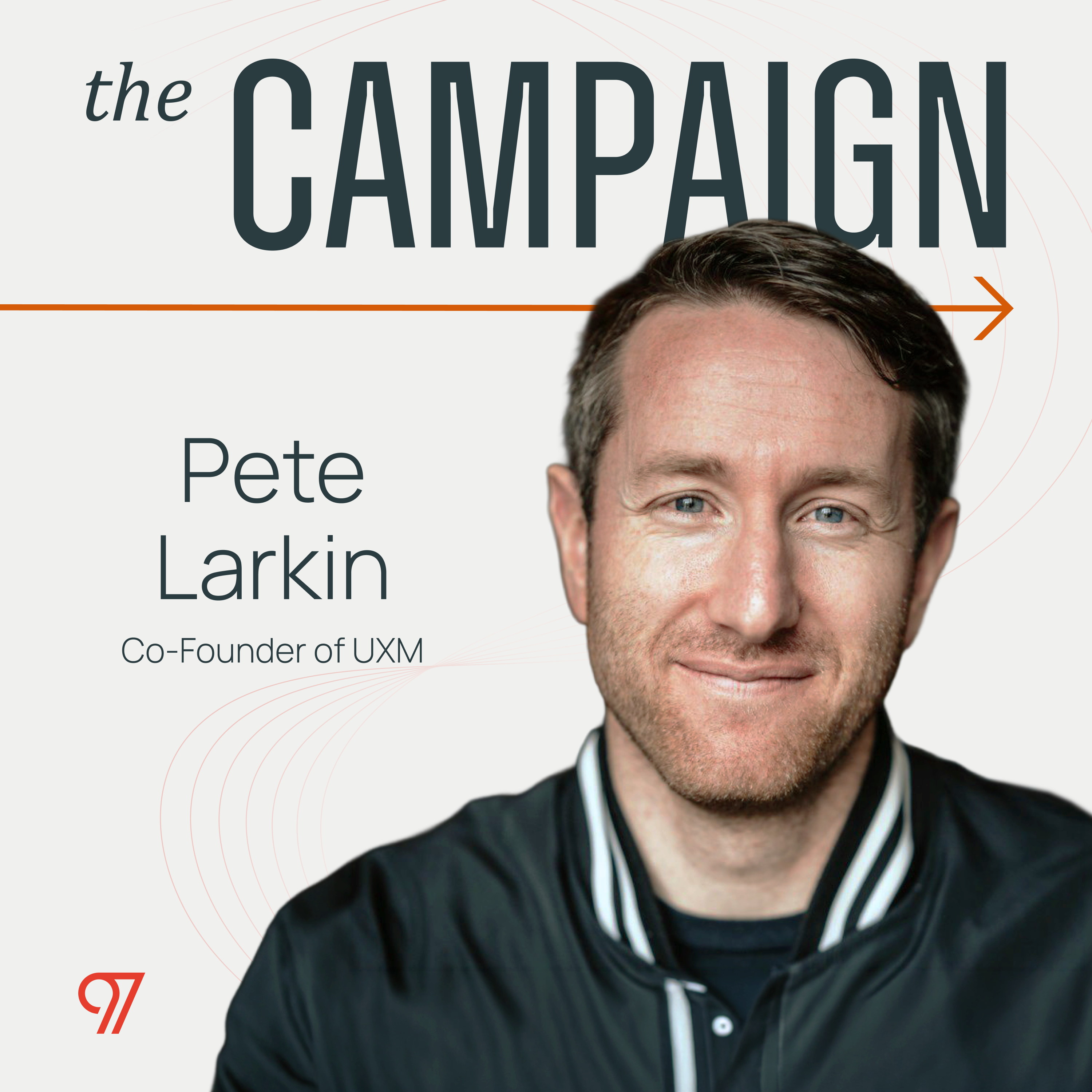
You can find past episodes of the campaign on YouTube, iTunes, Spotify and at 97th Floor.com. today's guest is Pete Larkin. Pete started in film, running his own production company. Before making the move into marketing. He has built a career as a marketing executive, entrepreneur and creator. Now he's made another leap into GTM engineering and AI orchestration, helping teams and individuals figure out where to start and how to put AI to work.
In this episode, Pete will break down what's actually keeping people from adopting AI and shares how to push past each one. He's also going to share with us some of what he's building today with AI. Let's get into it.
Pete, thank you so much for joining us today. We're excited to have you on.
[00:01:09] Speaker B: Thanks, Paxton. I'm excited for the conversation today.
[00:01:11] Speaker A: Okay. All right. Well, we're going to talk about AI adoption within teams and organizations and to start, but why don't you talk a little bit about some of the benefits that you've seen for individuals or for teams from going through this, a bit of a journey, working to adopt AI?
[00:01:28] Speaker B: Yeah, absolutely.
I think first and foremost is just my own way of working and in my personal life as well, it enables me just to do a lot more, more efficient, more effective in my work, which maybe this is a little bit philosophical, but Paxton, I think maybe in conversations past we've discussed a little bit about what do you do with that, what do you do with those efficiency gains. And for me, instead of just running at 150, 160% capacity with these new superpowers, if you will, for me, I'm able to reinvest into the things that I enjoy the most.
And so for me, on a personal level and my own work, it allows me to focus on the things that I care about the most and the things that I enjoy the most on an organizational level, my teams and the people that I work with, we are also more efficient and effective. But it's also transforming the way that we think and approach our work in such a way where, yes, like there are automations, but it's a cause for reinvention where it's not just how do we take AI and kind of fit this into a box of how we already do things? But how can we fundamentally step back and rethink the way that we do this work and to recreate it or reinvent it without the box of how those things were done in the past?
[00:03:00] Speaker A: Okay, so like an opportunity to reformat what we're doing, chase efficiency and reinvest that into that time, save from efficiency into better execution as we rethink what we're doing. I love that. So I, I conducted a small survey. Survey is a strong word. Among is about 40 people asking them what they see as the biggest roadblocks to their adoption of AI Personally and I think it might be good to go through as we read these. Like, I think they're pretty consistent of what people are feeling. You haven't seen these yet. And I'm going to read some of the most common answers and get your opinions and maybe ideas on how to overcome it as an individual and then maybe how to overcome it as a leader of a team who might have these roadblocks. So the first is by far the most common. It's like, not even close.
[00:03:51] Speaker B: Time, time.
[00:03:53] Speaker A: I feel like I don't have enough time to invest in learning how to do this thing. It's like there's like a big time barrier. I have to do all the things that I normally have to do. You've had a couple of LinkedIn posts I think that address this specifically.
Tell me your thoughts on that from individual as well as a team perspective.
[00:04:09] Speaker B: Absolutely. I love this one. It's investment. And when you look at say like planning for retirement and investing in your retirement now, like it can be hard to do that up front but then later on you get to, you get to enjoy that. And it's very similar with how we invest into AI. You don't see the gains immediately, you see it over time. And as you build out your new automations and workflows, those gains that you get back from that investment, like they come back in multiples. Right. And so the question then, well, how do we do that? Right? Because first it's, it's actually realizing and just mentally getting over the hurdle of like, okay, I believe that if I actually do this that I will see gains. It will be worth the investment of time. So, so it's making the decision first and then second, practically, how do you do that? For me, it's time blocking. I have to time block. I have to put it into my calendar. I'm a little bit unique in the sense that it's fun for me. And so I invest personal time in this, like after the kids, get the kids down for bed, hang out with my spouse, and when she's, you know, tired and going to bed, then like, AI school is starting and I lock in and I'm learning more. But for those who want to have a better sleep schedule than I do, time block it. Put it on your calendar. Find a time of day that maybe is a little bit slower or maybe when there's not so many meetings, but if you don't actually put it on your calendar and time block it and put it as a recurring thing, I think it should be daily.
It's going to be really hard. It's going to be really hard to. To build up your AI fluency and build up those skills.
[00:05:58] Speaker A: What to somebody who's like, okay, I'm gonna. I'm gonna block out the time, but I don't even know what to do.
What would you point them to?
[00:06:07] Speaker B: I'd say start with the courses that are available to you for free from the major LLMs. Anthropic is where I would start. Go do the free courses about Claude. They're great. They're great content. They're engaging, very professional, well organized. And then OpenAI's got some as well. I have some of my favorite creators that I follow on YouTube and link specifically on YouTube. Where I get the most value from the videos that I'm watching is Nate Herc.
He used to be local in Utah, now he's in Chicago. He's got a agency called I think It's True Horizon. But the content he puts out is so, so good. But here's the thing.
Whatever content you're consuming, you can't just be watching it. You have to open your computer and you have to follow along.
You have to be doing it as you're learning it or it won't stick. It'll be theoretical and not practical. So if you want the skills to stick, follow along on your computer.
[00:07:06] Speaker A: Love that. And then from a leader perspective, how do you help people get over this hurdle of time?
[00:07:13] Speaker B: I think it can feel overwhelming for employees because they feel like, okay, not only am I supposed to be learning this stuff, but I'm supposed to be more efficient, more effective. I'm supposed to be doing a lot more with this, but because I am expected to do more, I feel like I need to be doing more work and executing on these skills that I haven't developed yet. Right.
And so that's a little chicken in the egg.
[00:07:39] Speaker A: Here.
[00:07:39] Speaker B: And leaders need to understand that like you can't expect your employees to wake up one day and just magically have AI skills. You have to invest in the tools for them to have access. So give them budget. But then you also have to invest in the time just as they are investing in the time. You have to enable them to have time learning these skills during work time. You can't expect it to be during their personal time. It's just going to, going to burn them out. So give them time and encourage them to time block. Maybe even have like your AI hour every day and you could even say hey, full company. Like everyone in the company from like I don't know, say two to three, we're going to like this is AI hour or something. You know, pick a time and if that doesn't work for you for AI hour with the company, find another time that does.
But don't just encourage it. But also like in the one on ones talk about it and try and make it more of an expectation.
[00:08:39] Speaker A: That brings us. You mentioned resources. That's the number two most common response, which is cost and resources. I think from a team leadership standpoint, the answer is pretty clear. Like provide budget for that, provide the subscription when needed. From a, an individual standpoint, is there maybe something that's like cost effective or how to think about the cost? Because I think for people who haven't had a chance to dive in, they hear these horror stories about credit usage and racking up massive bills and all of that and that could be potentially a little intimidating. So how should somebody think about that?
[00:09:15] Speaker B: Yeah, I mean there's a lot of free tools to use. There's so many free tools, Google especially.
But I personally think even if your organization, your company isn't paying for any type of paid account, whether that's OpenAI or Claude, I mentioned those. There's of course there are others. To me, those are the two. If you're going to pay for an LLM like that, those are the ones that you would, you would typically pay for. To me it's hands down, no question about it is Claude. Like that's where you should put your money and go to the pro account. Pay the 20 bucks a month if your company isn't paying for it. And it's, it's well worth the investment. And so the starting anywhere when it comes to those tools, start there first and then expand from there. You'll see like as you're building out your capabilities, you're going to want to jump into additional tools as well, and again you'll build out those efficiencies and those gains and it will be well worth it. However, then the question is like you mentioned, credit uses usage. You don't have to worry too much about credit usage. And unless you're, you're building via API or if you're getting into Claude code and you're just like running through like tons and tons of tokens, my belief is if you're running through that many tokens, it's probably because the work are doing merits it.
I don't think that token usage should be too much of a concern for people trying to build out their skills.
[00:10:45] Speaker A: Okay.
Number three most common is the concept of hallucinations which I will lump in with another item which is like trust. I'm not sure I can trust what it produces or what I get out of it.
Would you say to either individuals or teams that have that concern?
[00:11:05] Speaker B: Yeah, the models continue to get better and better and I see like the frequency of like significant hallucinations, like serious hallucinations are dropping. And also as you learn more about these tools and these technologies, you'll see what AI is like really good at and what it's really good for and what it's not. And so one example is math. Right. When I'm doing sometimes pretty simple calculations and AI just struggles and it just doesn't get it right. And so I know in what situations I need to be extra diligent in the way that I review and look over the math and the results. But you should always be reviewing the output of the work. And ultimately before you even use the tools, before you even use AI, you need to understand and think about is this the right use case, is this the right time and place to be using AI?
And one, I'll just give a quick example. If I'm going to say create a customer facing marketing material before it goes out, I'm definitely going to review it. Right. Don't just trust it on its own to, to be high quality. Expect to, to have some edits and adjustments.
[00:12:19] Speaker A: Yeah, yeah.
Now I'm going to bring up some less common concerns that I think are actually really interesting and I did not expect to see.
[00:12:28] Speaker B: I'm excited to hear.
[00:12:29] Speaker A: I think there's, I don't think there's necessarily a great answer to these, but they're a little bit more philosophical. One is I'm concerned that if I dive too deep into AI that I'm going to get too dependent on it.
[00:12:43] Speaker B: I love this one too. We talk about this one with My kids about like, is it going to make us dumber?
And this one's tricky because like, I think about like churning butter sounds a little weird, but like, how many people do you know that know how to churn butter? And it was a skill at some point that was like very important skill, right? Or like breaking a horse. Advanced and technology makes certain skills irrelevant or unnecessary. And so I like to step back and say, like, how important is this skill to maintain for myself?
And here's a quick example. Like when I'm in, working with AI in Excel or, or Google Sheets, like there are certain things that, certain equations or functions within Excel that I don't really need to memorize or, or like maintain those skills and keep those fresh if the tools can do them for me. I don't, I think it's okay if it goes the way of the butter, right? Of churning the butter and like, if those skills like, falter. But then there are other skills. Critical thinking, I think is probably what more people like lean on when they come to this concern or this issue is that they, they worry about how it's going to impact their critical thinking and, and like keeping them sharp. And in my opinion, I think when you're using a thought companion and to help you enhance your current skills, it's not a dependency where you like stop thinking and you stop the, the critical thinking or developing, you know, skills to keep you sharp. I think it can actually help you grow and evolve the way that you think.
But the caveat, and like this is what I share with my kids.
I think it's important to understand what's happening. Like when you ask a question, there are certain low profile requests or tasks that I don't, I don't think it's that important that you understand like give me, show me your work or help me understand exactly how you did this. Don't just tell the AI to give you the answer, but to, to walk you through it and help you understand how it got there so that it becomes a learning tool. It is actually expanding how much you understand and learn. And I think it can help you move very, very fast or help you learn a lot faster.
[00:15:07] Speaker A: I love that. Okay. Another interesting uncommon answer, but I thought was kind of, I hadn't thought about before. One barrier to adoption is this concern or ambiguity around morality.
There's a lot of, kind of ethics that have been well established that AI comes in and challenges some of the assumptions around ethics and, and what we create is being presented as real or fake and like what to do about that, what's your current take on, on that concern?
[00:15:41] Speaker B: Yeah, I, I think we should be transparent and open about how we present AI work. I don't, I don't think we should ever try to pass off AI work as human.
Sense of like, for example, if I'm going to create an email using AI, say a marketing email at the bottom of the email, I'm not going to say this was, this email was created with AI.
I'm not also not trying to say like, pass it off as this email was created by a human. Right. Like, it's not, I'm not going one way or another with it. Right. I don't see it as unethical to not disclose in that sense. But like imagine you call in to like a support line or you know, customer support and you're, you're trying to get answers and you get on the line and it's AI talking to you and if you ask the question like is this AI and it lies to you or it says that it's not, I think that's super unethical. Also, this comes to taste, right? We talked about this, Paxton, and I loved your comment about this. But when it comes to outbound or cold outbound, in prospecting to have an AI call a human to try to have a conversation and sell something, all that says to me is that you don't care enough about me as a customer to send a real human to talk to me.
Right. And so don't take my time with your AI. Right. I think it's bad taste and I think going back we shouldn't try to pass stuff off as human if we're trying to make it look human.
That makes sense.
I think it's deceitful. So I think that that's where some of the ethics come in. I'd like to hear your perspective on this when it comes to taste.
[00:17:40] Speaker A: Yeah. So we developed an acronym to help guide us on how teams, individuals and companies will succeed with AI. And based off of the number one roadblocker concern being time as the thing that's preventing people from getting deeper. That's the acronym is time and so it's taste impact matching work and elevating. So T is taste, basically. Like the belief is teams will win in AI as they develop their taste. So if I'm a brand new marketer today, I'm not going to be as worried about learning the ins and outs of maybe like an analytics setup or converting data from here into a spreadsheet. I'm going to learn more about taste, like what is going to actually drive action? How do I persuade an individual to take this next step in this journey? The stronger your taste, the better you'll be able to drive AI in the correct direction. If you have no taste, that's AI slope.
So you can produce a lot, but it's not going to actually do anything. So then impact is self explanatory. Like I'm looking not to increase the volume of deliverables, instead I'm looking to increase the amount of impact that I have. Ideally on bottom line, matching is matching the correct work to the right intelligence. So we have artificial intelligence and organic intelligence. So matching means developing the instinct to know. This task is best suited for AI and this task is best suited for organic intelligence. And the last is elevate. So the concept of, you know, I'm not just going to spit this out from AI and not review it. Like AI can take it 80% of the way there, but humans should polish and elevate whatever this is before it goes out. I think there's some cases where that may not apply like you talked about, where it's disclosed or it's understood this is AI generated. In that case, like I think it may not apply. But um, yeah, so that's our, that's our acronym taste being developing our ability to actually persuade.
Pete, I know that you are doing some really cool stuff in AI and I think it would be a shame to end without hearing some of the cool things that you're working on and that you've built like for yourself or, or for work. Tell us about like two or three of the, the projects or things that you've built or are building with AI.
[00:20:02] Speaker B: Yeah, the one I'm most excited right now, I'm calling it. I have never shared this like in any type of format outside of very like closed doors, personal discussions. This is one that I'm calling the Family Operating System or fos.
And basically it is a way to take the conversations that are happening within my home to help me become a better father, to become a better spouse, to give me coaching on how I can address situations better.
So I'm excited to see how this one goes.
[00:20:36] Speaker A: How far are you along on that? Like are you. Has stuff been built? Are you testing right now?
[00:20:41] Speaker B: This is one of the things I love about AI is it enables me to do things that I in my wildest dreams never thought I would ever be able to do. I now consider myself to be a vibe coder. Never thought I would ever be like. And you know Coding anything besides HTML css, like it's just, I don't know, that's like I don't have those skills.
I believe that I could learn them if I was going to dedicate time to that. Going back to some of our previous discussion about, you know, being worried that our skills are going to, to fail us by being too dependent. Like it can greatly enhance your skills and what you're able to do in the act of doing so. Right now you asked like, where are you at? Is in the very early stages I've been with Claude.
I have been learning about different microphone systems and a radial array and how to pretty much build these microphones, this system in a way that it will be able to only record when it hears a human voice over a certain decimal point and then be able to transition from one room to another while stitching those audio files together into a single file.
So within this project there's electrical engineering, audio engineering, there's coding. Right. There's the software and the hardware and like there's so much into this. But before I would, I would never try something like this because I felt inadequate. I never didn't feel like I would be able to do that. But now I'm pretty good at following instructions. So yeah, it's pretty early stages. Tomorrow I'm meeting with an electrical engineer to I. There's like a 30 page build plan on how I plan to approach this and I'm going to present that plan to the electrical engineer to say hey, cool, what do you think?
You and I have talked about my podcast Paxton for Personal Learning. AI again is just an incredible tool. The gist of this project is it takes my favorite newsletters and it through a daily automation through Claude. It will convert my favorite newsletters into a podcast, about 15, 20 minutes per episode using Notebook LM that I really enjoy. I learn a lot from it and I enjoy listening to it. So that's one of the projects that I've really loved is. Is my personal podcast. We're on episode 156 today.
[00:23:25] Speaker A: Are you sharing how they can find that?
[00:23:27] Speaker B: Sure, sure. Yeah. You can find it on Spotify, you can find it on Apple Podcasts. The the show is called the AI Deep Dive. You'll have to probably put Pete Larkin in the search to find the right one. So AI Deep Dive Pete Larkin, a new episode every Monday through Friday.
[00:23:44] Speaker A: Cool, that's awesome.
[00:23:46] Speaker B: Yeah.
[00:23:46] Speaker A: Any other Cool.
[00:23:48] Speaker B: Yeah, some personal ones. Um, I have an agent that will go through searching for any flights when you go to Delta has like Their flash sales like that. You can find flights using points. So every day it will go to. To the website and will search for. For flights that pop up leaving Salt Lake City, which is my base air airport, leaving Salt Lake City. That is international. That is under 20,000 points points for the flight. And then if there is one, it will send me an email that says, hey, here's. Here are the details about the flight with this flash sale, which I love that. And it's also helping me find some property. And so it's. It's searching through different sources that I've given it access to to help me find land. So just some, like, interesting ways to use it.
[00:24:45] Speaker A: Man, I love that. I love that. Pete, thank you for sharing your knowledge with us. I have to say, like, you more than most people I know, like, you have the ability and proclivity to dive headfirst into some things and not worry about, you know, am I going to do this exactly right. Like, you're very much like, I'm just going to dive in and learn. And I think as a result, you end up getting, you know, very early into some really cool stuff. So, yeah, I appreciate you sharing that with us. To wrap up, the question that we like to end with is, could you share with us a marketer that has helped shape the way you view marketing?
[00:25:23] Speaker B: Yeah, I've been thinking on this since you gave me the. You like, there's a little cheating behind the scenes here. I was informed beforehand this question was coming. I've been thinking a little bit about it. This. This one's a little tricky. Of course, there's like Malcolm Gladwell or Seth Goda and some of the early, you know, Neil Patel, other marketers that, like, I really enjoy their books. I love learning from them. Adam Grant, this is more on, like, the philosophy side, but a more personal response to that. I think a lot of it has to do with just like, the friends that I meet and the connections that I make through networking and through different events and seeing the awesome work that they're doing that, like, I admire the work. Paxton, you're one of them. We went to school together.
And just like the incredible things that you and others are doing, that, like, I. That I admire inspires me. I'll drop Alex MacArthur's name. He's a friend of mine. One of the main reasons I have a lot of respect for Alex's work is because he puts it out on the line to do work that he really believes in. And he has a lot of fun doing it. And it's super creative, but I know it's risky. He always crushes it. And like, that's one thing I love about Alex.
And I'd also say, like the early days of the Harmon Brothers, like, I really love the work that they were doing. But yeah, those are a few.
[00:26:46] Speaker A: Yep. Great, great people to follow. Pete, thank you so much for taking the time.
Where could we send listeners to to either connect with you, follow you, or follow along with what you're doing?
[00:26:57] Speaker B: Yeah, absolutely. The majority of people will find me on LinkedIn. I recently created an Instagram account for business purposes. But yeah, find me Pete Larkin on LinkedIn. If you go to the umx.com I do in a lot of events. This is typically more for, for those in Utah, but if you want to come and hang out and, and connect like in person, the umx.com those will be the events that you'll find me at.
[00:27:23] Speaker A: Okay. All right. And we'll obviously post these in the show notes too. Pete, thank you so much for taking the time to share what you've learned with us.
[00:27:30] Speaker B: Yeah, thanks for having me. It's been a great time, man. I always love chatting with you and always about AI.
[00:27:35] Speaker A: Likewise. Likewise. That's it for today. If you enjoyed this episode, please consider leaving us a five star rating and subscribe so you don't miss future episodes.
Big thank you to Pete Larkin for joining us today. Be sure to connect with Pete on LinkedIn to hear about what he's working on and check out his daily AI podcast, AI Deep Dive.
You can find past episodes of the campaign and examples of our
[email protected]. There you can learn more about the agency and get in touch with a marketing specialist to get support for your own marketing campaigns. That's it for now. Thank you for listening. As always, keep innovating, keep converting.