[00:00:00] Speaker A: Hello everyone. I'm paxton grace, CEO of 97th floor and this is the campaign.
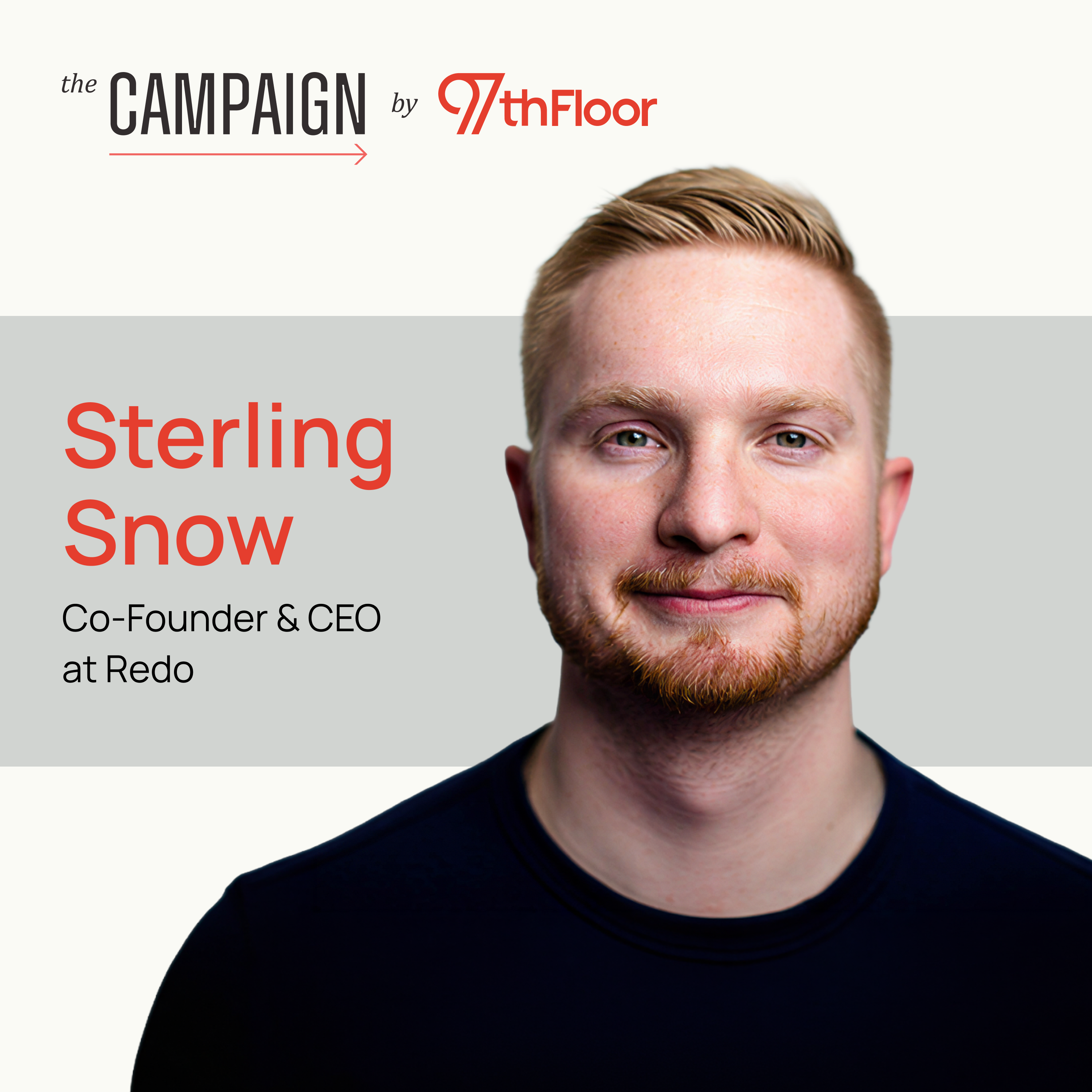
Thank you for joining us today for another episode of the campaign where we talk with marketing leaders about better knowing your audience, innovating beyond best practice, and converting visitors into customers. The campaign is produced by 97th Floor, a digital marketing agency designed to build world class organic and paid channel strategies for mid level and enterprise organizations. You can find past episodes of the campaign on YouTube, iTunes, Spotify and at 97th Floor.com. today's guest is Sterling Snow. Sterling is the CEO and co founder of Redo, a customer experience platform for online brands. He's also a member of Utah's oldest and largest early stage venture firm, Pelion Venture Partners. Sterling has led revenue teams at Bill and Divi and previously directed marketing and sales at LogMeIn. In this episode, we're going to talk with him about those early startup days when you're trying to find the channel that will launch your company's growth. Sterling's going to be talking to us about the time that he created an entirely new channel of Bill and he'll be sharing more about how to develop contrarian thinking that leads to the most effective marketing. Let's get into it. Sterling, thank you so much for joining us today. We're excited to have you on.
[00:01:11] Speaker B: Thanks for having me. It's going to be fun.
[00:01:13] Speaker A: All right, Sterling, you, your reputation goes far and wide for in the marketing space and I'd love to dig into your brain a little bit and learn about how you tackle certain issues.
And I think one area that I think would be great to start on is the early stage, like the real scrappy phase for startups. There's a lot of startups trying to make it right now and the biggest bottleneck for a lot of them is the marketing side. So you've talked about on some other interviews about the, what you call the haystack phase. Can you describe that, what that looks like and the mentality? There's.
[00:01:49] Speaker B: Yeah, it is a fun question. It's a fun one to like keep learning about as you go through, as you go through your journey. See it like multiple times, add some learnings. But like the haystack phase is where you're looking for a needle. Like you don't know what's going to work and there's basically this haystack of different things that like you've heard about or read about or think you should try and you're searching for your needle.
And the thing that like I get taught over and over again about this particular phase is that the single most important thing is your activity. Like the more activity you have, the more insights you have, the faster you can iterate on this stuff. And one thing for me that was wild is like, you know, I had some experience at my first company that I had and some things worked and then I was working at jive and those same things like didn't work and then, you know, found new things that worked and then go to Divi and the jive things didn't work, but some new things did. And so I'm a big believer in like making sure that you have clearly defined tests with parameters of what like success looks like and then basically doing as many of those as you can do well at the same time and then as you find things that you can quickly, quickly double down on or move on to the next experiment. But finding a needle in a haystack is basically about your ability to create insights off of your activity.
[00:03:27] Speaker A: I love that. Yeah, a lot of marketers have this debate around where good ideas should come from.
There's the, on one end of the spectrum it's like, hey, great ideas come from your gut. Like they don't come from anywhere else. Others like, like great ideas come from analytics. You need measurement, attribution and you know, otherwise you're taking random risks.
Tell me in the early stage, do you feel like that's even a debate worth having or is it sounds like it doesn't matter where it comes from, just get the ideas out and test them.
[00:03:59] Speaker B: I think that you can basically test all of these and you know, you start to have constraints around like budgets and stuff like that. But that's not really even what, what I'm talking about. Like when I would do this like in, in the early days, one of my formulas was like, okay, what's my cheapest cost? CPM that I can get in whatever way. And then what's sort of an aggressive offering that I can pair with that. And I'm just going to go take that to as many different like channels as I can. I, I, I think that it can get a little bit over intellectualized to be honest with you, especially at the early stages.
People who say that they're data driven in like the haystack phase, like there's, there's no data. So like what are you talking about?
You can, you can try to be smart and pull from other companies or other stops. But like, like I said before, it's rare to me that the same thing works like over and over and over again. So I think it's more just about try them all. I don't care where they, where the ideas come from, figure out how to make them cost efficient and time efficient and time bound and then just go and see what you learn.
[00:05:10] Speaker A: Yeah.
You have said great marketers create proprietary lead flow.
[00:05:16] Speaker B: Yeah.
[00:05:16] Speaker A: What does proprietary lead flow mean?
[00:05:19] Speaker B: Well, it's like there are, there are really good things that are like table stakes and I'll put like pretty much all of performance marketing like into those types of things. But for the very early stage companies you need, you need something that you have sort of an insight to that nobody else has. Otherwise you don't scale big enough to be able to spend the kinds of dollars on performance marketing that it'll take to compete. Right.
And so I very strongly believe good marketers create new channels instead of just like allocate money and energy into the ones that exist. That's a part of it. Like, don't get me wrong, but I think that the truly great ones, particularly in the early stages of a company's life, they can create new channels like that didn't exist before.
And it's hard. It's really, really hard. But that's kind of been my experience.
[00:06:19] Speaker A: Interesting.
So what have you seen work from like a proprietary lead flow at some startups that like maybe if, let's say a marketing leader at an early stage startup is listening right now, what would be some areas to have them go look?
[00:06:36] Speaker B: Well, I can, I can share a quick story of one of the ways that this kind of got highlighted to me. So you know, this is early, early days at Divi and one of my like real first tasks is like, hey, we need, like we need to start generating demand for this. And I was trying all the stuff that had worked at Jive and it wasn't working.
And so I'm, I'm just like, I'm absolutely spiraling, right? I'm like, I'm going to get fired. And this, I'm the dumbest and just like all, all the, all of negative things that, that were coming and it's like, okay, where, where are my buyers? Okay, let's just start there. Like where in their finance professionals. Like, okay, I can't, again, I don't have the resources to just go and target these people on, you know, LinkedIn or Google or whatever. So like where else are they? And one of the ideas was like, okay, they're in these, they get these newsletters, you know, like business update type newsletters. So I remember calling one of them Owler was One of them. This is so long ago, I'm not even sure if they still do this, but, like, and they just did, like, published, basically, like Google Alerts, but in, like, an email format and in a little bit more customizable. And I was like, hey, you guys haven't, like, done ads or anything, but could I pay you, like, a thousand bucks and see what this does?
And so. And they were like, well, sure. Like, we'd love to see if we have, you know, a viable channel here. And so, you know, we. We wrote up a thing that got sent out, and I mean, just like, very, very quickly we got. We were getting, like, hundreds of demo requests. And it's like that channel is. Is like a. And now it's very common. Like, everybody did that very shortly thereafter, because I went and I exploited it. We took it to Morning Brew and the Hustle and like, this. Again, this was before most of them had, like, ad offerings. Oftentimes we were the very first, and we would show up and say, hey, we want to do this. And not all of them worked the same. You know, like, ironically, like, one that we did with the New York Times was terrible, but a lot of them were excellent. And that was like, our number one channel for multiple years.
And so, like, that's an example to me of creating a new channel, and then everybody finds it and you got to go find the next one. But that's sort of an easy story that I would use to highlight the principle.
[00:09:03] Speaker A: I love that. Yeah. I think something that I've always preached is great marketing will never work again for another company at a different time. It only works right now for this audience and this company, which means, like, what everyone wants is to be told. They want to be given a list, like, go do this. But what you're talking about is, you know, where we're going, there is no list. You know, you have to make this up.
So what? Like, I think one of the things holding people back from that is, well, I don't know how to buy ads on a newsletter. I mean, now that's easy. It's. The path is well trodden.
So what do you find helps from a mentality, or maybe actually more helpful is if you're a leader building a marketing team. How do you hire those kinds of people that have that willingness to go pave a road that hasn't been paved before?
[00:09:57] Speaker B: Yeah, I. I think there's a real temptation to your point. Like, everyone kind of just wants to be told what to do. Like, where do I spend this Money to get this return. And everybody's kind of looking for that sense of certainty. I think the first thing is just to sort of disabuse yourself of that notion. The next thing is, is you look for people who've kind of done this, whether they knew what they were doing or not. But you look for this in like an interview process.
You know, I was interviewing a candidate a couple weeks ago who, you know, they had a lawn mowing business, which is not uncommon. Bunches of people did. But what he did that was very different. He created his own channel is he went and actually like said to, you know, he had 10, 10 clients that he was mowing their lawn. He said, hey, if you go post in these different community forums, I'll do your lawn for free for this month or whatever. And so he like 5 xed basically overnight his, his demand for this little, this little lawn care business that he had when he was 14 years old. And if you can find people who, their brains just sort of think like that, they're a little more hacker, a little bit more artist, a little bit more mad scientist. And usually you'll see examples of that, like over people's lives.
But that's, that's sort of what I look for, is those like, guerrilla kind of tactics because, you know, everybody, we've gotten good. There are people who are very good at spending money in, in performance channels. And that's great. You should have them. I just don't think they should be your first hire when you're still trying to figure out everything else about, about your business.
[00:11:35] Speaker A: Yeah, yeah. The desire for structure.
[00:11:37] Speaker B: Yep.
[00:11:38] Speaker A: It's just not there on the, in the early days. I love that.
[00:11:41] Speaker B: Yep.
[00:11:42] Speaker A: I want to shift gears a little bit to talk about marketing tactics moving forward.
You know, a lot's changing in the space. AI is changing a lot.
A lot of the plays that used to work five years, 10 years ago, they just don't work anymore for lots of different reasons.
If you were to offer some advice to marketing leaders going into next year, by the time this year airs, maybe this year, what would be at the top of that list of where they should be thinking, what they should be trying out.
[00:12:11] Speaker B: So I think in marketing specifically, there's so much noise and so much competing for our attention that it's cliche, but you really have to figure out how to zig when people are zagging. And that's very easy to say and very hard to do.
And so truthfully, like I think about, I mean, everyone's gonna have to figure out AI search and AEO and all that stuff and you gotta figure it out. But it's like okay, go do the table stake stuff and then find me where the Alpha's going to be.
And like I think that some of the more human level, high touch kind of things are gonna be some of that zigging where people are zagging. I think about like how ABM was, you know, five, 10 years ago.
I think some of that stuff's going to really come back targeted accounts, stuff like that because you know the whole like, like the spray and pray of ads and stuff is going to continually diminish.
So I don't know that I have like perfect answers. But it's like you will only have a chance at finding Alpha if you're doing things that other people aren't doing.
And I think that those are going to maybe look a little more human than they have for the past 10 years just because of efficient AI and AI search is going to make the market.
[00:13:36] Speaker A: Right, let's talk about that human centered approach. So Redo is doing a lot on the one to one kind of personalization side. Yeah, tell me about the thesis of Redo as it, as it pertains to that. One to one.
[00:13:52] Speaker B: Yeah. So, so our whole thing is we, we build software tools to connect like brands and shoppers.
[00:14:01] Speaker A: Okay.
[00:14:01] Speaker B: We started with returns and then we did email and order tracking. Just all these different sort of digital connection points between shoppers and brands. Well really like the, the prize there is the data set. Okay. So it's this, it's this unique, what we call shopper record of like who is pax? Well I know his sizes and I know his preferences but I also know he opens his promotional emails on Saturday afternoons and I know that you know, he actually returns things all the time. So he's actually like a lower LTV customer. So how does a brand treat packs as packs and Sterling is Sterling and not people is like segments of, you know, middle aged dudes in Utah. Right. Like how do we, how do we do things that convert at a higher level? So it's a, it's a data thing for, for us that allows for a higher degree of personalization which I do think is, is kind of the promise of AI done. Well so anyway that's, that's kind of how we think about it. And then we get, we're able to better drive whatever type of, of interaction a brand or a shopper are looking for. Higher exchange rates, better converting emails and text messages, bigger cart sizes, you know, all that Kind of stuff.
[00:15:18] Speaker A: Do you see yourself ever growing that into the B2B side or do you intend for that to stay strictly B2C?
[00:15:25] Speaker B: No, I, well, I think there's interesting stuff in B2B. I really do.
I think that to me is where so AI sort of gives us an infinite scalability that we haven't had before. I think that's most applicable to B2C. Not that it's not applicable to B2B, but there's something there.
And I think that the answer is like one day, One day I think you can start to take that stuff outside of it. But I think we got a lot of, a lot of wood to chop on B2C first.
[00:16:02] Speaker A: Yeah, you know, I'm not, this isn't like a, a paid sponsorship or anything, but I am interested to know what kind of results are people saying on the one to one side, you know, because I think personalization can, can go off the rails too. Like I get so many emails about that talk about the, the stairs south of campus at byu. It's like, okay, I know I went to byu. I know he knows about those stairs. Let me say something. It's like, and it like that kind of stuff doesn't work. But it sounds like what you're doing is much more sophisticated than just like connecting those single two dots. Yeah, tell me about the like the results people are seeing.
[00:16:35] Speaker B: I do think that stuff is just, it's just like people sniff that out so fast. What's unique about us is because we're really very sort of purpose driven. We're like getting you to complete a purchase or, you know, manage an exchange or something like that.
We don't have to do the weird stuff which is just like scraping your public profile. Then like throwing in some, you know, connection point. It's more just about we know enough to put an attractive offer in front of you that you're going to appreciate and that's going to do a job for a redo brand.
And so you asked about, you asked about the results and like honestly when we have access to all the data and it's like we see things convert between 2 and 3x better, which is like we have brands who call us and they're like, this is making me 30 million more dollars a year. Like, where have you been my whole life?
And it's not even that we reinvented the wheel, it's that we consolidated data that had been in different silos and then put it in a position to be useful.
But yeah, it's very different than like the cold outreach you get in B2B, which is like, saw you went to UVU. I love the Wolverines. They have a basketball game this weekend. It's. It's not like that at all.
[00:18:02] Speaker A: Yeah, yeah. I'm interested to know AI is talked about so often in our space and it's rare when it's talked about and actually provides value.
So it's like, I'm interested to know how you or people at Redo are using AI and marketing in like a way that's actually effective or generating something for you.
[00:18:27] Speaker B: Yeah, you know, there, there are, I feel like tools that I will swear by. You know, we're big, big fans of clay. We're big fans of Unify.
And I think that there are actual tools out there providing real value. There's no like, silver bullet of like, I turned this on and overnight, you know, my whole B2B motion changed. But there are things that are.
It just feels like the next iteration, you know, B2B. We used to live in like discovery.org and Zoom info and now feels like we live more in like a clay type type world.
But those are some of the tools that I would point to. And then I would also say, like, in B2B, I think there's an opportunity to zig where people are zagging and have more of those human touch points. Because, you know, this as a marketer, like, every channel that works ends up getting so saturated that it doesn't work. Sometimes that happens super fast, sometimes that happens slow. But like, your inbox is certainly one of them. And so, you know, how do you lean into micro events? How do you lean into partnerships? How do you lean into in person interactions? And so a lot of our, our. A lot of our, like AI driven work that we do in marketing is, is. Has nothing to do with it at all. Because I'm just betting that everybody's inbox and their sort of awareness and care factor of cold out, it's been, it's been deteriorating, but it'll just kind of, kind of explode.
[00:19:55] Speaker A: Yeah, email is definitely a victim of the AI surge. Like all that cold outreach.
[00:20:02] Speaker B: Reddit too, you know, it's. It's all of it. Right?
[00:20:06] Speaker A: Yeah. Yeah. For real.
So you had this, this hot take that. I, I'm really interested in learning more about which is comping marketers on revenue. Yeah.
Yeah. Tell me more about that.
[00:20:19] Speaker B: Yeah, so for, for a long time now, the, the guiding principle to me has been that that everybody sort of gets measured and compensated one level below them in like the funnel. Right. So if you think about marketing, sales, implementation, retention and, and so everybody sort of having to care about the level, one level outside of their control and it produces a much tighter degree of like collaboration. When like my success is now dependent on you, I'm going to spend a bunch of time with you to understand what makes you successful and that'll in turn make me successful. But yeah, marketing is like, what do we always care about is we care about things like, you know, demand gen and roas, and we care about these marketing metrics and that's great that you should, they're important. But the one level deeper is where it gets really interesting and that's where like these, these things start to convert to, to revenue. Like I don't really want to talk about MQLs or SQLs, that all those things are just a leading indicator of something else and I want to compensate people. I set up quotas and comp plans for people to be one level deeper in that funnel and, and that's how we determine success and career progress and trajectory and all that stuff.
[00:21:40] Speaker A: That's interesting. I like that. I mean, one of the secrets that I feel like as soon as people can understand this, they can take off is that everyone is paid on commission.
[00:21:48] Speaker B: Yeah.
[00:21:49] Speaker A: No matter what your job is, you're paying on commission. If there's no money coming in, no one gets paid.
I think a counter, like, I guess where I can see people getting hung up on that is, you know, it was good lead, you should have closed that.
But this, the sales rep, man, it's not a good sales rep. Like that shouldn't, I shouldn't pay for that. Like, what would be the response to that?
[00:22:12] Speaker B: It's just like that same sales rep is telling you that it's a garbage lead from a garbage marketer. And so, you know, we're going to create a system that holds you the exact same amount of accountable to each other. And I'm not going to spend any time playing policeman about who's good and who's bad.
We're going to set up a system that, that is, that is good at holding everybody accountable so that I don't have to hear that ever again.
[00:22:39] Speaker A: Yeah, yeah. Now how do you deal with attribution? Because that opens up potentially a big can of worms on attribution.
Did this actually come from the ad or was it from this billboard and then the ad and then the organic post and you know, you never really know what did it. Yeah.
[00:22:56] Speaker B: You know, and you can make this as complicated as you want. Right. Like I think really for me I've seen it go well when you just. Let's clearly define marketing sourced sales source, what's sort of our ideal mix and then let's go at it. Let's not, let's not spend a bunch of our time and energy on like the most complex multi touch attribution model that we can find. It's just like let's, let's have very, very clear lines in the sand and then let's go, let's go actually like do the work.
So I, again I.
If you can do a good job aligning the incentives and taking away the excuses, then people just get to work on the actual needle movers instead of trying to just claim credit for whatever is like going to kind of happen no matter what they do. But I've been a part of a lot of situations where it's a lot of, you just deal with a lot of this, this, this credit seeking or blame shifting types of cultures and doesn't, doesn't end well for anybody.
[00:24:01] Speaker A: Yeah, yeah. And I'd imagine a system like this eventually just kind of weeds that out.
[00:24:06] Speaker B: It does. It usually weeds them out at the beginning because they're like, oh, I'm not gonna do that. Because some people make very long and seemingly successful careers because they're just really effective, sort of like perception shifters.
And in a system where it's just very black and white, usually they will self select out before, before they even get in the door.
[00:24:30] Speaker A: So you've used this framework that you call budget quota and goal. Yeah. Where the goal is kind of a stretch target that unlocks special team events.
I'd love to learn about that as it relates to the marketing side.
[00:24:43] Speaker B: Yeah, well, so budget quota stretch is basically just sort of the goaling system.
So budget would be like a board number, quota would be like a team number and stretch would be like, you know, we did really well.
And it does a couple of things. It allows you to sort of protect the business because you, you budget your financials, your spending all of those things off of a budget number that ideally you have like a 95% certainty you're going to hit. But then you're able to push yourself to a more, a more exciting sort of quota number that like would represent a much better and healthier business. But, and that, that would represent a real win, but that you're not leaving anything on the table because people, you know, wins and momentum are a real thing. So you want to be able to knock down some of those milestones but you don't want to leave anything on the table. So stretch is kind of like that mechanism that allows you to really, like, empty out the tank, but there's sort of additional rewards. Whatever matters to the team. Right. Sometimes that's incentives or trips, or sometimes it's comp. Or sometimes it's faster. Promotions like that can vary team to team, situation to situation. But yeah, that budget quota stretch has been a very important thing for me in working in these startups for the past 15 years.
[00:26:09] Speaker A: Yeah, I mean, there may be a lot of sales teams that have run with something like that, but not a lot of marketing teams. I'm curious how you feel the culture of marketing, it seems like you would advocate. These are the same team and the culture should be the same. Is that, Would you say that's accurate?
[00:26:28] Speaker B: Yeah.
[00:26:28] Speaker A: No.
[00:26:28] Speaker B: I mean, we've, I've always said, like, we don't have a marketing team and a sales team and a post sales team. We have a revenue team and we are each responsible for different parts of the relay race. But like, you can't, you cannot have one be successful without the other. And then you set, you set all those things. And in my experience is that really great marketers love it because they sort of shine through and really bad ones absolutely hate it because again, there's just like nowhere to hide.
And so I, I'm a, I'm a big fan of like publishing and talking about this stuff early and often because it, it serves to excite the right people and dissuade the wrong people.
[00:27:15] Speaker A: You've talked about on the SDR side, the, the cost is going to go through the roof. I'm interested in why you feel like it's, it's gonna either become more expensive or why the SDR side is gonna shrink. Yeah.
[00:27:30] Speaker B: So, you know, at every, you know, at jive and divi, you know, heavy, heavy SDR motions, kind of that more traditional B2B Utah sales playbook. And then a review, like, we don't do it at all. We don't have any.
And the reason being, I think in this day and age, with the efficiency that we need to build, it's like that extra cost, that extra handoff in the customer journey, those two things make it sort of unpalatable.
So you're gonna have, you're gonna have higher capacity reps doing like full cycle things and very much assisted in a lot of their workflows and as much automation as you can have there.
And then, you know, I think, you know, you're seeing A lot of these tools, like one mind that, you know, we're, we're a custom continue to get better and better and better. So like anything inbound, I think is highly likely to be mostly automated in the very near future.
And so most of what you care about is outbound, full cycle. Everything else, I think is fairly easy at this point to automate away.
[00:28:43] Speaker A: So you don't see the SDR motion going away more so that, that being a dedicated role. That's what you see going away?
[00:28:49] Speaker B: Yeah, I see that being a technology use, not like a, not like a human powered use.
[00:28:55] Speaker A: I haven't come across one mind. What, what does one mind do?
[00:28:59] Speaker B: You should go try it. It's. It's quite, quite wild.
Basically an AI sdr, an AI se. It'll do everything. We train it like it, by the way, it's very expensive. But when we train it like we would an employee, but then it's sort of infinitely scalable, flips through the decks, answers the questions, is, is honestly like phenomenal. And so I think anything that, that comes that's sort of inbound, that's, that's very much, you know, the future.
And it's, it's wild. You should go, you should go try it. It'll. It's a paradigm shifter for sure.
[00:29:32] Speaker A: What's your. Speaking of in like, what's your take on the freemium model? And yeah, just curious. There's lots of debate back and forth. Some people saying like freemium is the future. Are they saying like freedom needs to die and you're wasting all these resources on people who don't ever pay?
Curious your approach there.
[00:29:53] Speaker B: You know, I'm a big like usage based model guy and so I love freemium, but I don't like not making money. So I love giving you something for free, but I like making money on that same thing. And I do think if you push yourself to think in those constraints, you can come up with creative business models. Divi was obviously a big learning for me there where like you could give the software away for free and monetize on Interchange. So it was freemium, but it was not, you know, you were making money. And you know, similar with redo, it's like, well, we give you all this software for free, but we make money on, on the usage of it and it's, it's free to you. So I love the, the freemium from a reduction of friction and an ability to grow fast.
But I, I would, I would say if you put your head down, you can figure out how to make money on something that's free. We have so many different flows and back ends and money transferring and partnership agreements and like figure out how to figure out how to make money on it while, while it being free to whoever you're selling to.
[00:31:05] Speaker A: I, I want to wrap on, you know, reading tea leaves a little bit, but specifically around team building. So one of the big concerns with AI developing is going to come for everybody's job. Headcount's going to go way down. These companies are going to be able to see a lot of money. My personal opinion is I think headcount is just going to change and maybe V, you know, marketing leaders need to think a little bit differently about what the team looks like. Not necessarily.
It's a, I mean some people may lose jobs, but I think the makeup of a team, a marketing team is going to change. So I would say maybe 2026, 2027, if, if I'm a VP of marketing and I'm looking at what is the composition of my team in the face of AI development? How would you say, I mean similar to this discussion around SDRs on the sales side, how. What do you think like a marketing team should look like with, with AI being developed?
[00:32:01] Speaker B: Yeah, these, these questions are always interesting because people have very strong opinions and almost up being like wrong. We're just so bad at like predicting how these, how these innovations actually manifest themselves in, in like the economy. But you know, here's, here's what I would say.
The skill set and like what we are asking people to do does change dramatically. Okay. And you go from being, you go from being more of a, an X's and O's go and do this thing to being more of like a. Well, what things should we be doing at all? More of like a strategist and an orchestrator, more of a creative thinker. Because that's, that's the skill set that is amplified instead of like automated. Right.
And so I think you're going to need more of the, more of the people who can creatively find alpha and less of the people who just push which buttons you tell them to push at particular times.
But that's like, by the way, that's not like an uncommon evolution in even like marketing. Right. Is as the ads platforms themselves have gotten much better. It's like, did we have less paid marketing people? Like, no, I don't like at least not, not like in the aggregate.
So I tend to agree with you that like we, we have sort of infinite demand for better solutions, more creativity and the skill set is going to change a little bit around, around those types of things.
[00:33:41] Speaker A: So a little bit less like, hey, I need an email marketer and more I need somebody who's going to understand our audience and figure out how to communicate them. Maybe that's email, maybe that's somewhere else.
[00:33:51] Speaker B: Maybe some.
[00:33:52] Speaker A: And just getting more of those minds.
[00:33:54] Speaker B: That's right. It's like who's gonna figure out who our audience is in the first place? Right. Like I, I don't need maybe, maybe I don't need copywriters, but I need people who can decide which copy needs to be written. Right. Like, and it's sort of a, it's sort of a nuanced shift. But yeah, that's, that's kind of how I think about it.
[00:34:12] Speaker A: I love that.
Sterling, what people want to learn more about what you're working on, what you're doing. What would be the best place to send them?
[00:34:19] Speaker B: Yeah, redo.com is, is a great place to kind of understand like who we are, what we're doing. For people who are interested in, you know, roles and the team and all that kind of stuff, that's the best place.
[00:34:31] Speaker A: Okay, great.
So that's R E D o dot com. We'll make sure that a link is in our show notes.
Sterling, thank you so much for bringing your, your perspective. I love your hot takes and kind of putting a lot of marketing, spinning the story, putting on its head a little bit. I think that's what the industry needs a lot. So thank you for joining us today and sharing those takes.
[00:34:53] Speaker B: Big fan. Thanks for, thanks for having me on.
[00:34:55] Speaker A: That's it for today everybody. If you enjoy this episode, please consider leaving us a five star rating and subscribe so you don't miss future episodes.
Huge thank you to Sterling Snow for joining us today. You can find out more about him and what he's working
[email protected] that's R-E D O.com.
you can also find past episodes of the campaign and examples of our work at 97th Floor.com.
learn more about the agency and get in touch with a marketing specialist if you want support for your own marketing campaigns. That's it for now. Thank you for listening and we'll see you back here. Until then, keep innovating, keep converting.